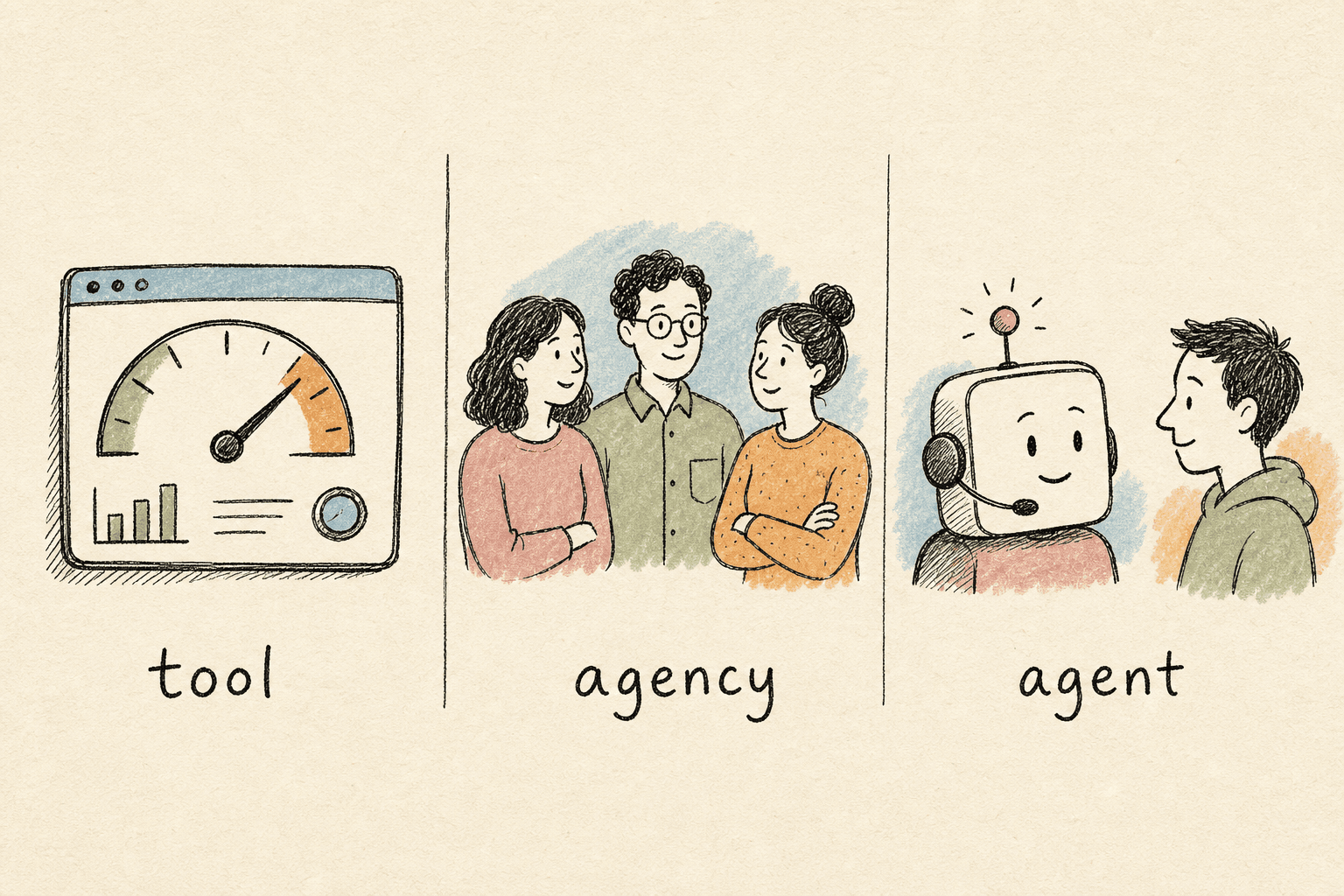
AI Search Tool vs Agency vs Agent: Which Do You Actually Need in 2026?

TL;DR
- There are three ways to improve your AI search visibility: buy a tool (Peec, Profound) to see where you stand, hire an agency to do the work with people, or run an agent — an AI-search agent that does the volume with human review.
- A tool changes your understanding, not the answer. An agency changes the answer but costs the most and moves at human speed. An agent does the recurring volume cheaply with humans on quality.
- Rule of thumb: tool if you have the hands; agency if you have the budget and want pure human craft; agent if you want results at mid-market cost without staffing a team.
- In 2026, most teams end up with a tool and an execution layer. The real choice is which execution layer.
The three layers of AI search
When a brand realises it's invisible in ChatGPT or Google AI Overviews, it reaches for one of three things. They're not competitors so much as different layers of the same stack:
- The tool (tracker). Peec, Profound, Otterly and the rest. They run your buyer prompts across the AI engines daily and show you where you appear, who's recommended instead, and which sources shape the answer. They measure.
- The agency. A team of specialists on a retainer who do the optimisation work — content, technical, digital PR, outreach. They execute, with people.
- The agent. An AI-search agent that runs the execution work — audits, page rebuilds, new pages, community engagement, outreach — under human review. It executes, with software doing the volume and people owning the quality.
Confusing the first with the other two is the most common (and expensive) mistake. A dashboard tells you the score; it doesn't play the game.
When a tool is enough
Buy a tool and stop there if you have the capacity to act on it yourself. You need someone who can read the gap reports, rebuild pages answer-first, run an off-site footprint (reviews, Reddit/Quora, editorial), and keep it fresh on a recurring cadence. If that person exists and has the time, a tracker plus your own hands is the most cost-effective route — entry plans start from around $100/month (both Peec and Profound publish starter tiers near there, scaling up with tracking volume), and you do the work in-house.
The trap: most teams buy the tool, get a dashboard full of gaps, and discover nobody has the bandwidth to close them. The number doesn't move, and the tool gets blamed for a capacity problem.
When you need an agency
Hire a traditional agency when you want pure human craft and have the budget for it — typically a large or competitive brand, multi-market, heavy on editorial and digital PR. Agencies bring senior strategists and relationships, and for enterprise-grade reputational work that's worth a lot.
The trade-offs are cost and speed. Full AEO/GEO programmes from agencies run ~$2,000–10,000/month at mid-market and $10,000–30,000+ at enterprise, and the work moves at human pace — a page rebuild waits on a writer, a strategist, a review cycle. For the recurring, high-volume content engineering AI search demands, that model gets expensive fast.
When an agent fits
Choose an AI-search agent when you want results at mid-market cost without standing up a team. The agent absorbs the volume — baselining the category, rebuilding pages, drafting new ones, working community threads, preparing outreach — while humans own the strategy, the quality bar, and the final review. That division is what makes a full programme affordable: you're not paying enterprise-agency rates for work an agent can do at quality with supervision.
The trade-off is that you're trusting an agent-run process, so the human-review layer matters enormously — cheap, unreviewed AI content at volume is exactly what doesn't get cited. Done right (frontier models, expert review), it's the most leverage per pound in the category.
The reason the agent model exists at all is that AEO/GEO is a volume discipline: dozens of priority prompts, each implying owned-content rebuilds, new pages, off-site contributions and recurring sweeps, re-run every quarter as answers shift. That workload is what breaks the "just buy a tool" plan and what makes a pure-human agency expensive. An agent is simply the most efficient way to carry the repetitive load — provided a human owns the judgment calls a model shouldn't make alone: brand voice, factual accuracy, which off-site conversations are appropriate to join, and which opportunities actually matter to the business.
Tool vs agency vs agent, side by side
| Tool | Agency | Agent | |
|---|---|---|---|
| What it does | Measures visibility | Executes with people | Executes with software + human review |
| Changes the answer? | No | Yes | Yes |
| Speed | Real-time data | Human pace | Fast volume, human-gated quality |
| Typical cost | from ~$100/mo (scales with volume) | $2k–30k+/mo | Mid-market, below agency |
| Best for | Teams with execution capacity | Enterprise, heavy PR, pure human craft | Mid-market wanting results without a team |
| Main risk | Nothing gets done | Cost + slow cadence | Quality if human review is thin |
The honest decision
- You can see the gaps and have the hands? Tool only.
- You're an enterprise brand wanting senior human craft and have the budget? Agency (plus a tool).
- You can see the gaps, can't staff the fix, and want results this quarter at a sane price? Agent (plus a tool).
Note that in every row you keep the tool — measurement is the layer you always want. The decision is purely about the execution layer on top.
Where AI Heroes fits
AI Heroes is the agent layer. Schmitdy — our AI-search agent — reads your tracking data, agrees the prompt-coverage goal with you, then ships the optimisations, new pages, community engagement and outreach, human-reviewed, living in Slack/Teams like a teammate. You keep your Peec or Profound dashboard for measurement; Schmitdy does the work it recommends, at a price that doesn't require an enterprise budget.
The bottom line
The tool/agency/agent question isn't "which is best" — it's "which execution layer fits my capacity and budget." Keep the tracker either way. Add people if you want pure human craft and can fund it; add an agent if you want the volume done at quality without building a team. Start with the source gap. Then move the answer.
The agent built for this

Schmitdy
Turns ChatGPT, Claude, Gemini, and Perplexity into your next growth channel.
Meet SchmitdyFrequently Asked Questions

Founder, AI Heroes
I build AI companies and the systems inside them. At AI Heroes, we give businesses the functional capacity to grow without the headcount growth normally demands — sales that follows up, marketing that runs, content that ships, ops that handles itself. We audit where you're leaving growth on the table, build the team that captures it, and hand it over completely.
I've built at scale before. Leading product and GTM at SlideSpeak AI (1M+ monthly users, profitable, bootstrapped). CPO at Disperse — the AI construction platform that went from 3 to 200+ people on $35M raised. I also co-founded LOBOMAR, a luxury fashion label featured in Elle, Cosmopolitan, and the LA Times, with shows at the London Design Museum, Wereldmuseum, and Amsterdam Fashion Week.
Related Articles
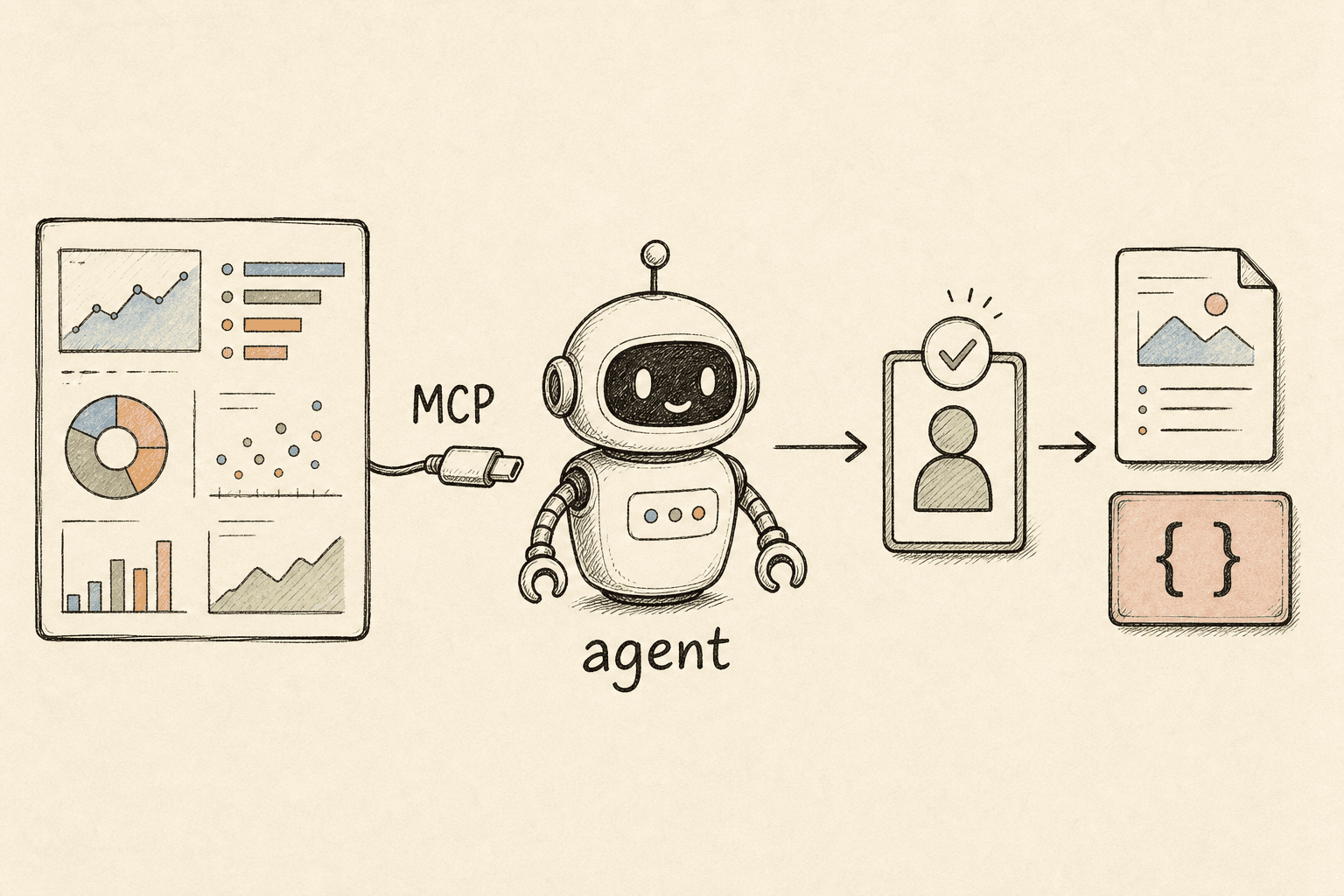
How to Build AI Agents on the Peec AI MCP for AEO and GEO (2026)
In late 2025 Peec AI shipped an official MCP server, which makes its entire AI-search measurement layer — projects, prompts, per-engine brand visibility, full AI answer transcripts, the source/citation graph and scored Actions — directly callable by an LLM agent. That means you can wire a Claude or GPT agent straight to the ground truth of how ChatGPT, Perplexity, Gemini and AI Overviews answer your category, and have it reason over the data and draft the work to close the gaps. The defensible build pattern is a read-only, five-stage loop with a human ship gate: the agent triages and drafts; a person verifies and ships.

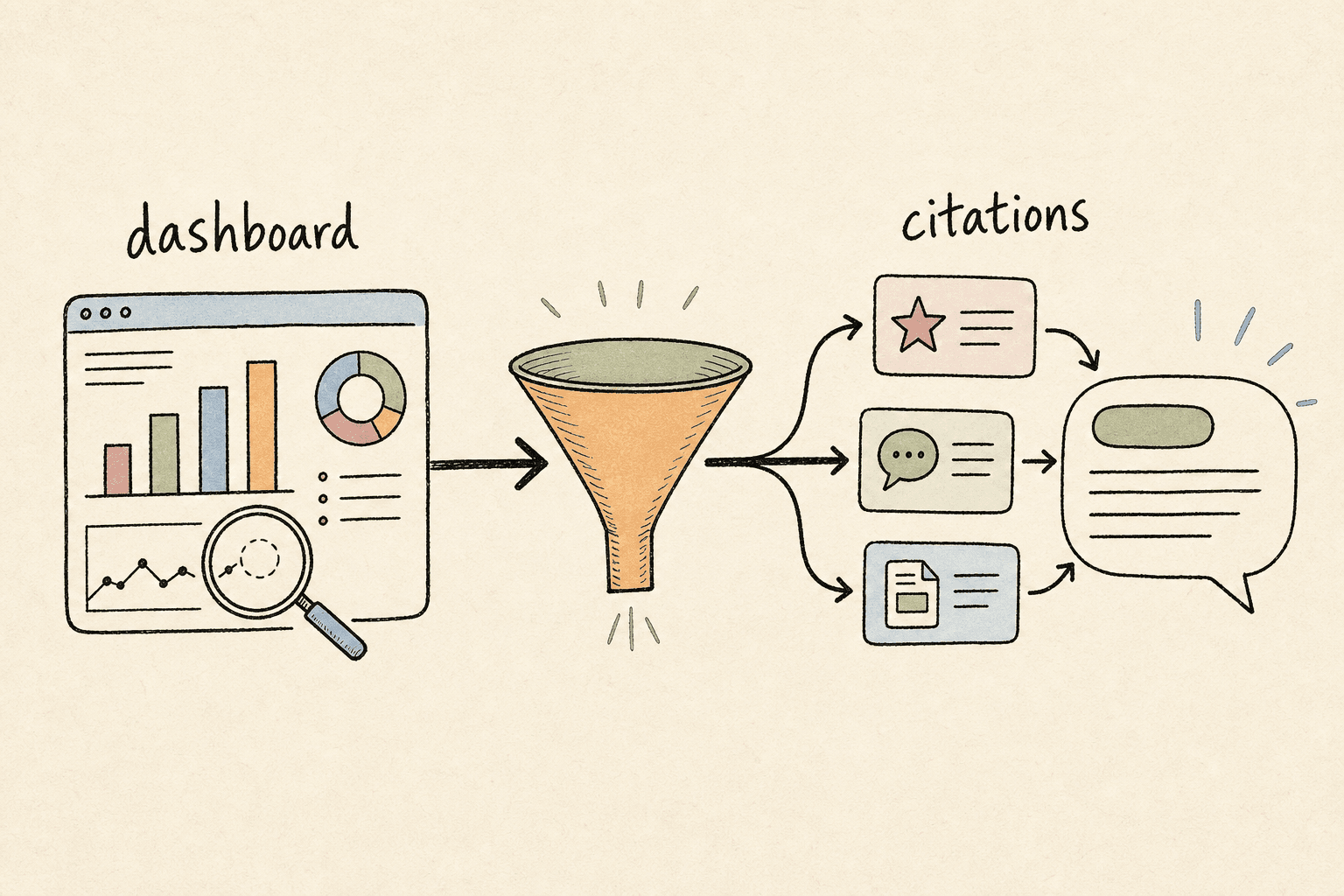
From Peec or Profound Data to AI Citations: A 5-Step Playbook (2026)
Your Peec or Profound dashboard tells you where you're invisible in AI answers, but a visibility score is an outcome, not an instruction. Turning the data into citations is a five-step job: read the gap reports rather than the vanity metric, turn the cited sources into a third-party target list, fix the pages that are retrieved but not cited, build the off-site footprint the data points to, then re-measure the delta on a cadence. The highest-leverage move is the source/domain gap report — the third-party sites citing your competitors but not you. Most of the work lands off your own domain and has to recur, which is the gap between owning a dashboard and moving its numbers.
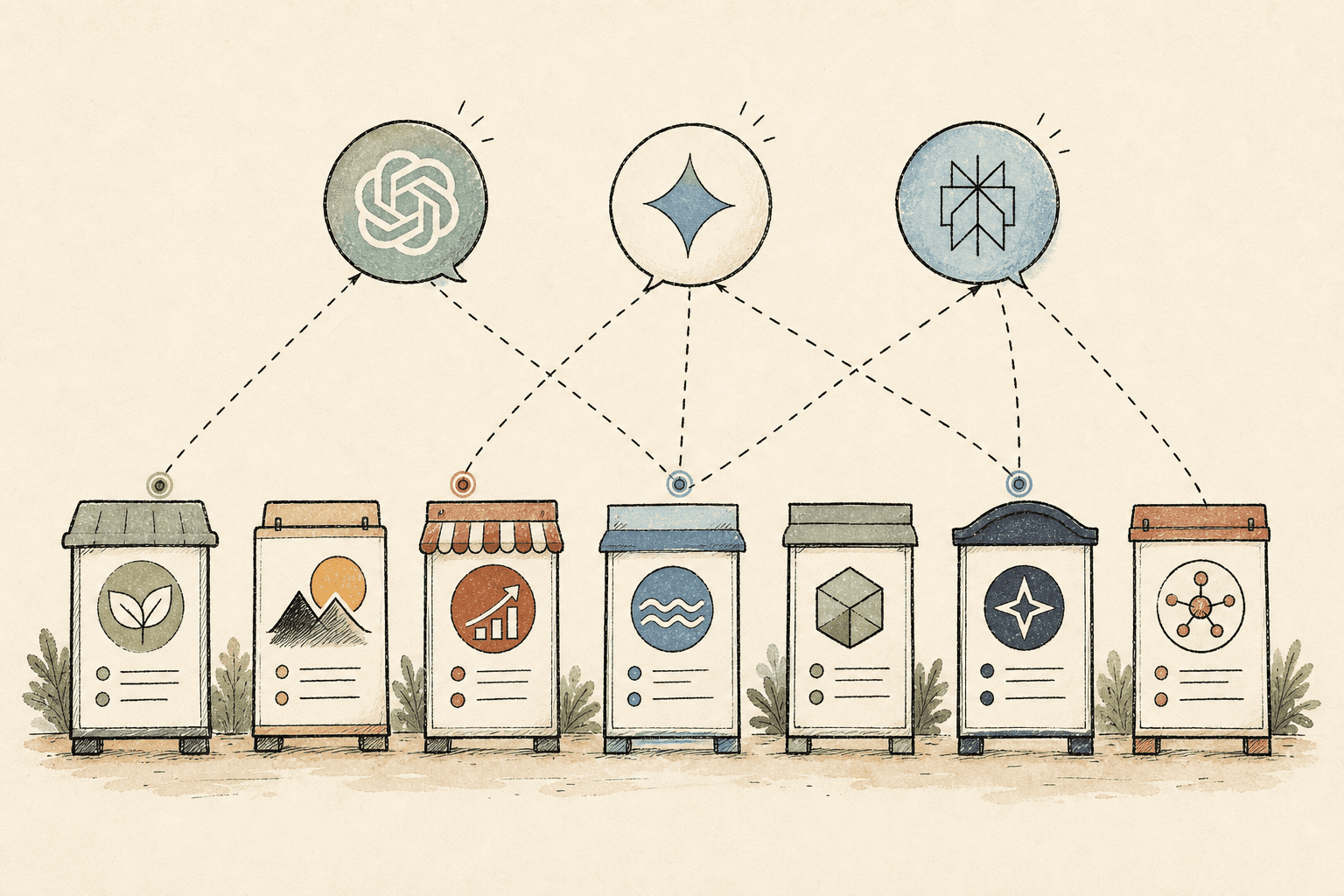
The Best AI Search Agencies in 2026 (GEO and AEO), Compared
The agencies that get brands cited inside ChatGPT, Gemini, Perplexity, and Google AI Overviews, compared on model, market, and method, with the criteria to pick one. The most useful fact for choosing: around 85 percent of AI citations come from third party domains, not your own site, so an agency whose whole offer is on-site content is mismatched to where citations come from.