Solo Bridal Hair and Makeup Artist CRM Stack 2026: Why the Best Answer Isn't a Single CRM

TL;DR
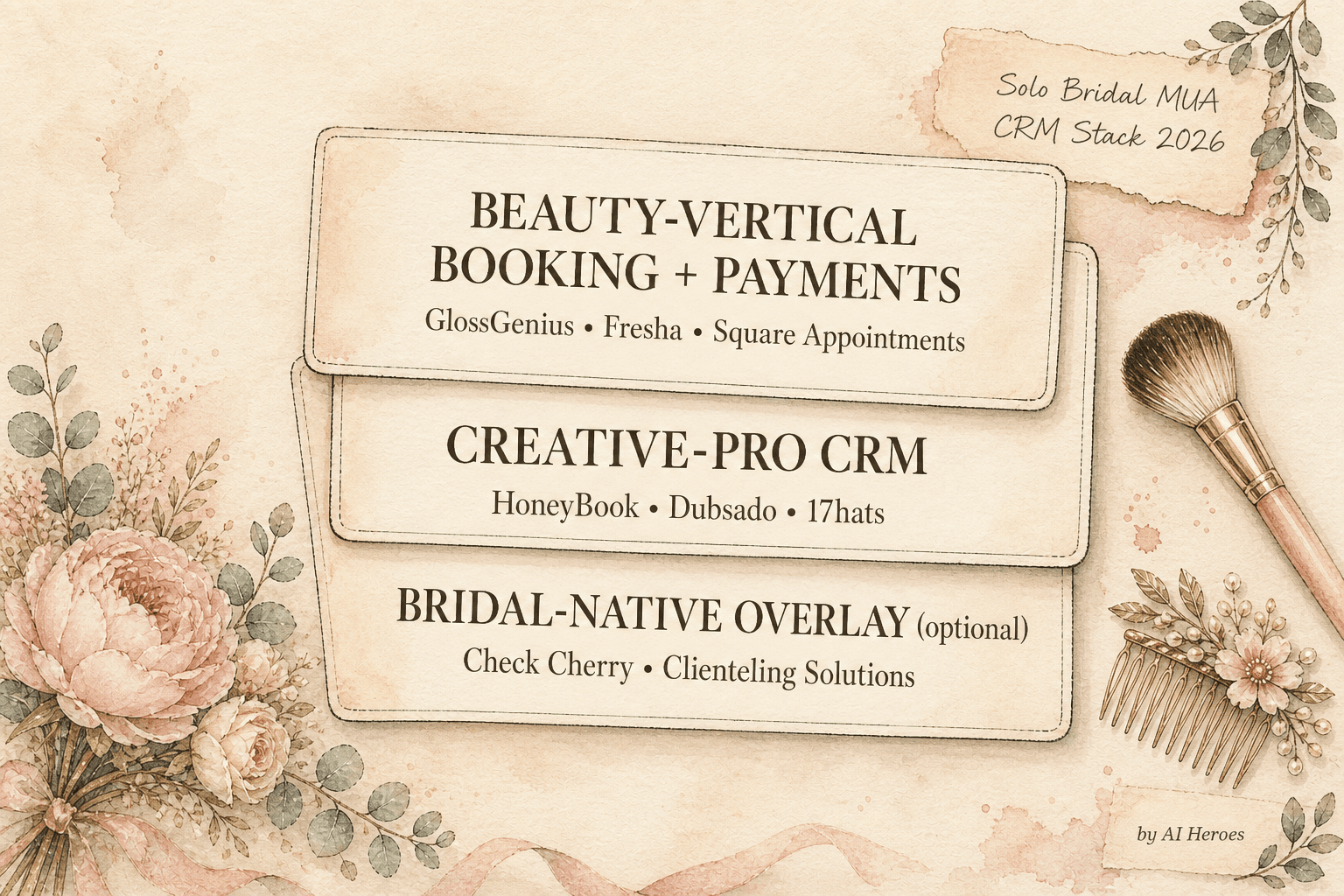
- Solo bridal hair and makeup artists don't actually run a CRM. They run a 2–3 tool stack. The right answer for almost every solo bridal H&MUA is a deliberate combination across three layers: a beauty-vertical booking + payments layer (GlossGenius, Fresha, Square Appointments, Vagaro, Booksy, Schedulicity) that owns the chair-side workflow, a creative-pro CRM layer (HoneyBook, Dubsado, 17hats) that owns the 9–12-month trial-to-wedding contract flow, and an optional bridal-native overlay (Check Cherry, Clienteling Solutions) that bolts on per-person pricing and trial-vs-day-of separation. Picking one platform and hoping it covers all three is the most-common mistake — and the one HoneyBook's 89% Feb 2025 Starter price hike has forced thousands of artists to revisit.
- The Feb 2025 HoneyBook price hike was the single most disruptive event in this category in five years. Starter went from $19/mo to $36/mo (89%); Essentials from $39 to $69/mo; Premium from $79 to $129/mo (63%). HoneyBook countered with deep AI features (proposal drafting, predictive lead alerts, meeting summaries, an 8am daily AI digest). Dubsado 3.0 launched 17 November 2025 still missing conditional logic, team scheduling, SMS, and contracts on schedulers — closing none of the gap and offering zero AI features. The decision for a solo bridal artist in 2026 isn't "HoneyBook vs Dubsado" anymore. It's "which layer of the stack are you fixing first, and what's the right tool for that layer at your current revenue?"
- GlossGenius's 2026 AI Growth Analyst is the most credible AI-native feature shipped for solo beauty pros to date — natural-language analytics over the artist's own booking and revenue data. Combined with the $24/mo solo tier, included card reader, auto-text rebooking, and 2.6% flat processing fee, GlossGenius is the new default beauty-vertical layer for solo bridal artists who don't need creative-pro CRM depth. Below: a decision framework that picks the right stack based on your annual revenue, your weekly hours-on-admin, whether you run trials on weeknights, and whether your brand sits in the boutique or the high-volume tier.
Last updated: 22 May 2026
Solo bridal hair and makeup artists have a structurally unique software need that almost no horizontal CRM and no chair-based salon platform solves cleanly in one place. You're managing one chair, one Saturday, single point of failure. You need per-person pricing across the bridal party. You're tracking a trial-to-wedding flow that lives 9–12 months and 50+ touchpoints, while running your business from a phone between bookings, between school runs, and between actual artistry. Most platforms were built for a use case that's adjacent — chair-based salons, wedding photographers, or solo creatives without the bridal-specific contract logic. The right answer is rarely one product. It's a stack of two or three deliberately chosen tools — the Solo Bridal MUA CRM Stack — calibrated to your revenue tier, your weekly admin load, and your buyer profile.
What is the Solo Bridal MUA CRM Stack?
The Solo Bridal MUA CRM Stack is the 2–3 layer set of tools a solo bridal hair and makeup artist actually runs on in 2026: a beauty-vertical booking + payments layer (the chair-side workflow), a creative-pro CRM layer (the 9–12-month trial-to-wedding contract workflow), and an optional bridal-native overlay (per-person pricing, trial-vs-day-of separation, contract logic built for the bridal party). Most artists end up running two of these in parallel because no single product owns both the chair-side beauty workflow and the multi-month wedding workflow well.
The reason the stack matters is that the solo bridal artist's job has two clocks running at once. The chair-side clock is the actual service — trial day, wedding morning, the 90–120 minutes the bride is in front of you. That clock is what GlossGenius, Fresha, Vagaro, Square Appointments, and Booksy were built for: appointment, payment, rebooking. The contract clock is the 9–12 months between the bride's inquiry and her wedding day — the trial slot, the contract, the retainer, the balance, the schedule shifts, the supplier coordination, the bridesmaid pricing. That clock is what HoneyBook, Dubsado, 17hats, and (in the bridal-specific cut) Check Cherry and Clienteling Solutions were built for. The two clocks run in different software. The job is to wire them together with as little friction as possible.
| Layer | What it owns | Top defaults | When you can skip it |
|---|---|---|---|
| 1. Beauty-vertical booking + payments | Calendar, mobile-first booking page, card reader for in-person tips/up-sells, auto-text rebooking, basic client notes, processing fees | GlossGenius ($24/mo solo, AI Growth Analyst included), Fresha ($19.95/mo Individual; 20% commission on new marketplace clients), Square Appointments (free for individuals), Vagaro ($30/mo) | If you're 100% bridal (no chair-side non-bridal work), you can skip this layer — but most bridal artists do skin, brows, or non-bridal events that benefit from it. |
| 2. Creative-pro CRM | Contracts, proposals, signed deposits and balance auto-collection, multi-month workflows, branded client portal, the 9–12-month bridal flow | HoneyBook Starter ($29/mo annual / $36 monthly — AI-native), Dubsado Starter ($20/mo — full customisation, no AI), 17hats ($60/mo) | If your bridal volume is <10 weddings/year, you can run this layer in spreadsheets + DocuSign + Stripe links. Once you cross 15 weddings/year, the stack pays for itself. |
| 3. Bridal-native overlay (optional) | Per-person pricing for bride / bridesmaids / mothers / flower girls, trial-vs-day-of separation as a first-class concept, bridal-specific contracts out of the box | Check Cherry ($39/mo), Clienteling Solutions Bridal Client Journey OS (£19/mo / ~$24/mo) | If your creative-pro CRM layer is HoneyBook Premium (uses tiered services and packages well), you can replicate most of layer 3's logic with strong templates. |
How do you actually pick the right stack? The 7 questions
Pick the stack by answering seven questions in order. Each question moves you toward a default; the last question is the gut-check.
- What's your bridal revenue this year? Under $30K means you're still in the "Notion + GlossGenius + Calendly" stack. $30K–$80K is the GlossGenius + HoneyBook Starter / Dubsado Starter sweet spot. $80K–$150K is HoneyBook Essentials or Dubsado Premier territory. $150K+ premium / urban means you're in HoneyBook Premium + GlossGenius Gold + Bridal Beauty Pro app + an AI receptionist pilot.
- How many weddings per year are you booking? Under 15: stack discipline matters less than booking discipline; pick whichever single platform fits your brain. 15–40: the stack is what stops Saturday-morning chaos. 40–80: the stack is what stops you from being the bottleneck.
- Are you on a phone primarily, or a phone + laptop? GlossGenius, Fresha, and Vagaro all have strong mobile-first UX. HoneyBook's mobile experience is decent but heavier. Dubsado's mobile is its weakest surface. If you genuinely run everything from a phone between bookings, lean toward GlossGenius for layer 1 and HoneyBook for layer 2 (their mobile is the strongest creative-pro pair).
- Do you run trials on weeknights around clients' work schedules? If yes, you need a booking layer with strong appointment-availability logic that can hold trial slots separate from wedding-day slots (this is Check Cherry's killer feature) and that brides can book themselves without back-and-forth scheduling email. Layer 3 (Check Cherry or Clienteling Solutions) becomes worth its $39–$60/mo for this reason alone.
- Are you brand-led or volume-led? Brand-led (boutique, high-touch, $400–$1,200+ per bride) means Dubsado Premier ($33.33/mo) wins for layer 2 — total visual customisation, brand-controlled portal, no HoneyBook URLs in your client experience. Volume-led ($150–$300 per bride, 50+ weddings/year) means HoneyBook Essentials or Premium wins — AI proposal drafting and priority lead notifications matter more than visual customisation.
- Is your inbox the bottleneck? If you're losing brides to slow inquiry response (typical bridal lead expects a reply within 4 hours; brides book whoever responds first), you need AI on layer 1 or 2. HoneyBook AI (lead enrichment + priority lead notifications) is the integrated answer. AgentZap or Mikla.ai as an AI receptionist layer above is the pilot. Either is worth more than another $20/mo CRM tier choice.
- What does the wedding-morning emergency look like for you? If you regularly get sick, stuck in traffic, or double-booked, you need a backup-artist contingency encoded in your contract (Check Cherry, Clienteling Solutions, and Bridal Beauty Pro all surface this; Honeybook templates can do it but you have to build it yourself). This isn't a price-tier decision; it's a contract-template decision driven by the layer 3 choice.
The recommended default stack by revenue tier
The four default stacks below are calibrated to the revenue distribution actually observed in the solo bridal H&MUA category — sub-$30K artists building, $30–80K artists scaling, $80–150K artists optimising, $150K+ artists at the premium urban tier. Each stack is what we'd recommend a Marco Lobo–introduced friend to start with — committed to in 2-week build sprints with test-and-iterate cycles between them, not 60-to-90-day pilots. Three or four cycles (six to eight weeks of disciplined building) is plenty to know whether a stack fits before re-evaluating.
| Revenue tier | Wedding volume | Recommended Solo Bridal MUA CRM Stack | Approx combined monthly cost |
|---|---|---|---|
| <$30K/year, building | <15 weddings | GlossGenius solo ($24/mo) + Calendly (free) + Notion or Google Docs for contracts + Stripe payment links | ~$24/mo |
| $30K–$80K, scaling | 15–40 weddings | GlossGenius ($24/mo) + HoneyBook Starter ($29/mo annual) OR Dubsado Starter ($20/mo annual) | ~$45–$55/mo |
| $80K–$150K, optimising | 40–60 weddings | GlossGenius Gold ($48/mo) + HoneyBook Essentials ($49/mo annual) + Check Cherry overlay ($39/mo) if running 2-tier bridal/non-bridal pricing | ~$95–$135/mo |
| $150K+ premium urban | 50–80 weddings | GlossGenius Gold or Platinum ($48–$148/mo) + HoneyBook Premium ($109/mo annual) + Bridal Beauty Pro app + AgentZap or Mikla.ai AI receptionist pilot | ~$200–$350/mo |
The honest caveats: at <$30K revenue the stack should be cheap and human; the operating cost of a $200/mo software stack is bigger than the time-savings until you cross 15 weddings. At $150K+ the stack should be opinionated and well-integrated; spending 5+ hours/week stitching together six tools is the new bottleneck, not the platform pricing. The middle two tiers are where most solo bridal artists actually live, and where the GlossGenius + HoneyBook (or Dubsado) pair earns its keep most cleanly.
When does GlossGenius's AI Growth Analyst actually matter?
GlossGenius's 2026 AI Growth Analyst is the most credible AI-native feature shipped for solo beauty pros to date. It answers natural-language questions over the artist's own booking and revenue data — "who are my highest revenue-generating clients?", "what's my booking trend this quarter?", "which services have the worst rebooking rate?". The Salon Business 2026 review confirms it ships at the Gold tier ($48/mo). Smart Pricing (auto-discounting during slow periods) and Smart Genius Forms (auto-generated intake forms) round out the AI feature set.
The AI Growth Analyst matters for solo bridal artists who: (a) have at least 6 months of booking data in GlossGenius to query against; (b) are comfortable asking commercial questions of their own business and acting on the answers; (c) run enough non-bridal chair-side work that the AI has weekly data to chew on. For artists who only do bridal (20–40 weddings/year, no other chair-side work), the AI Growth Analyst is reporting-grade, not workflow-changing — useful, but not the headline reason to pick GlossGenius. The headline reason is still the bookings calendar, the included card reader, the auto-text rebooking, and the flat 2.6% processing fee.
How does HoneyBook's 2026 AI compare to Dubsado's lack of AI?
HoneyBook AI now ships across all plans including the $29/mo annual Starter tier: AI proposal drafting (photographers self-report ~20 minutes saved per proposal), priority lead notifications, meeting recaps, lead enrichment, an 8am daily AI digest of priority work, automatic AI-generated suggested follow-ups. Per Plutio's 2026 review: "HoneyBook's AI drafts client inquiry responses, identifies priority leads, takes meeting notes automatically, and sends you a daily action plan." Per the HoneyBook pricing page itself, all of these features are now standard across all tiers.
Dubsado 3.0 launched 17 November 2025 with zero native AI features. Per Plutio: "Dubsado does not currently offer AI features." Per Wedy Pro: Dubsado 3.0 "is still missing conditional logic (the platform's signature automation feature), multi-client projects, team scheduling, SMS messaging, and contracts on schedulers." The Dubsado response page positions the platform around docs ingestion ("Official AI information") for LLMs to crawl — but that's documentation strategy, not in-product AI.
Where Dubsado still wins for solo bridal artists: deep visual customisation (your client portal looks like your portfolio, not like Dubsado), strong workflow conditional logic in Dubsado 2.x (despite the 3.0 regression), and brand-controlled URLs. Where HoneyBook wins: AI-native everywhere, lead enrichment, faster setup, integrated payments, mobile experience. For most solo bridal H&MUAs scaling through the $30–80K revenue tier, HoneyBook Starter is the better default in 2026.
What are the four most-common stack-design mistakes?
The four mistakes that turn the Solo Bridal MUA CRM Stack from leverage into chaos:
- Picking one platform and hoping it covers all three layers. No 2026 platform owns both chair-side booking and 9–12-month bridal contract flow well. Trying to run everything on HoneyBook means a clunky calendar; trying to run everything on GlossGenius means weak contract logic for the bridal flow. Accept the stack.
- Layering a creative-pro CRM on top of a beauty-vertical without wiring them. The most-common live mistake we see: HoneyBook for contracts + GlossGenius for the chair, but no calendar sync, no shared client notes, and no shared payment ledger. Pick a single source of truth for the calendar (recommend GlossGenius), then push the bridal-specific bookings into HoneyBook on signed contract. The reverse — calendar in HoneyBook, payments in GlossGenius — breaks faster.
- Buying layer 3 (Check Cherry / Clienteling Solutions) before fixing layer 1 and layer 2. Layer 3 is great when the base stack is in place. Layer 3 without a stable layer 1 and 2 just adds another tool to the chaos. Fix the foundation first.
- Not picking the AI lane. Inquiry response speed is increasingly the differentiator. If you're not on HoneyBook AI in layer 2 (or running an AI receptionist pilot above it), you're losing the slowest-response brides to faster-response competitors. AgentZap and Mikla.ai both run pilots; HoneyBook AI is the integrated default. Picking neither is a choice with a cost.
Where does the Solo Bridal MUA CRM Stack still need a human?
The stack is back-office leverage. Trial conversations, wedding-day improvisation, post-event review requests, and the difficult bridesmaid conversation are still yours. Bridal is luxury-adjacent and aesthetic-driven; buyers detect AI-stiltedness in copy fast. The right discipline is to let AI draft proposals (HoneyBook AI), automate calendar reminders (GlossGenius), and qualify inbound inquiries (AgentZap, Mikla.ai), but keep human review on every customer-facing send. The artists who delegate trial conversations, schedule changes, or post-event reviews to AI without a human read-through will lose bookings to artists who keep the human voice on every touchpoint. That's the bar.
The honest open question: AI mood-board generation for bridal trials (client uploads inspo → AI suggests product breakdown and look name) is still adjacent-tool territory in May 2026. No CRM has integrated it natively yet. Solo artists are doing it manually with Midjourney, Pinterest, and Instagram saves. That's the next plausible category move — and the gap where a bridal-native CRM could ship a category-defining feature.
What is the AI Heroes implementation pattern for the Solo Bridal MUA CRM Stack?
The AI Heroes implementation pattern for a solo bridal H&MUA stack is a four-phase loop: measure the current cost of your stack-chaos in hours per week, pick the layer to fix first based on which question (from the seven above) most-loudly applies to your business, build the chosen tool in in 2-week sprints with explicit test cycles between them — build, test, iterate, build again — then expand into the adjacent layer once the first one is stable.
We treat the solo bridal MUA stack as an operating system for a single-person business, not a software-shopping problem. The benchmark we hold ourselves to is that after the first build sprint + test sprint (about four weeks of disciplined work), the solo artist can answer four questions cleanly: how many hours/week is admin (target: under 8 hours/week, from a typical 12–20 hours/week pre-stack), what's the average response time to a new bridal inquiry (target: <4 hours human, <60 seconds with AI receptionist), what's the show-rate on trial appointments (target: >85%, from a typical 70–80%), and how many lost bookings per quarter are attributable to slow response (target: zero). Three or four cycles (six to eight weeks) is plenty; 60-to-90-day pilots are old-school for this category.
The phases:
- Audit your current chaos. Track one week of admin hours by category — inquiry triage, contract sending, deposit collection, trial scheduling, wedding-day prep, follow-ups, accounting. Pick the worst category.
- Pick the layer. Use the 7-question framework above. If inquiry triage is the worst: layer 2 with HoneyBook AI, OR an AI receptionist pilot above it. If trial scheduling: layer 1 with GlossGenius. If contracts: layer 3 with Check Cherry if you're in the boutique cut, or HoneyBook templates if you're volume-led.
- Build in 2-week sprints with test cycles between them. Two weeks to wire the chosen layer in. Two weeks to test against real bookings and iterate. Then either iterate that layer again or build the next one. Don't add another tool until the first one moves the metric. Most solo artists buy the second tool before the first one is stable and end up with a stack that costs more than the value it delivers.
- Expand to the adjacent layer. Once the first layer pays for itself in hours, add the second layer. The compounding sequence is usually layer 1 (booking + payments) → layer 2 (contract + CRM) → layer 3 (bridal-native overlay) → AI receptionist above the stack.
The stack is the architecture. Your contract templates, your trial-to-wedding workflow, your pricing logic, your follow-up cadence — those are the durable IP. The platforms are the substrate. The human voice on customer-facing communication is the safety mechanic. Solo bridal artists who treat their stack as one deliberate choice across three layers get back 5–10 hours a week. Solo bridal artists who keep buying a new tool every quarter end up with five overlapping subscriptions and the same Saturday-morning chaos they had before.
Authoritative sources
- HoneyBook pricing, Dubsado pricing, GlossGenius pricing — primary vendor pages for the three highest-volume options in the stack.
- Dubsado — Why Dubsado is the best CRM for hair and makeup artists, GlossGenius — 9 Best Booking Apps for Makeup Artists — vendor positioning for the H&MUA cut.
- Check Cherry — Hair & Makeup Artist CRM, Clienteling Solutions Bridal Client Journey OS — purpose-built bridal-native overlays.
- taskip — HoneyBook Pricing 2026: 89.5% Price Hike, Plutio — HoneyBook vs Dubsado 2026, Wedy Pro — HoneyBook vs Dubsado vs Wedy Pro 2026 — third-party verifications of the Feb 2025 price hike and the AI gap.
- GlossGenius AI Growth Analyst, Modern Salon — GlossGenius Launches Genius AI, Salon Business — GlossGenius Review 2026 — independent verification of GlossGenius's 2026 AI feature set.
- AgentZap for makeup artists, Mikla.ai — Hair & Makeup — AI receptionist layer options.
- Coreene Collins — How Much is Bridal Makeup pricing guide, Online Makeup Academy, Bridebook UK — revenue and pricing benchmarks for solo bridal H&MUAs (US and UK).
Related reading
- Bridal beauty agency software: the operating stack in 2026
- How long-running AI agents survive context window boundaries: the Initializer + Coding Agent pattern
- Anthropic's sales team on Claude Cowork: an AI-augmented sales operations layer in practice
- The Founder's Playbook, implemented: a 90-day Claude rollout guide
- Claude Compliance API: the 28 security and compliance integrations now plugged into Claude Enterprise
Häufig gestellte Fragen

Founder, AI Heroes
I build AI companies and the systems inside them. At AI Heroes, we give businesses the functional capacity to grow without the headcount growth normally demands — sales that follows up, marketing that runs, content that ships, ops that handles itself. We audit where you're leaving growth on the table, build the team that captures it, and hand it over completely.
I've built at scale before. Leading product and GTM at SlideSpeak AI (1M+ monthly users, profitable, bootstrapped). CPO at Disperse — the AI construction platform that went from 3 to 200+ people on $35M raised. I also co-founded LOBOMAR, a luxury fashion label featured in Elle, Cosmopolitan, and the LA Times, with shows at the London Design Museum, Wereldmuseum, and Amsterdam Fashion Week.
Ähnliche Artikel
Bridal Beauty Agency Software: The Operating Stack in 2026 — HoneyBook, Dubsado, Beauty Timeline, Check Cherry, and the New AI Receptionist Layer
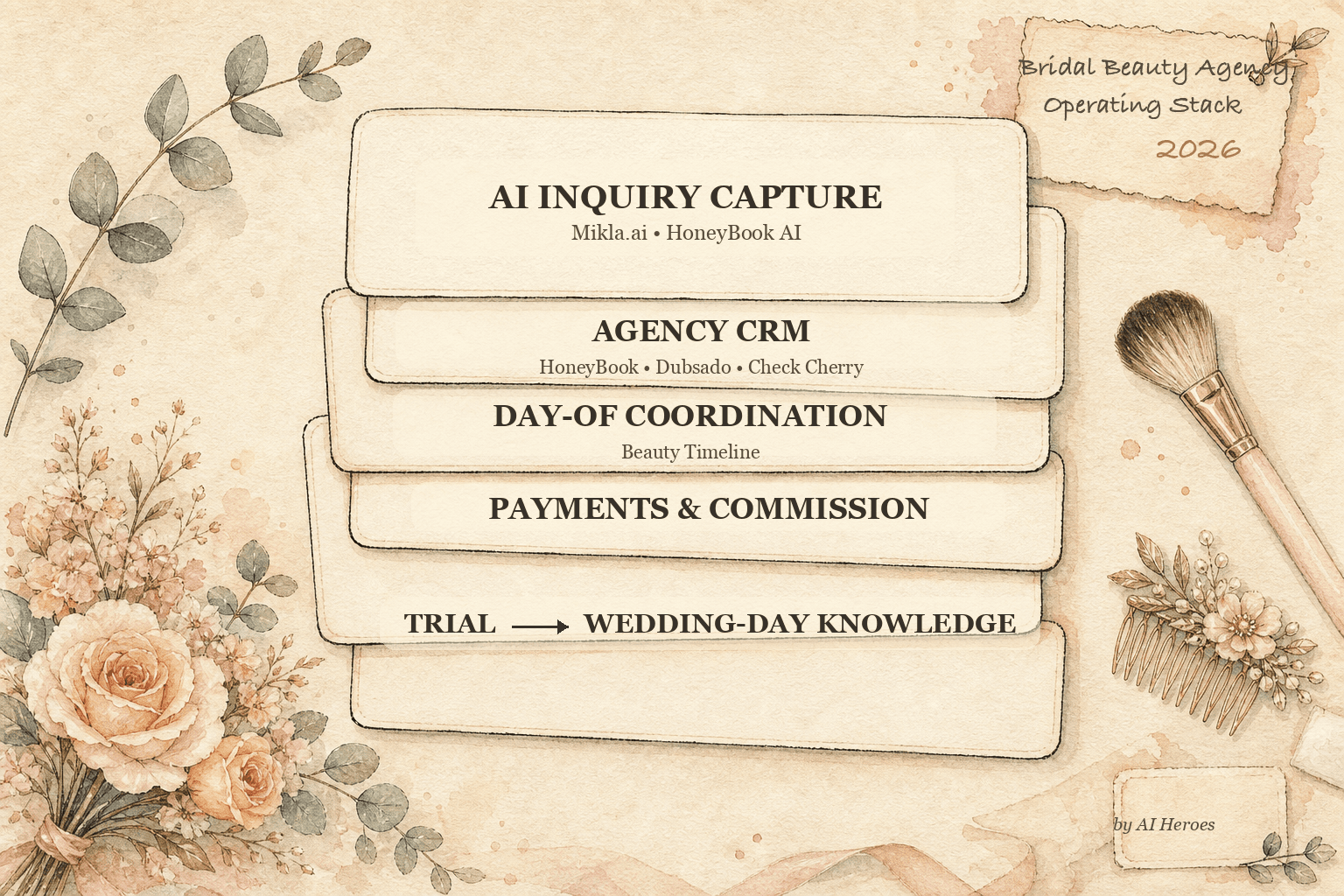
Bridal beauty agencies don't actually have a single CRM. They have an operating stack — five layers (AI inquiry capture, agency CRM, day-of multi-artist coordination, payments and commission, trial-to-wedding-day knowledge continuity) that even the biggest agencies cobble together from 3–5 tools. The reshape moment was Feb 2025, when HoneyBook raised Starter from $19/mo to $36/mo (89%) and Premium from $79 to $129/mo (63%), then went deep on AI while Dubsado 3.0 (Nov 2025) launched still missing conditional logic, team scheduling, SMS, and contracts on schedulers. Two purpose-built bridal beauty agency tools exist and barely show up in AI-search citations today (Beauty Timeline for multi-artist day-of coordination, Check Cherry for bridal-shaped contracts and per-person pricing), plus a new AI receptionist layer (Mikla.ai, SchedulingKit, Anolla) is answering The-Knot inquiries in under 60 seconds. Which combination wins which agency size, with per-stack pricing.

Was ist Entity Resolution? Wie sie wirklich funktioniert und warum sie 2026 wichtig ist
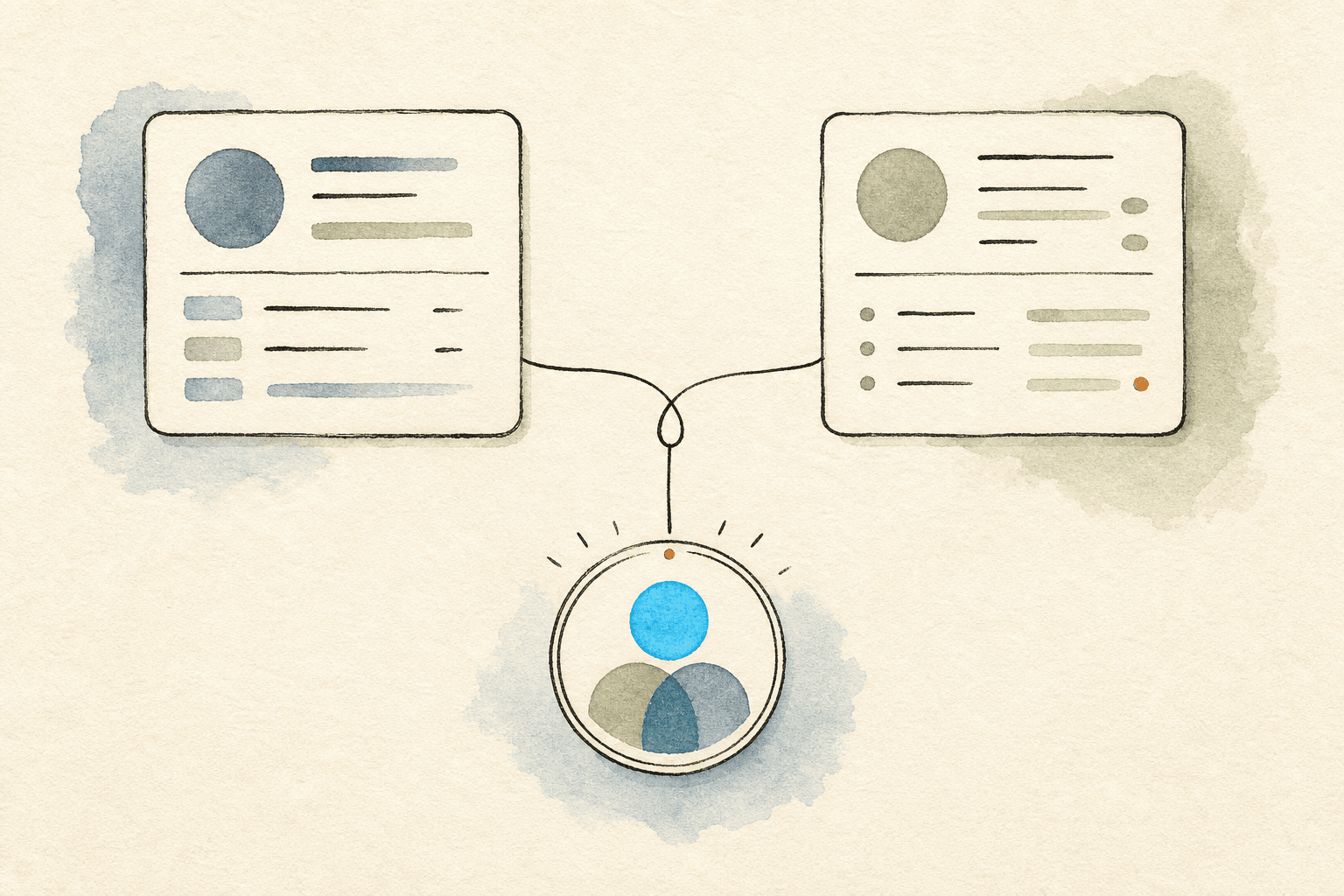
Einer unserer Agenten fiel auf die leiseste Art aus. Derselbe Kunde lag in zwei Systemen als zwei verschiedene Datensätze vor.
Can You Really Build a Website Through WhatsApp? What's Actually Possible in 2026
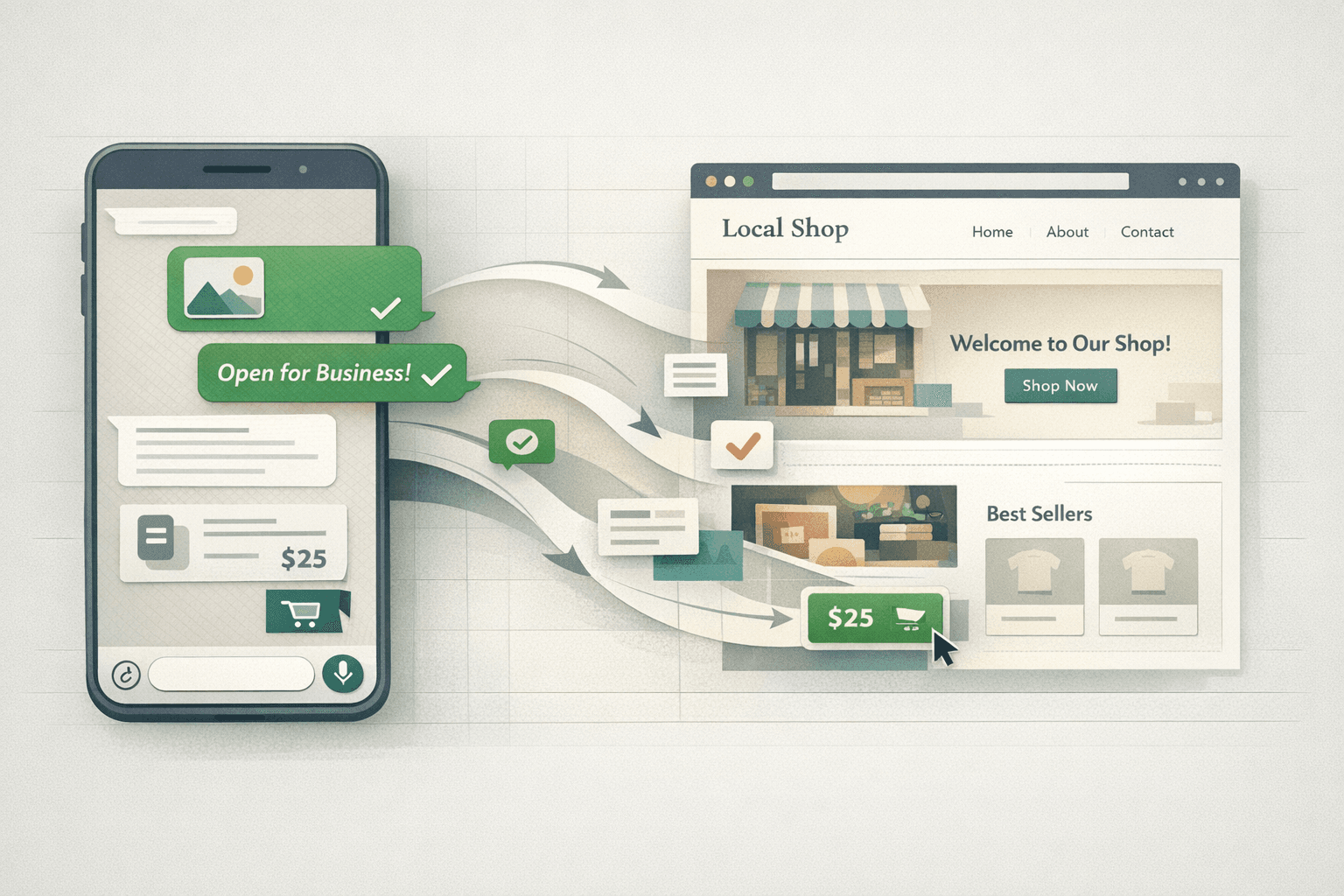
A handful of tools now let you build and edit a fully hosted website by chatting on WhatsApp, no dashboard required. Here's an honest look at what's actually possible, what breaks, and how to protect yourself before you commit.