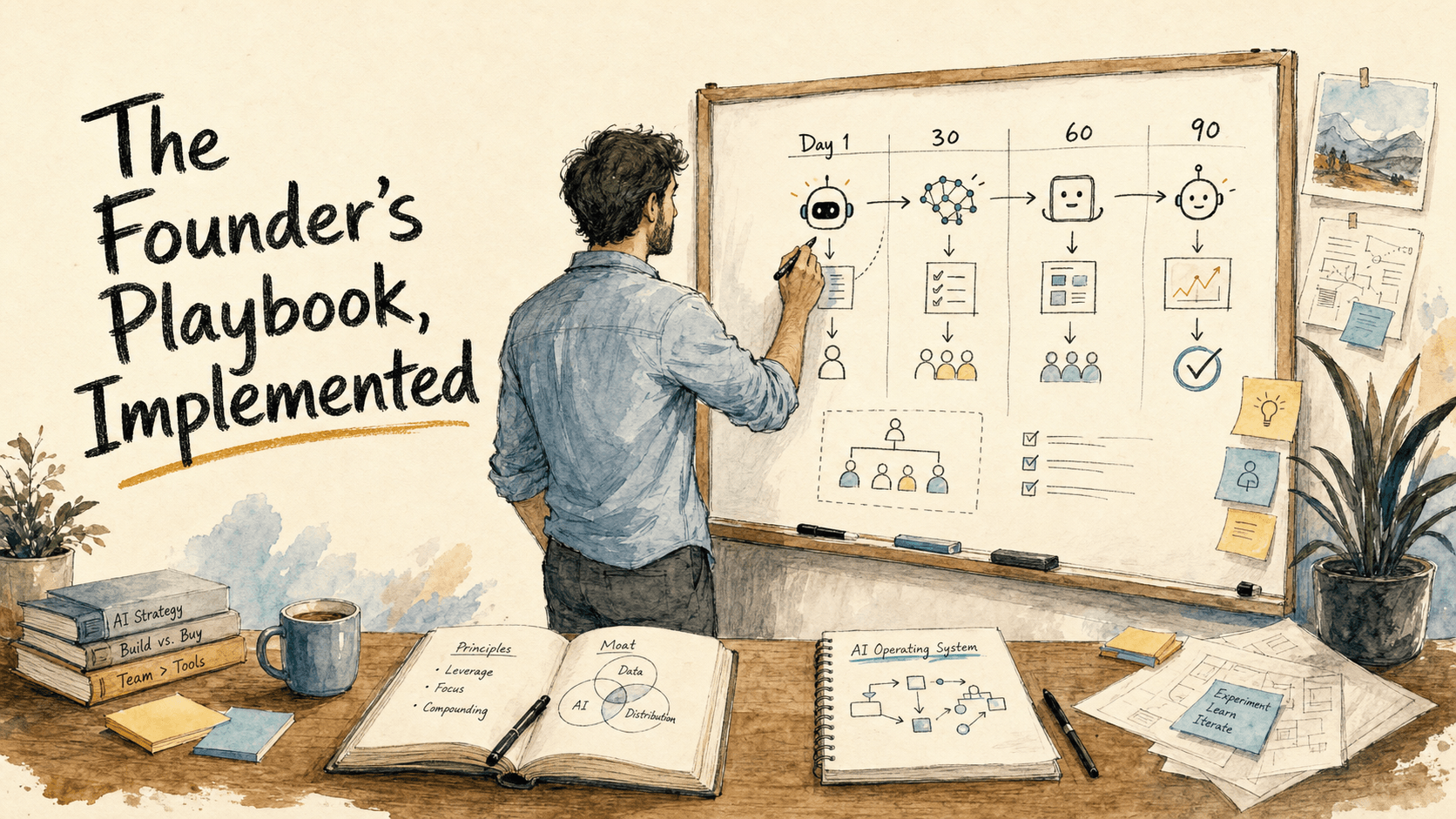
The Founder's Playbook, Implemented: A 90-Day Claude Rollout Guide for Founders (2026)

TL;DR
- The Anthropic Founder's Playbook is the right strategic read for 2026, but it is not an implementation plan. It gives founders the stage map: Idea, MVP, Launch, Scale. The missing layer is who owns the workflows, what artifacts Claude should read, what gets automated first, and how the founder keeps judgment in the loop.
- The Monday morning version is not "give everyone Claude." It is pick three recurring workflows, write the operating instructions, connect the source systems, create review checkpoints, and measure whether founder attention actually moved away from admin and back toward product, customers, and narrative.
- The first 90 days should produce a working AI operations layer, not a pile of prompts. At AI Heroes, we treat Claude, Claude Code, Claude Cowork, skills, plugins, and agent fleets as implementation surfaces for one operating system: evidence, execution, review, memory, and compounding improvement.
Anthropic's Founder's Playbook is useful because it starts from the right premise: the founder's job is changing from individual contributor to orchestrator. The PDF playbook maps the startup lifecycle into four stages - Idea, MVP, Launch, and Scale - and shows how Claude can support research, agentic coding, workflow automation, security review, measurement, and company-building.
That is the framework. The implementation problem is harder.
Every founder can now open Claude and ask for a competitive landscape, a product spec, a customer interview guide, a codebase refactor, a board memo, or a sales sequence. That does not mean the company is AI-native. It usually means the founder has one more brilliant private workspace that nobody else can reliably reuse.
The difference is the AI operations layer: the written instructions, source access, skills, tools, schedules, approvals, and memory that let Claude do company work the same way twice.
What is the Anthropic Founder's Playbook?
The Anthropic Founder's Playbook is a 2026 guide for building an AI-native startup with Claude. Its core claim is that AI changes the startup lifecycle because founders can now research, build, automate, and scale with far less headcount than the old validate, raise, hire, build loop assumed.
The playbook divides the journey into four stages. In the Idea stage, Claude is mainly a research and validation partner. In the MVP stage, Claude Code becomes the build surface, but only after architecture, scope, and measurement are defined. In the Launch stage, Claude Cowork and connected workflows start replacing founder attention in operational loops. In the Scale stage, the same AI infrastructure supports enterprise documentation, support, go-to-market, compliance, and institutional knowledge.
Anthropic's timing matters. The same week, Anthropic also introduced Claude for Small Business, a Claude Cowork package with connectors and ready-to-run workflows across tools such as QuickBooks, PayPal, HubSpot, Canva, DocuSign, Google Workspace, and Microsoft 365. That announcement points at the same friction the playbook names: most businesses do not need another empty chat box; they need AI inside the work.
Public adoption data tells the same story from another angle. The OECD's 2025 SME AI adoption paper reports much lower formal AI use among small and medium firms than large firms, while an Intuit QuickBooks survey found that 68% of surveyed US small businesses said they use AI regularly. That gap is the whole implementation problem: casual AI use is spreading fast, but operational AI is still uneven.
What does the Founder's Playbook tell you to do at each stage?
The playbook is strongest when it forces founders to keep the stage discipline. Agentic coding makes it easy to build before you have evidence. Workflow automation makes it easy to automate a bad process. Claude can make either mistake faster unless the founder gives the system a clear operating frame.
| Startup stage | Anthropic's useful recommendation | Implementation reality inside a founder-led company | What AI Heroes would ship first |
|---|---|---|---|
| Idea | Use Claude for hypothesis pressure-testing, market mapping, customer discovery, and synthesis. | Founders ask Claude to confirm the idea they already love. Interview notes, competitor research, and disconfirming evidence stay scattered. | A discovery workspace with target personas, interview scripts, competitor files, source links, synthesis rules, and a weekly evidence review. |
| MVP | Use Claude Code after architecture, scope, metrics, and security checks are defined. | The founder lets the agent build too much because every extra feature feels cheap. Context disappears between sessions. | A CLAUDE.md architecture file, MVP scope contract, session template, test plan, and pre-launch security checklist. |
| Launch | Use Claude Cowork to build operational workflows around support, triage, reporting, and product management. | The founder remains the router for everything because the company never wrote down how decisions move. | Three connected workflows: customer feedback triage, weekly metrics brief, and product/spec routing with human approvals. |
| Scale | Use Claude to turn founder knowledge into documentation, GTM systems, support infrastructure, and compounding product specificity. | Domain knowledge remains trapped in calls, Slack threads, and the founder's head. | A knowledge-to-skill pipeline that converts repeated founder judgment into reusable skills, playbooks, and agent routines. |
The common thread is simple: do not start with tools. Start with recurring work that already has a human owner, input sources, quality standards, and a review path.
What should a founder do on Monday morning?
On Monday morning, a founder should not announce an "AI transformation." They should choose one painful recurring workflow from each of three zones: evidence, execution, and operations.
Evidence work is how the company learns: customer interviews, market research, competitor tracking, feedback synthesis, churn analysis, investor updates. Execution work is how the company ships: product specs, code tasks, QA, security reviews, documentation, campaign assets. Operations work is how the company keeps promises: CRM hygiene, invoice chasing, weekly reports, support routing, renewal tracking, meeting prep.
For each workflow, write a one-page operating brief before you let Claude touch it. The brief needs five things: the business outcome, the source systems, the decision rules, the human approval points, and the definition of a good output. If the founder cannot write those five things, the workflow is not ready for automation. It is ready for clarification.
This is where most rollouts fail. The founder gives Claude a task but not the company's judgment. The output is impressive once, inconsistent twice, and quietly abandoned by week three.
At AI Heroes, we solve this by making the operating brief the first artifact. Then we turn the repeatable part into a skill, plugin, scheduled task, or agent workflow depending on the surface. The technology choice follows the workflow, not the other way around.
How should a founder roll out Claude across the company in the first 90 days?
A founder-led Claude rollout should move in three phases: prove one workflow, connect the operating layer, then compound what works. Ninety days is long enough to build something real and short enough to prevent platform theatre.
| Phase | Founder question | What to implement | What to measure | Failure mode to watch |
|---|---|---|---|---|
| Days 1-30 | Where is founder attention being wasted on repeatable work? | Three workflow briefs, one Claude Code project context, one Cowork-ready operational workflow, and a simple approval channel. | Hours of founder time moved, output acceptance rate, rework rate, source coverage. | Choosing novelty tasks instead of high-frequency business work. |
| Days 31-60 | Which workflows deserve to become shared infrastructure? | Convert the best workflow into a reusable skill or plugin, connect live source systems, add a weekly review loop, and document edge cases. | Repeat usage, number of team members using it, quality drift, approval latency. | Treating a good prompt as production infrastructure. |
| Days 61-90 | How does the system improve without the founder re-explaining everything? | Add memory, failure logs, versioned instructions, regression tests where relevant, and a second workflow that reuses the same operating pattern. | Compounding rate: fewer repeated explanations, fewer missed follow-ups, faster shipping cycles. | Scaling before the first workflow is stable. |
This sequence works because it preserves founder judgment while removing founder drag. The founder still decides what matters. Claude takes the repeatable work around that decision and makes it run.
Where does the Founder's Playbook fall short?
Anthropic can credibly explain how Claude changes the startup lifecycle. It cannot know your specific sales process, product risk, compliance exposure, data permissions, brand voice, founder calendar, or customer edge cases. That is not a flaw in the playbook. It is the boundary between a public framework and a company implementation.
| Missing piece | Why the public playbook cannot solve it | What to add in implementation |
|---|---|---|
| Permission design | Only your company knows which folders, inboxes, repos, CRM records, and financial files each role should see. | Map source systems by workflow, not by department. Keep existing permissions where possible and create explicit exceptions. |
| Review thresholds | "Human in the loop" is too vague unless the loop has rules. | Define which outputs can be used directly, which need approval, and which must never be sent or paid without a named human. |
| Institutional memory | Claude sessions are useful, but they do not automatically become company knowledge. | Write durable context files, skill references, decision logs, and weekly learning summaries. |
| Workflow economics | A task can feel impressive and still not matter commercially. | Track accepted outputs, avoided rework, cycle time, owner time, and downstream revenue or retention impact. |
| Failure handling | Connected agents fail in boring ways: bad inputs, stale permissions, changed UI, missing context, ambiguous ownership. | Add failure logs, retry rules, escalation paths, and a weekly improvement cadence before widening usage. |
The failure mode is treating the Founder's Playbook as a content piece to admire instead of an operating system to install. The right response is not to disagree with Anthropic. It is to make the playbook executable.
How do founder-CEOs measure AI ROI inside their company?
Founder-CEOs should measure AI ROI as operating leverage, not as "number of prompts sent." The best first metric is founder attention moved: how many hours per week no longer require the founder to gather context, chase status, rewrite routine drafts, or manually route work.
The second metric is accepted output rate. If Claude drafts ten customer follow-ups and the team rewrites nine of them, you did not automate follow-up. You created a review burden. If Claude drafts ten and seven go out after light human edits, you have a workflow worth hardening.
The third metric is compounding context. A good AI rollout should reduce repeated explanation. By week eight, the system should already know your ICP, tone, product architecture, security caveats, proposal structure, and the difference between a founder judgment call and routine routing. If the founder is still pasting the same context every session, the company has prompts, not infrastructure.
The fourth metric is business movement. For an early-stage founder that might be five more qualified customer interviews per week, a shorter MVP release cycle, faster bug triage, cleaner CRM follow-up, or one weekly investor update that no longer eats Sunday night.
What does AI Heroes add when we implement the playbook?
AI Heroes turns founder AI adoption into implementation work. We build the operating layer: the skills, plugins, context files, connected agents, source permissions, review cadences, and deployment discipline that make Claude useful inside the business rather than merely impressive in a demo.
That usually starts with a blunt question: what work would break if the founder disappeared for a week?
The answer tells us where to build. If sales follow-up stalls, we wire the pipeline, inbox context, lead scoring, and proposal process. If product execution stalls, we build the Claude Code context, issue flow, test discipline, and release review. If content and market signal stall, we build the research, draft, evidence, and publishing workflow. If operations stall, we connect the reporting, scheduling, finance, and escalation loops.
This is the practical extension of Anthropic's playbook. The founder should become an orchestrator, but orchestration requires instruments. The company needs named workflows, connected source systems, durable memory, and agents that know when to act and when to ask.
Related reading for founder-led AI implementation
If you are turning the Founder's Playbook into an actual company rollout, these AI Heroes pieces are the natural companion set:
- Claude skills: why your best prompts keep failing - the architecture layer that turns founder judgment into reusable execution.
- AI agent workflow automation - how recurring company work becomes an agent workflow instead of an ad hoc chat.
- AI institutional knowledge - why company memory matters once more than one person uses Claude.
- Claude Code vs ChatGPT Codex - when to keep the founder in the build loop and when to delegate.
- Microsoft Copilot Cowork vs Claude Code - how tool choice changes when the work is app-native, code-native, or agent-native.
- AI Solutions - examples of the workflows AI Heroes builds when the playbook becomes implementation.
The agent built for this
Richard
A forward-deployed AI agent that gets your software live and adopted inside every customer.
Meet RichardFrequently Asked Questions

Founder, AI Heroes
I build AI companies and the systems inside them. At AI Heroes, we give businesses the functional capacity to grow without the headcount growth normally demands — sales that follows up, marketing that runs, content that ships, ops that handles itself. We audit where you're leaving growth on the table, build the team that captures it, and hand it over completely.
I've built at scale before. Leading product and GTM at SlideSpeak AI (1M+ monthly users, profitable, bootstrapped). CPO at Disperse — the AI construction platform that went from 3 to 200+ people on $35M raised. I also co-founded LOBOMAR, a luxury fashion label featured in Elle, Cosmopolitan, and the LA Times, with shows at the London Design Museum, Wereldmuseum, and Amsterdam Fashion Week.
Related Articles
How to Get Started with Claude Cowork: A Decision Framework for Knowledge Workers (2026)
Claude Cowork is where you delegate a whole task instead of asking a question — point it at your files and apps, describe the outcome, get finished work. The hard part isn't the prompt, it's knowing which tasks to hand it. Here's a 5-signal fit test, the three shapes a Cowork task can take, and how to get your first deliverable in ten minutes.

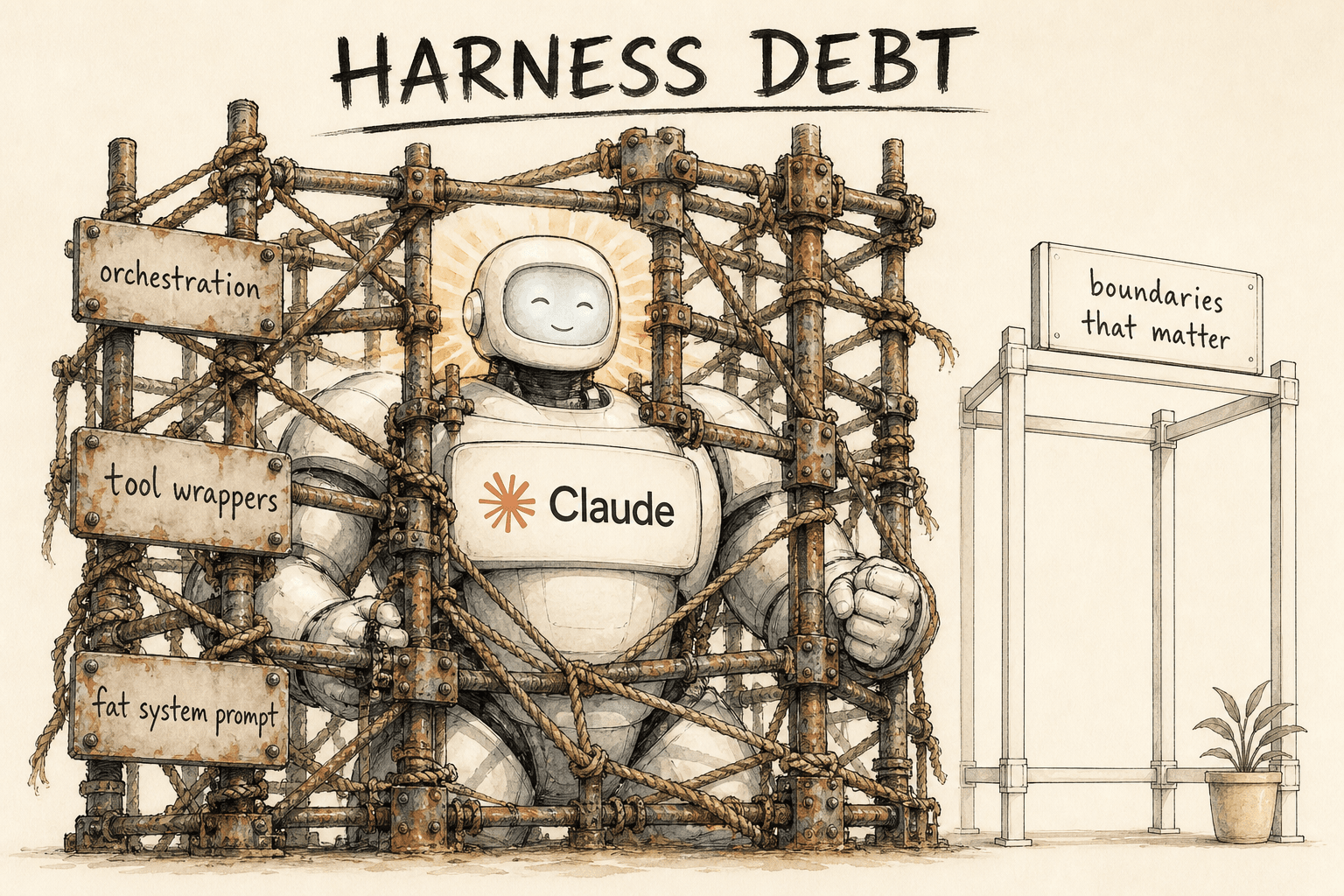
Harness Debt: Your AI Agent Scaffolding Is Quietly Fighting the Model (2026)
Your AI agent is probably worse than the model inside it — and the gap is your own scaffolding. An experimental harness scored over 2x Anthropic's standard one on the same model. The fix isn't a bigger framework; it's deleting the assumptions that went stale the day Claude Opus 4.6 shipped.

Claude for Small Business in 2026: Is It Worth It for a 10-50 Person Team?
Claude for Small Business is useful when it moves work out of the chat window and into finance, sales, marketing, and operations workflows. Here is how to decide whether it belongs in your 10-50 person company.