
Forward Deployment
Richard
Agent file / Richard
Deploy your product into your customer's systems — 10 accounts at a time.
Richard is your forward-deployed agent. He embeds in your customer's and your own team's Slack or Teams, learns how that customer actually works, then wires your product in, builds the integration glue, migrates the messy data, trains the real users, and drives adoption. Your people orchestrate him from your own Slack — instead of flying a senior engineer to every account.
Deploys inside
 Slack
Slack Microsoft Teams
 Salesforce
 ServiceNow
of enterprise AI pilots stall before measurable impact
rise in forward-deployed engineer roles in 9 months
to hire one forward-deployed engineer — per account batch
Meet Richard, the engineer you forward-deploy into every account at once.
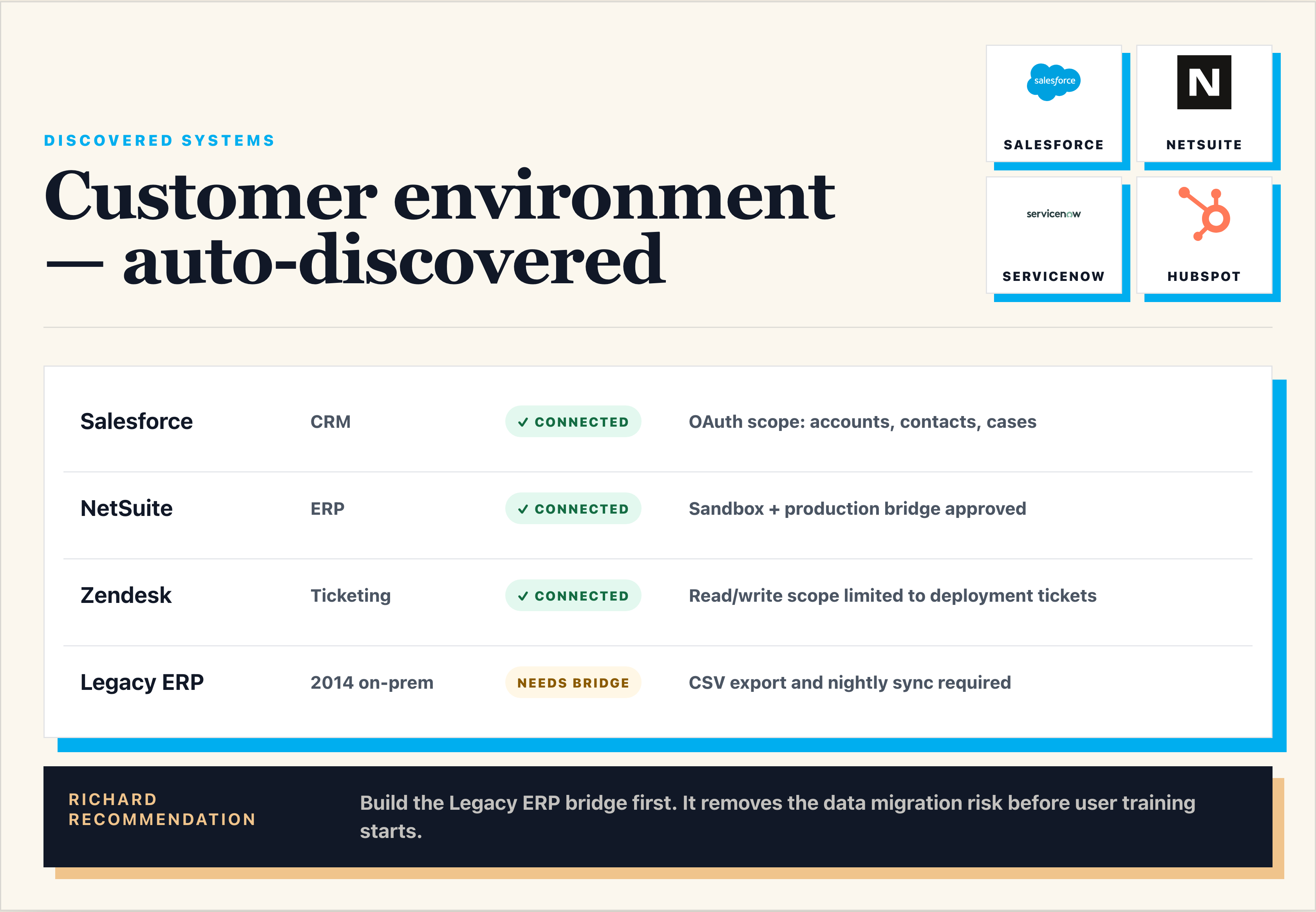
He starts where the work is — inside your customer's systems and your team's Slack or Teams. He learns how that specific customer runs: their data, their workflows, the undocumented stuff your demo never survives contact with.
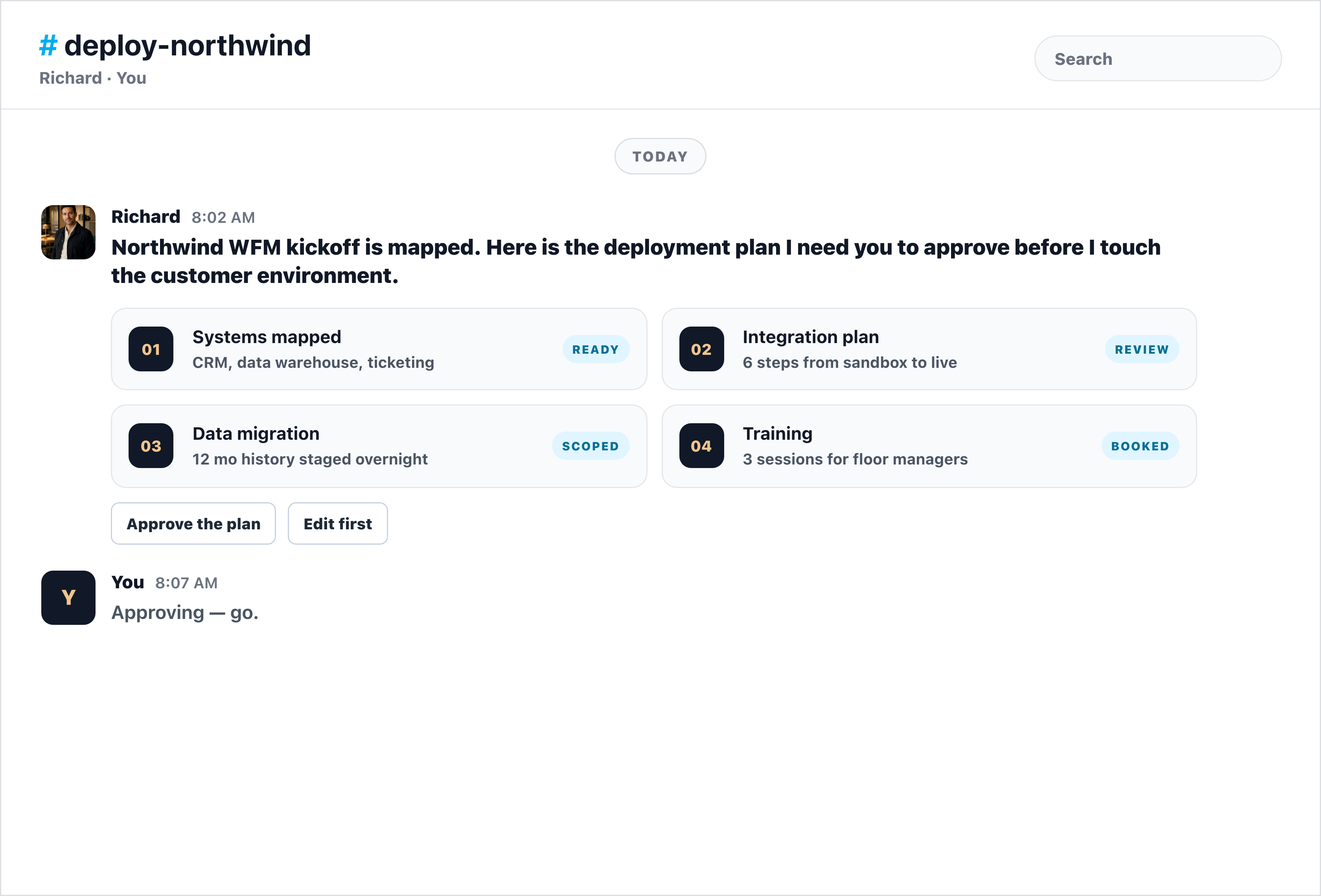
SlackMicrosoft TeamsThen that becomes a deployment plan — what to wire in, what to migrate, who to train, and what "live and adopted" actually means for this account — routed to your team to approve before he touches anything.
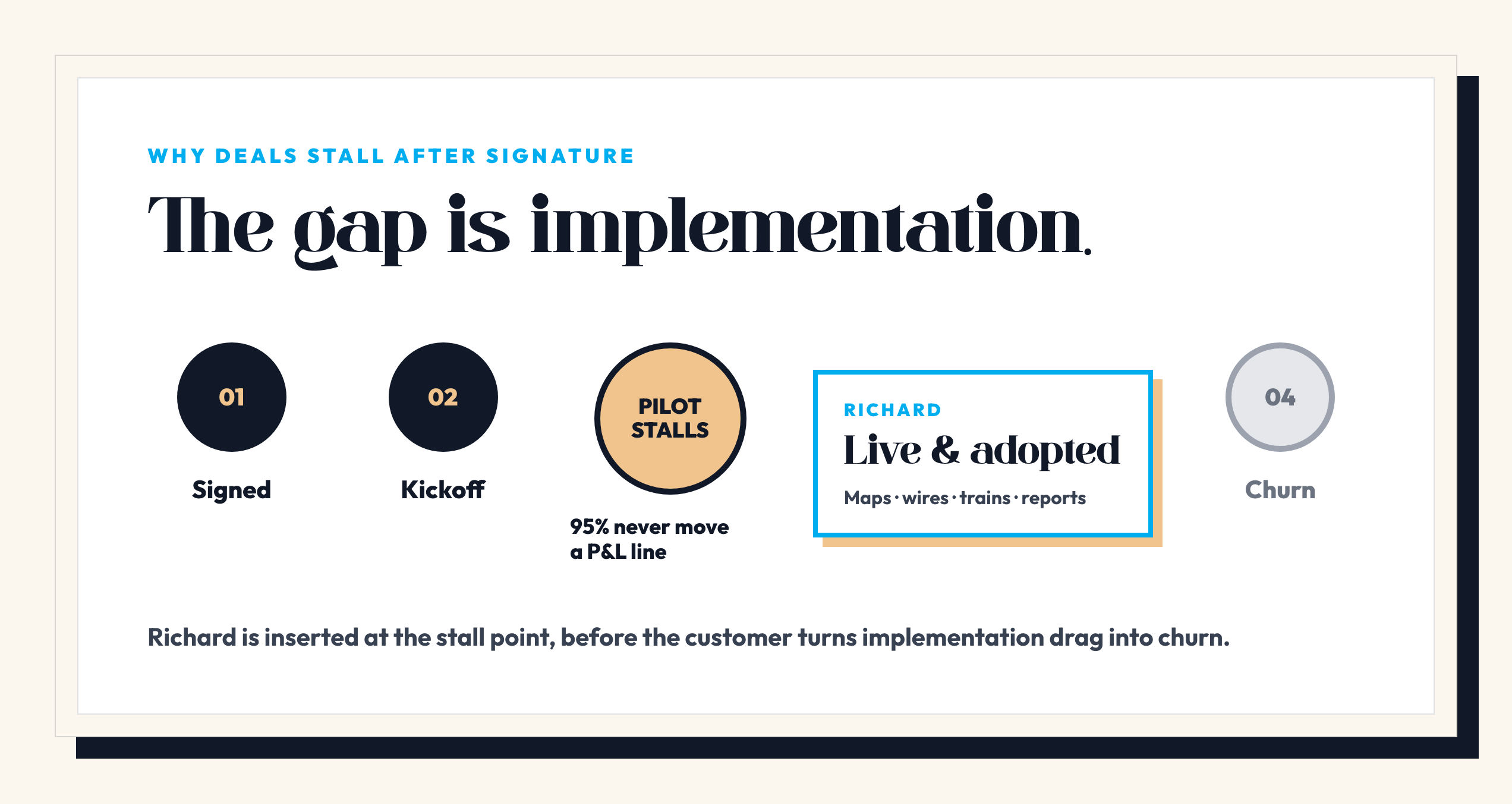
You don't have an adoption problem. You have an implementation problem.
- 95% of enterprise AI pilots never move a P&L line — not because the model is weak, but because nobody bridges the gap between the demo and the customer's messy production reality.
- The bottleneck isn't the technology. It's the talent to deploy it — and that talent is the longest pole in the tent on every rollout.
- Richard does the forward-deployed work itself: maps the undocumented workflow, wires your product into the real stack, and writes the glue that makes it stick.
Onboard every customer the way your best engineer did the very first one.
That heroic first rollout — the one a founder or principal engineer hand-carried — becomes a motion Richard runs on every account.
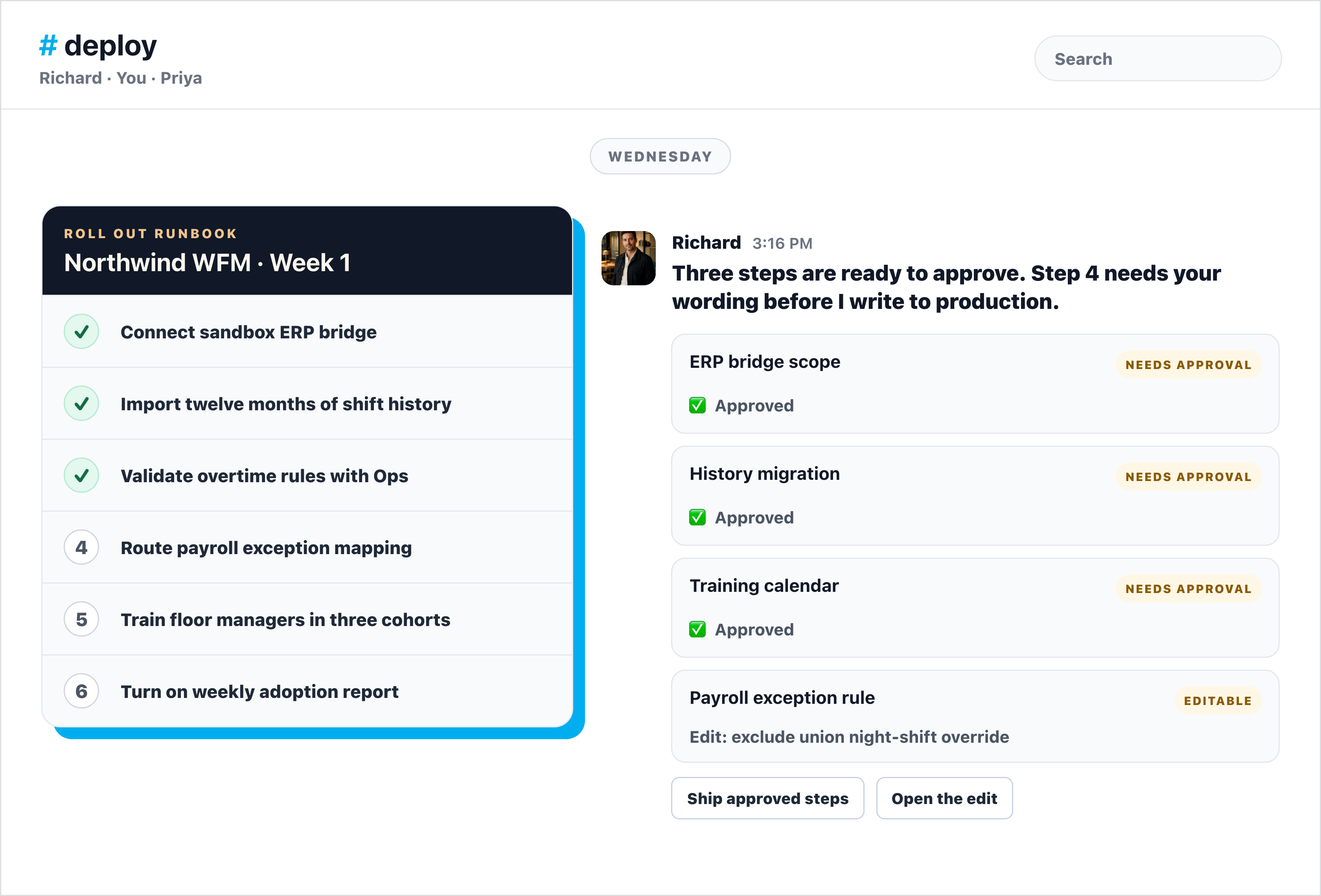
- Drafts the integration config, data migration, and rollout runbook for each customer, shaped to their stack — not a generic template.
- Routes every change through your Slack or Teams for approval before it ships. Richard does the work; your team keeps the boundary.
- Captures what worked into a reusable playbook, so account #40 deploys faster than account #4.
- Speaks your product cold — fact-checked against your own docs, edge cases, and guardrails.
Always on. So your timelines never slip.
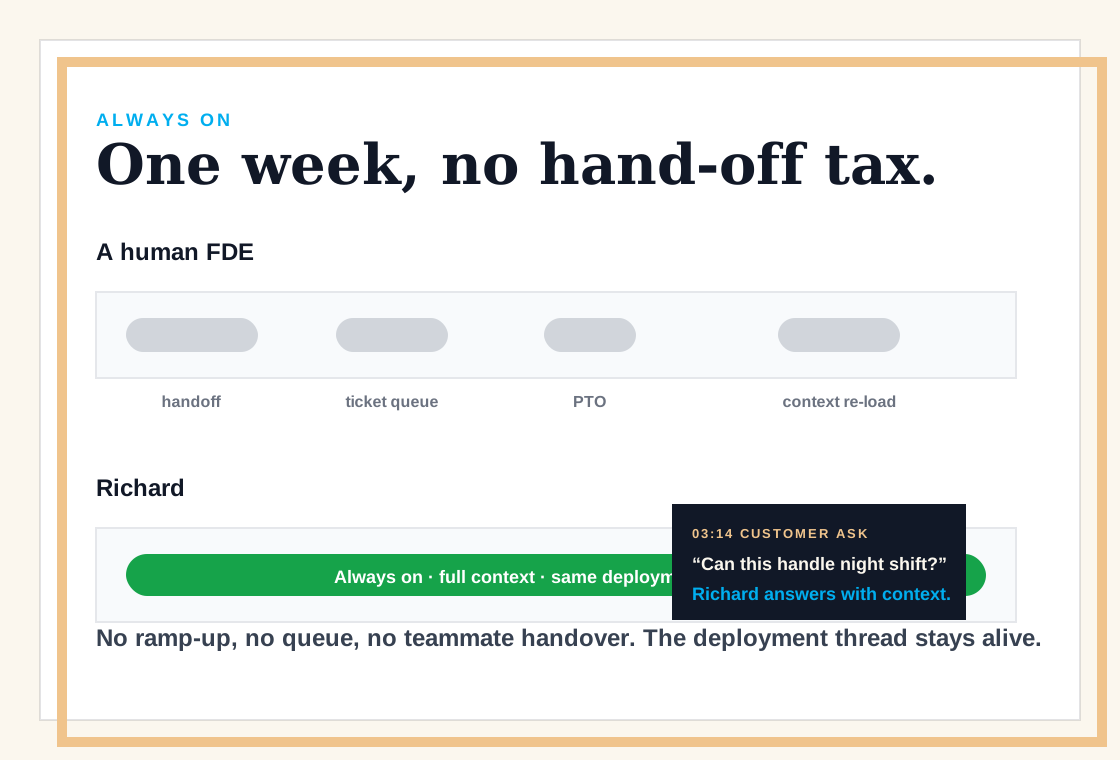
Richard works like a teammate who lives inside the project — full context, all the time.
- Full context on every account, always. No ramp-up, no re-explaining the customer's setup to the next engineer.
- Responds the moment the customer asks — not next sprint, not after standup. No queue, no ticket backlog.
- Zero hand-off tax. Nothing gets lost between teammates or between accounts, because it's the same agent holding the whole thread.
- Never reassigned, never on PTO, never poached. Deployments don't stall because a key person left.
- The result is the customer experience your best engineer gives on day one — on every account, every day.
Stop trying to hire your way out of implementation.
Forward-deployed engineers are the hottest hire in AI — and the hardest to scale.
- Open FDE roles jumped 800% in nine months, at $300K–$600K+ each — and you still need a new one for every batch of accounts.
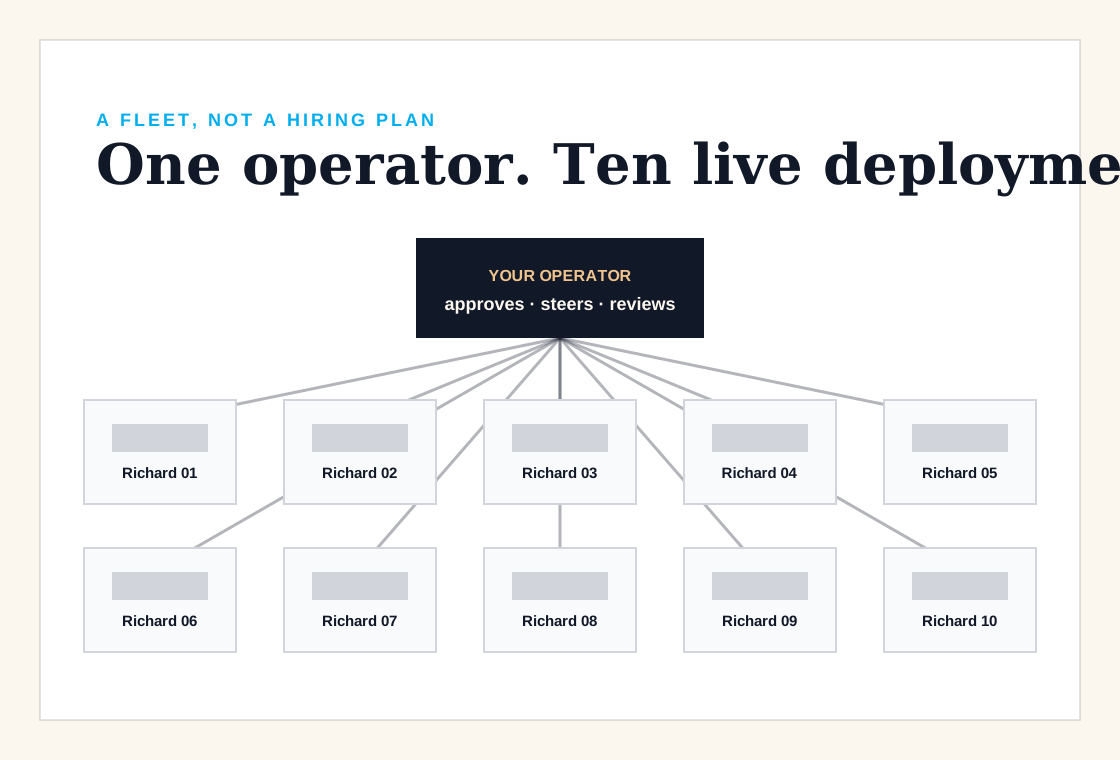
- With Richard, one operator runs deployments across 10+ customers at once. The model that worked for one white-glove account now works for the whole book.
- Your senior engineers stay on the product roadmap instead of living in customer Jira.
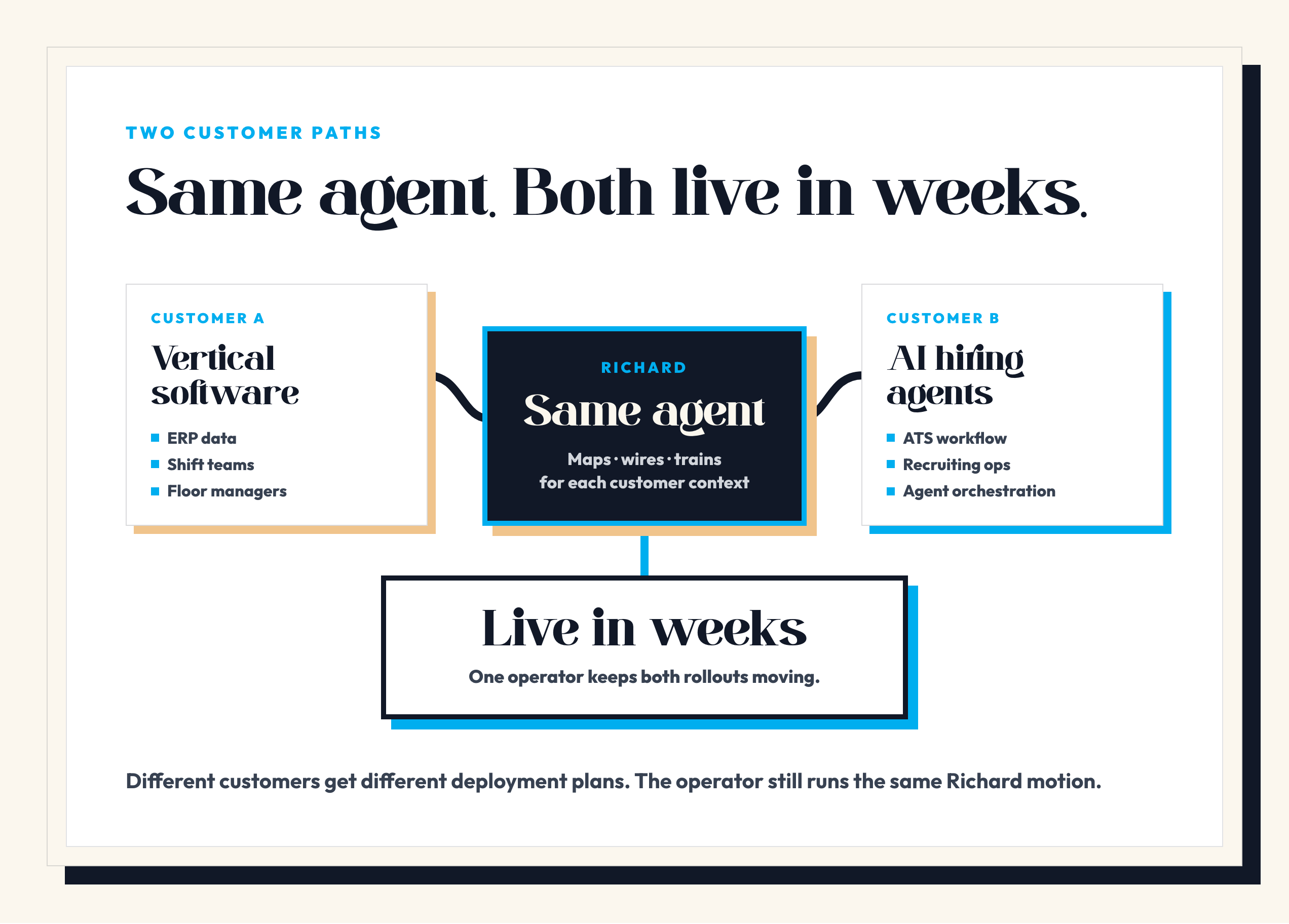
Same agent. Two very different customers. Both live in weeks.
Two deployments, one operator. Watch Richard do the forward-deployed work in each.
01 · Summary
Same Richard deploys both contexts without rebuilding the motion.
One operator runs Richard across two very different customer stacks. Each deployment gets its own mapping, glue, training, and live week plan.

He learns your product once. Then every deployment compounds.
Richard's memory is the asset. Every integration pattern, every objection, every legacy quirk he solves on one account is remembered and reused on the next — so your deployment motion gets faster and cheaper the more customers you sign.
Slack + Teams
Each deployment
Richard memory
Compounds.
Deployment motion
Next one is faster
Three companies. One bottleneck.
The useful move wasn't another solutions hire. It was a forward-deployed agent that turned implementation from the thing that kills deals into the thing that closes them.

"We were great at selling and terrible at going live. Two principal engineers were stuck doing rollouts instead of building. Richard took the deployments — we shipped to 14 accounts last quarter and pulled both of them back onto the product."
Daniel Mercer
Founder & CEO
Series-A AI company — 32-person team

"Implementation was where every deal went to die. Now one of my CSMs runs Richard across a dozen accounts and time-to-live dropped from a quarter to a few weeks."
Priya Nadkarni
Head of Customer Success
Vertical SaaS — mid-market

"We'd been told to hire three forward-deployed engineers. We deployed Richard instead, and our solutions team finally stopped being the bottleneck."
Tomas Vogel
VP Solutions Engineering
B2B platform
The work is hands-on. The boundary is yours.
Richard is for software and AI companies whose growth is capped by how fast they can deploy — not a managed-service retainer with a nicer deck.
01Does Richard replace our forward-deployed engineers?
He does the repeatable 80% — mapping, wiring, migration, training, adoption follow-up — so your engineers handle the genuinely novel 20% instead of every rollout.
02What does the customer approve?
Access scope, the deployment plan, every data migration, and any change that touches their production systems. Richard proposes and executes; the customer holds the gate.
03How does he get into customer systems safely?
Scoped, audited credentials per account, least-privilege, with every action logged. Nothing touches production without a human approval.
04What if a customer's stack is a mess?
That's the point. The messy, undocumented stack is exactly where pilots stall and where Richard earns his keep.
05How is this different from hiring an FDE or an SI?
An SI bills hours and leaves. A hire takes months and covers one account at a time. Richard covers your whole book at once and gets faster with every deployment.
06What does handover look like?
Every deployment leaves a runbook, the integration config, and the playbook behind — owned by you, not locked in a vendor.
Start with the accounts that are stuck
Hire Richard. Get every customer live.
A named agent for stack mapping, integration, data migration, user training, and weekly adoption — across your whole book at once. You see the plan, the change, the approval, and the customer going live.