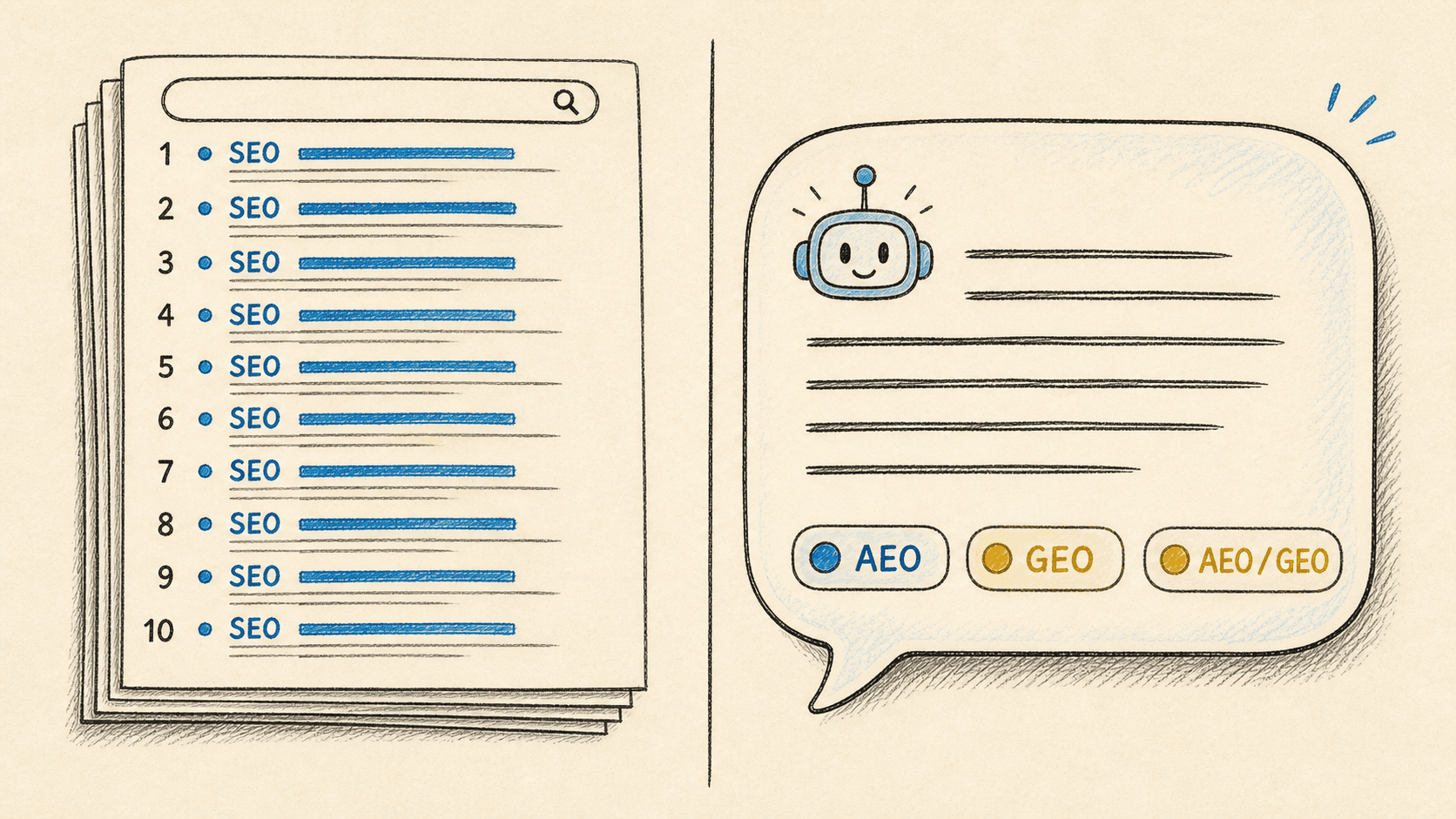

TL;DR
- SEO optimises your pages to rank in classic search and earn the click. GEO (Generative Engine Optimization) and AEO (Answer Engine Optimization) optimise to be cited inside the AI answer in ChatGPT, Perplexity, Google AI Overviews, Gemini and Copilot.
- GEO was coined in a November 2023 Princeton and Georgia Tech research paper; AEO grew out of the SEO industry. In 2026 most practitioners and vendors use the two interchangeably, though a minority still draw a line. We explain the real distinction and why it rarely changes what you do.
- This is not optional positioning. In early 2026, 68 percent of US Google searches ended without a click, and Google AI Overviews cut click-through on the top result by around 58 percent when they appear.
- You still do all three. SEO feeds the pool the AI engines retrieve from; GEO and AEO win the citation inside the answer. But you measure them on citation share across engines, not on blue-link position.
What are SEO, AEO and GEO?
Three terms, two jobs. Here are the plain definitions before the nuance.
SEO (Search Engine Optimization) is the discipline you already know: structure your site and earn authority so your pages rank in the classic results, the ten blue links. The metric is position and the prize is the click. As eMarketer principal analyst Kelsey Voss puts it, "SEO is about ranking pages for clicks." It is mature, well documented and still necessary, but the surface it optimises for is shrinking as answers move into AI summaries.
AEO (Answer Engine Optimization) is optimising your content and presence so AI answer engines cite, mention or recommend your brand when someone asks a question. The prize is not the click. It is being named in the answer.
GEO (Generative Engine Optimization) is the same idea framed around generative engines: being the source a model uses to compose its answer. The term is not marketing slang. It was coined in a November 2023 academic paper by Aggarwal and colleagues at Princeton, Georgia Tech, the Allen Institute and IIT Delhi (accepted to KDD 2024), which introduced GEO as "the first novel paradigm to aid content creators in improving their content visibility in generative engine responses."
You will also see AI search optimization, LLMO, GSO and AIO used for the same goal. The vocabulary is noisy. The work is not.
Are AEO and GEO the same thing?
This is the question most comparisons dodge, so here is the honest answer: it depends who you ask, and in practice it rarely changes what you do.
The dominant 2026 view is that they are the same. Digiday, writing in October 2025, said plainly that "there is no common taxonomy" and that AEO, GEO and GSO "all mean the same thing." eMarketer agrees that GEO, AEO, GSO, LLMO and AIO "describe the same underlying approach" and notes the naming debate "will take years, not months." The measurement vendor Profound published a piece titled "AEO vs GEO: why they're the same thing."
A minority disagree, and their distinction is worth understanding. In that view, AEO is about getting your answer extracted into direct-answer surfaces (featured snippets, voice results, the one-box), while GEO is about being cited inside a longer generative response that synthesises several sources. It is a real conceptual difference. It is just one the engines themselves have largely merged, because Google AI Overviews, ChatGPT and Perplexity now both extract and synthesise in the same answer.
Our take, as people who do this work: treat AEO and GEO as one discipline with two names, pick the term your team prefers, and spend your energy on the work rather than the label. The distinction only matters at the edges (pure voice-assistant optimisation leans AEO; long-form citation in a research answer leans GEO), and even there the levers overlap.
AEO and GEO vs SEO: what actually changes
SEO and AEO/GEO are not the same game with a new coat of paint. The goal, the surface, the metric and where the work lives all move.
| SEO | AEO / GEO | |
|---|---|---|
| Goal | Rank a link | Be cited in the answer |
| Surface | Ten blue links | AI answers (ChatGPT, Perplexity, AI Overviews, Gemini, Copilot) |
| Metric | Keyword position, clicks | Citation share, visibility, share of voice |
| Top levers | On-page plus backlinks for rank | Content shape, evidence, entity authority, off-site footprint, freshness |
| Where the work lives | Mostly your own site | Largely off your own site |
| Win condition | You get the click | The model recommends you |
The biggest mental shift is who owns the battleground. In SEO, your domain is where you win. In AEO and GEO, much of what decides the answer happens on third-party sources you do not own: the reviews, community threads and independent articles the engines trust.
Why this matters now: the 2026 data
If you think this is early, look at where the clicks went.
In the first four months of 2026, 68 percent of US Google searches ended without any click, according to SparkToro's analysis of Similarweb clickstream data, up from around 60 percent in 2024 and roughly 45 percent a decade ago. (The two years use different data providers, so read it as a trend, not a clean year-on-year delta.) Position-one organic click-through has slid from 31.7 percent in 2022 to 27.6 percent in 2026.
Google AI Overviews are the main reason. They now appear on more than 20 percent of searches (Ahrefs measured 20.5 percent across 146 million result pages in September 2025), and when they appear, Ahrefs found they cut the click-through rate on the number-one result by around 58 percent. Pew Research, studying March 2025 data, found that when an AI summary showed, users clicked a result in just 8 percent of visits versus 15 percent without one, and clicked a link inside the summary itself in only 1 percent.
Adoption is not niche. eMarketer forecasts that 31.3 percent of the US population will use generative AI search in 2026. ChatGPT reported 800 million weekly users in October 2025, and Google's Gemini passed 750 million monthly users by its Q4 2025 earnings in February 2026.
One more number reframes the whole thing. Most publishers get under 1 percent of their referral traffic from AI engines today, even when they are cited often. But those AI-referred visitors convert far better: the Washington Post reported AI visitors subscribing at four to five times the rate of search visitors. The traffic is small, high-intent, and growing fast. When ChatGPT made brand names clickable inside answers on 7 May 2026, trackers measured referral jumps of roughly 60 percent (Profound) to 158 percent (Similarweb) week on week.
How do AI engines actually pick sources?
Here is the part most guides miss, and the part that should shape your strategy: the engines do not agree with each other.
Each major AI engine has a persistent editorial identity, a default kind of source it reaches for. According to Profound's analysis of 680 million citations (August 2024 to June 2025), Wikipedia is ChatGPT's dominant source, making up 7.8 percent of all its citations and nearly half of its top ten sources. Perplexity leans the other way: Reddit is its single most-cited source, at 6.6 percent of its total. Conductor's seven-month study across seven engines found these preferences hold "intent by intent, time after time," and they do not line up across engines, not even between Google's own three. Gemini's top-cited domains overlap with Google AI Mode only 27 percent of the time, and only 11 percent of domains are cited by both ChatGPT and Perplexity.
The practical implication is large. There is no single "rank well and you appear everywhere" lever. Winning ChatGPT can mean a strong, accurate reference-grade and Wikipedia presence; winning Perplexity can mean genuine, helpful participation in the Reddit and community threads it trusts. A real GEO programme optimises per engine, for the prompts that matter to your business, then re-checks, because 40 to 60 percent of cited sources change month to month.
What actually works to get cited
The good news is that the foundational lever is evidence-based, not folklore. The original 2023 GEO paper tested optimisation methods on real generative engines and found that adding quotations, relevant statistics, and cited sources to your content boosted its visibility in AI answers by up to 40 percent. That is a relative visibility lift in their tests, not a traffic guarantee, but the direction is clear and it matches what the engines reward in practice.
Built on that, the working playbook for 2026:
- Keep the SEO fundamentals. A crawlable site in raw HTML (most AI crawlers do not execute JavaScript), clean architecture, and genuine authority. SEO gets you into the candidate pool the engines retrieve from.
- Shape content answer-first. Lead each section with a direct one-sentence answer, then explain. Use question-led headings, comparison tables, FAQs and tight, atomic paragraphs the engines can extract and attribute cleanly.
- Back claims with evidence. Quotations, named statistics and cited sources: the exact levers the research validated.
- Build the off-site footprint the engines trust. Reviews, the right community threads, editorial roundups and independent articles, tuned to where your target engines actually look.
- Build entity authority. One consistent description of who you are everywhere, plus a clean, accurate reference presence (Wikipedia and Wikidata where appropriate).
- Keep it fresh. Citations decay and the cited set churns monthly, so treat this as a recurring programme, not a one-off project.
The common mistake is the opposite of all this: publishing more thin, unsourced content faster. Unsourced volume is exactly what does not get cited.
So do you do SEO, AEO and GEO all at once?
Yes, and they reinforce each other rather than compete. Classic ranking still feeds AI retrieval. Ahrefs found that 38 percent of pages cited in Google AI Overviews also rank in the organic top ten, so SEO is a genuine feeder. But the same study found 62 percent of those citations come from outside the top ten, which is the proof that AEO and GEO are a partly separate game you have to play deliberately. SEO gets you considered. AEO and GEO win the citation.
What changes is measurement. You stop judging success only by keyword position and start tracking citation share: how often you are named in answers, your share of voice against competitors, and which sources the engines cite for your category. Purpose-built AI-visibility trackers measure exactly this across engines, and the category is now well funded and real (Profound raised 96 million dollars, per Fortune in February 2026; Peec AI raised 21 million, per TechCrunch in November 2025). A tracker tells you where you are missing. It does not close the gap. That takes an execution layer, whether in-house, an agency, or an AI-search agent.
The bottom line
SEO ranks links. AEO and GEO, two names for one discipline in 2026, get you cited inside AI answers. You do all three, but the AEO and GEO levers (content shape, evidence, entity authority, off-site footprint, freshness) are different enough, engine-specific enough, and recurring enough that most teams need a deliberate programme to run them, not a one-time content refresh.
That is the work AI Heroes does. We read where you stand in AI answers across engines, agree the prompts that matter to your business, then ship the optimisations, new pages, evidence-backed content and off-site presence that move citation share, with humans on quality. If you want to be the source the answer is built from, not just a link that ranks, that is the whole job.
The agent built for this

Schmitdy
Turns ChatGPT, Claude, Gemini, and Perplexity into your next growth channel.
Meet SchmitdyFrequently Asked Questions

Founder, AI Heroes
I build AI companies and the systems inside them. At AI Heroes, we give businesses the functional capacity to grow without the headcount growth normally demands — sales that follows up, marketing that runs, content that ships, ops that handles itself. We audit where you're leaving growth on the table, build the team that captures it, and hand it over completely.
I've built at scale before. Leading product and GTM at SlideSpeak AI (1M+ monthly users, profitable, bootstrapped). CPO at Disperse — the AI construction platform that went from 3 to 200+ people on $35M raised. I also co-founded LOBOMAR, a luxury fashion label featured in Elle, Cosmopolitan, and the LA Times, with shows at the London Design Museum, Wereldmuseum, and Amsterdam Fashion Week.
Related Articles
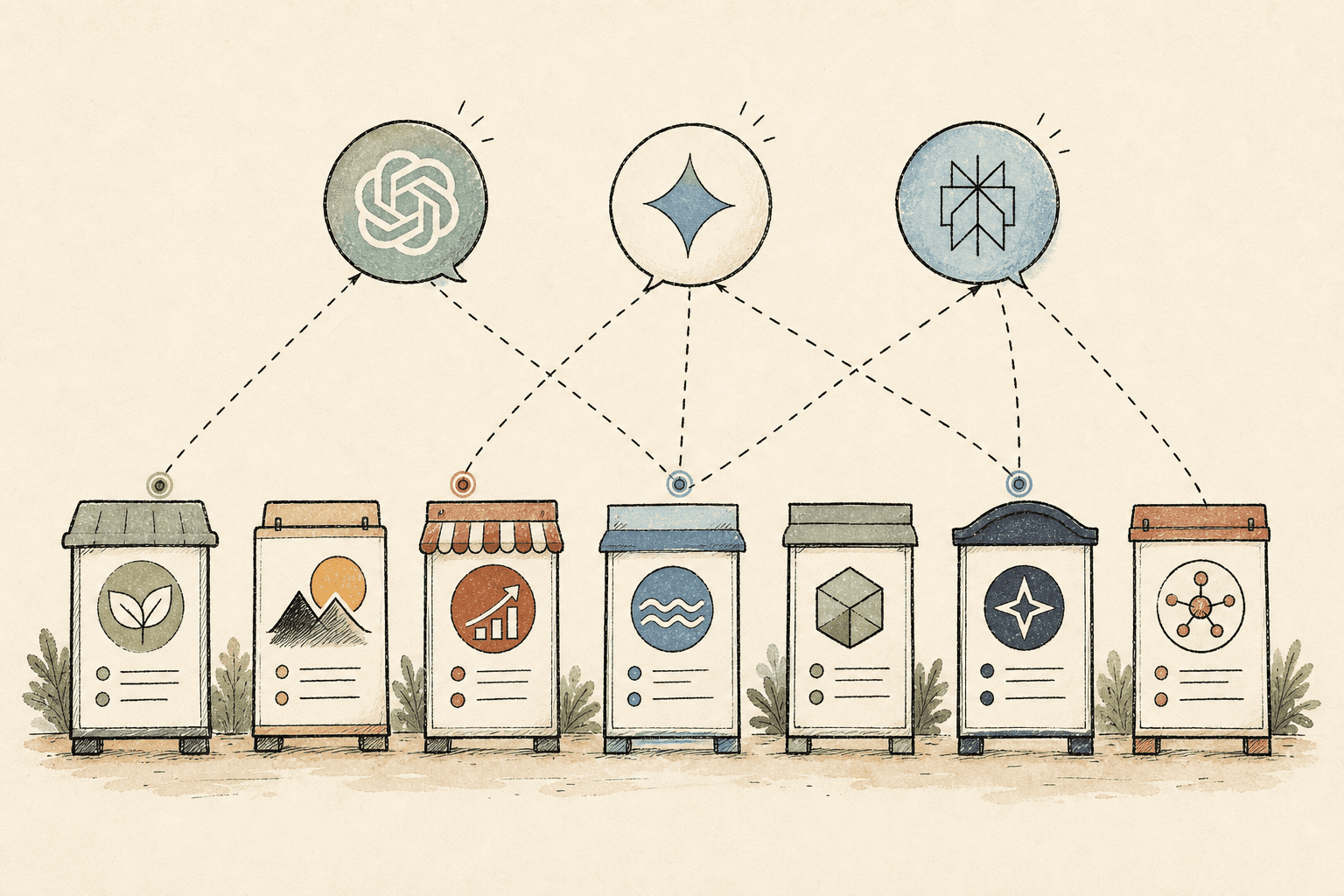
The Best AI Search Agencies in 2026 (GEO and AEO), Compared
The agencies that get brands cited inside ChatGPT, Gemini, Perplexity, and Google AI Overviews, compared on model, market, and method, with the criteria to pick one. The most useful fact for choosing: around 85 percent of AI citations come from third party domains, not your own site, so an agency whose whole offer is on-site content is mismatched to where citations come from.

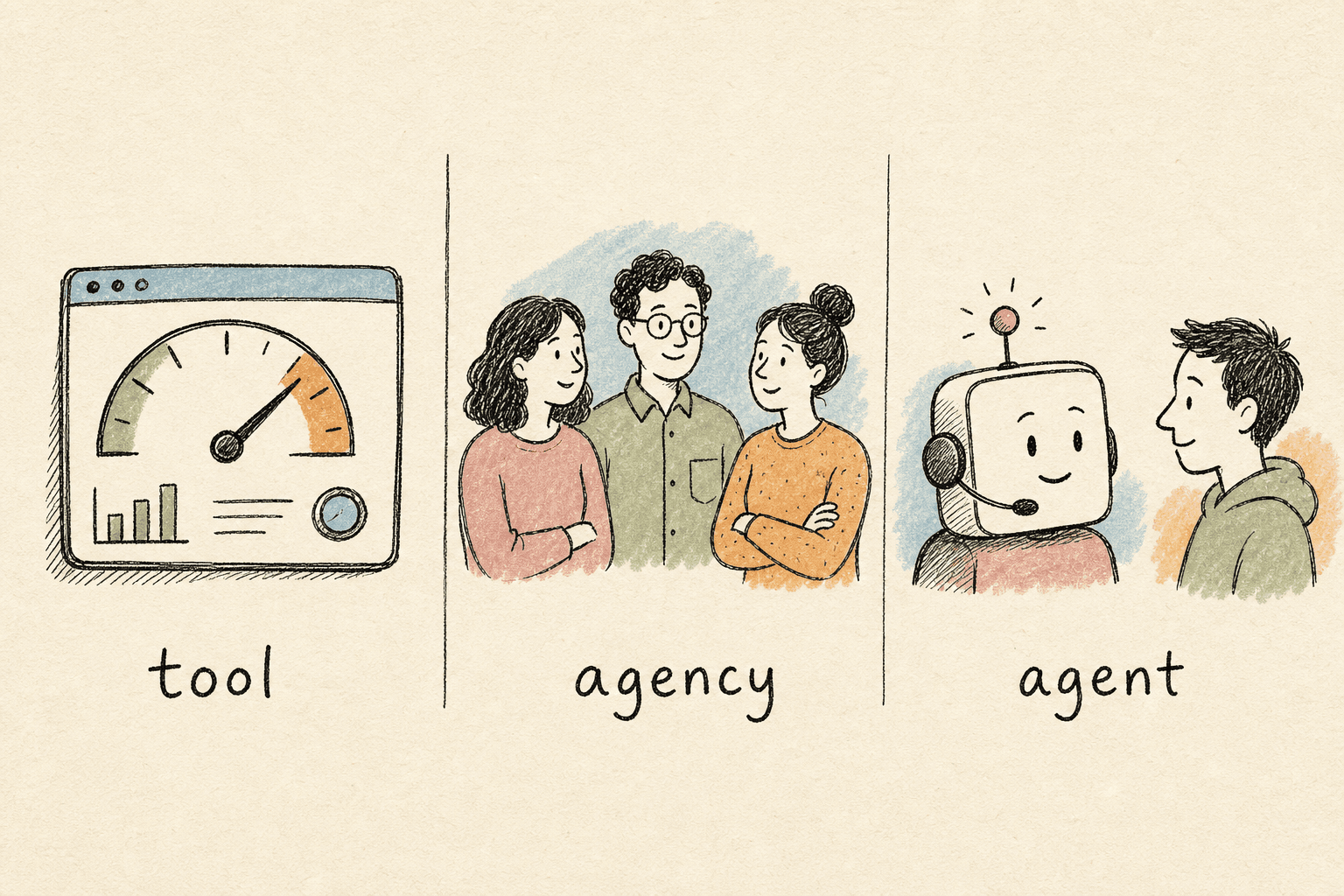
AI Search Tool vs Agency vs Agent: Which Do You Actually Need in 2026?
There are three ways to improve your AI search visibility, and they're layers of the same stack, not rivals: a tool (Peec, Profound) measures where you stand; an agency executes the optimisation work with people; an agent — an AI-search agent — does the recurring volume under human review. A tool changes your understanding, not the answer. An agency changes the answer but costs the most and moves at human speed. An agent does the volume at mid-market cost with humans owning quality and strategy. In 2026 most teams keep a tool and add one execution layer — the real decision is which one.
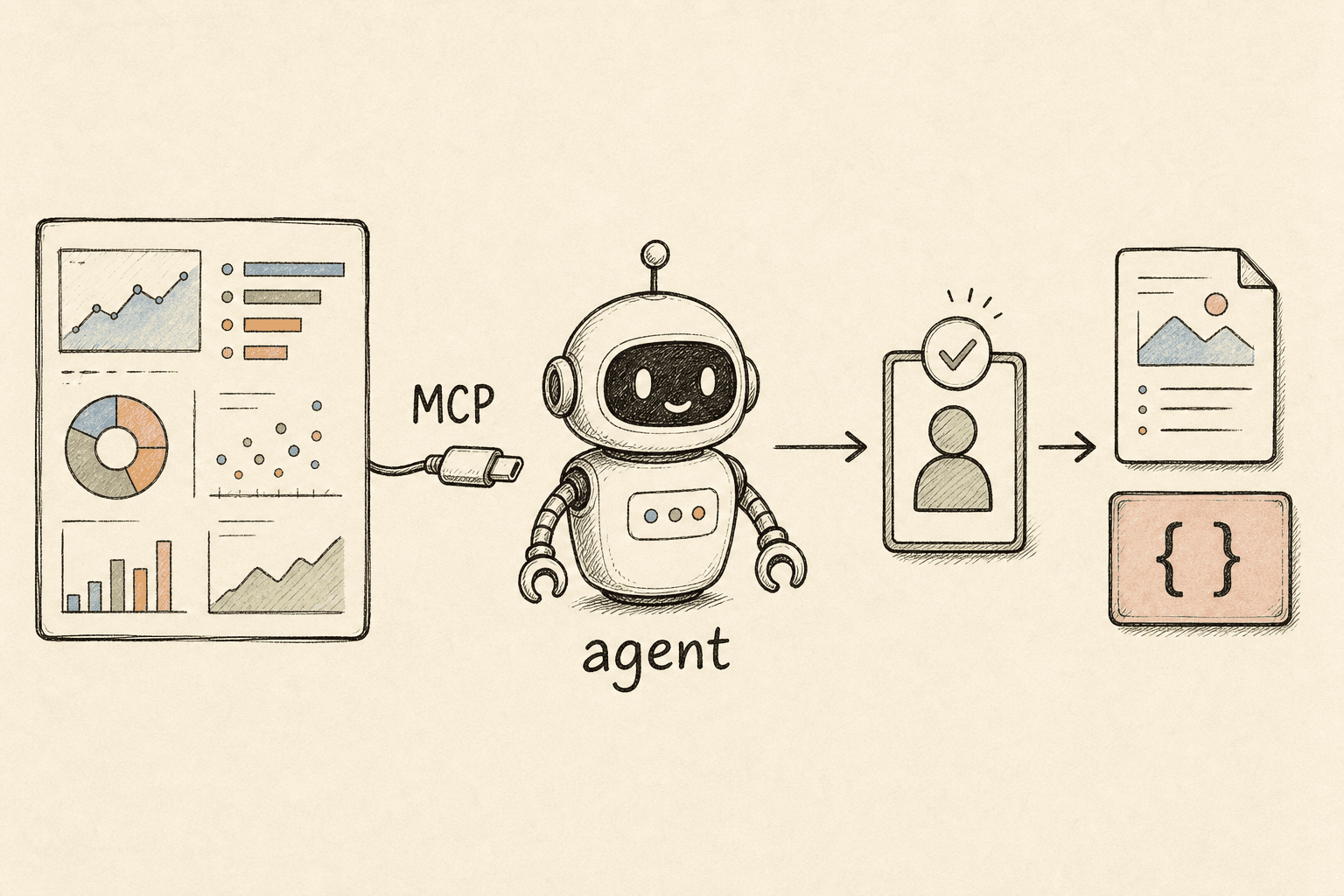
How to Build AI Agents on the Peec AI MCP for AEO and GEO (2026)
In late 2025 Peec AI shipped an official MCP server, which makes its entire AI-search measurement layer — projects, prompts, per-engine brand visibility, full AI answer transcripts, the source/citation graph and scored Actions — directly callable by an LLM agent. That means you can wire a Claude or GPT agent straight to the ground truth of how ChatGPT, Perplexity, Gemini and AI Overviews answer your category, and have it reason over the data and draft the work to close the gaps. The defensible build pattern is a read-only, five-stage loop with a human ship gate: the agent triages and drafts; a person verifies and ships.