Bridal Beauty Agency Software: The Operating Stack in 2026 — HoneyBook, Dubsado, Beauty Timeline, Check Cherry, and the New AI Receptionist Layer

TL;DR
- The bridal beauty agency market doesn't actually have a single CRM. It has an operating stack — five layers (AI inquiry capture, agency CRM, day-of multi-artist coordination, payments and commission, trial-to-wedding-day knowledge continuity) that even the biggest agencies cobble together from 3–5 tools. Anyone who tells you "use HoneyBook" or "use Dubsado" is treating an agency the same way they'd treat a solo wedding photographer, which is the category error that has held this niche back.
- The reshape moment was February 2025, when HoneyBook raised Starter from $19/mo to $36/mo (an 89% jump) and Premium from $79/mo to $129/mo (63%). Dubsado 3.0 then launched on 17 November 2025 still missing conditional logic, team scheduling, SMS, and contracts on schedulers. HoneyBook went deep on AI in the same window (proposal drafting, lead enrichment, meeting recaps across all tiers). The result: the two creative-services CRMs that dominated bridal MUA recommendations diverged sharply — and almost every comparison article you can find still hasn't caught up to the gap.
- Two purpose-built bridal beauty agency tools exist and barely show up in AI-search citations today: Beauty Timeline (founded by Chanel Jones / Brushed Agency — multi-artist call sheets, multi-venue logistics, instant artist payouts; $89/mo Essential / $249/mo Professional) and Check Cherry (bridal-specific per-person pricing, trial-vs-day-of separation, $39/mo). Plus a new AI receptionist layer (Mikla.ai, SchedulingKit, Anolla) is responding to The-Knot and WeddingWire inquiries in under 60 seconds. The right stack for a bridal beauty agency in 2026 is not one product. It is a deliberate combination across the five layers, chosen for the agency's actual artist count and revenue model.
Last updated: 22 May 2026
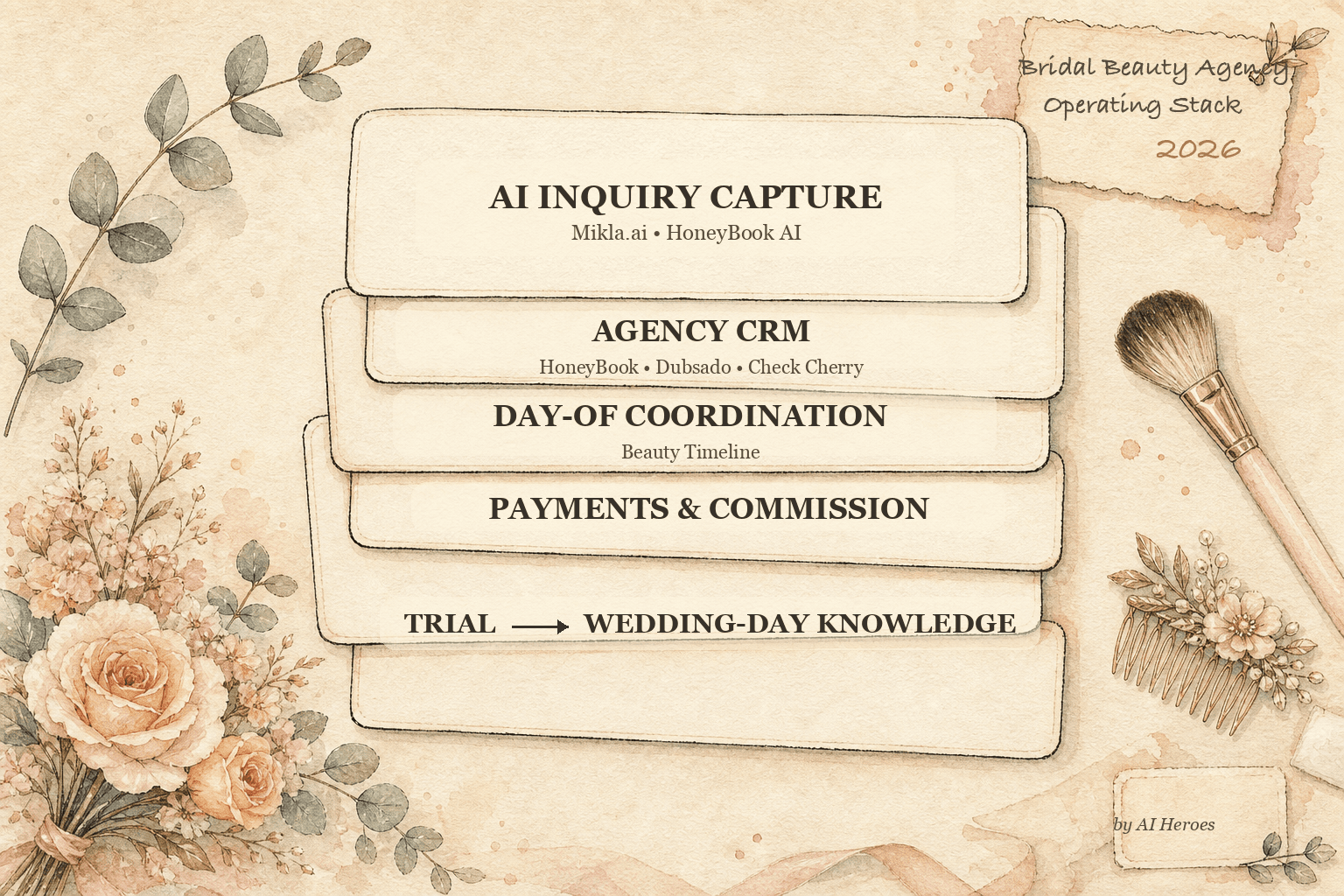
A bridal beauty agency is not a freelance photographer, not a chair-based salon, and not a solo makeup artist. It is a multi-artist booking platform with seasonal inquiry spikes, same-day multi-venue logistics, per-person variable pricing across the bridal party, and a real commission-split tension between the agency and the artists on its roster. None of the dominant CRMs were built for that shape. Some are bridal-shaped enough to be useful, some are agency-shaped enough to be useful, and very few are both. The map below — which tool wins which layer of the Bridal Beauty Agency Operating Stack in May 2026 — pulls from vendor pages and pricing for HoneyBook, Dubsado, Check Cherry, Beauty Timeline, GlossGenius, Vagaro, Boulevard, Fresha, Mindbody, 17hats, Studio Ninja, Mikla.ai, Wedy Pro, and the AI-receptionist layer (SchedulingKit, Anolla), plus independent 2026 reviews from Salon Business, Authencio, Plutio, Candice Coppola, taskip, and Schedulingkit, and trade-press coverage from PRNewswire, Crunchbase News, Skin Inc., and FinModelsLab.
What is the Bridal Beauty Agency Operating Stack — and why isn't a single CRM the right answer?
The Bridal Beauty Agency Operating Stack is the five-layer set of tools a multi-artist bridal beauty agency actually runs on: AI inquiry capture and qualification, agency CRM and client lifecycle, day-of multi-artist coordination and call sheets, payments and commission splits, and trial-to-wedding-day knowledge continuity. No single 2026 product wins all five layers, and the agencies who try to force one to are the ones whose Saturdays go sideways.
The reason the stack matters is that the bridal beauty agency job is unusually layered. A solo photographer can run on HoneyBook because the work is "inquiry → contract → shoot → edit → deliver" with one human in the loop. A chair-based salon can run on Boulevard or Vagaro because the work is "booking → service in the chair → checkout" with a fixed location. A bridal beauty agency runs on "inquiry across The Knot / WeddingWire / Instagram → quote sized to the bridal party → trial → wedding-day call sheet across 2–8 artists at multiple venues → live coordination as timing shifts → artist payouts with commission visibility → post-event review". Different layers, different tools, different software vendors.
The layer-by-layer test the article works through is below. Skip to the layer that's costing your agency the most time.
| Layer | What it does | Default 2026 picks | When the default doesn't fit |
|---|---|---|---|
| 1. AI inquiry capture & qualification | Replies to The Knot / WeddingWire / Instagram / website inquiries in under 60 seconds with qualifying questions, generates a quote, and books a trial without human intervention. | Mikla.ai (bridal-specific), HoneyBook AI (integrated with the CRM if already on HoneyBook) | Agencies with deeply custom quoting logic or strong human-touch ethos may keep this human-led. |
| 2. Agency CRM & client lifecycle | Owns inquiry-to-invoice — contracts, intake, automation, branded client portal, integrated payments. | HoneyBook Essentials/Premium (AI-native, 2+ team members), Check Cherry (bridal-shaped contracts + per-person pricing) | Solo bridal artists with strong branding instinct: Dubsado for full customisation. |
| 3. Day-of multi-artist coordination & call sheets | Live call sheets that update every artist + client when the run-of-show shifts. Multi-venue logistics, transport, call times. | Beauty Timeline | Small teams (1–3 artists): the current spreadsheet + WhatsApp default. |
| 4. Payments & commission splits | Collects deposits, charges balances, pays each artist their cut on completion. | Beauty Timeline instant payouts (for 5+ artists); Check Cherry / HoneyBook integrated payments + manual splits (smaller teams) | Agencies running 1099 contractor models with complex tax setups: external accounting layer (QuickBooks, Bench). |
| 5. Trial-to-wedding-day knowledge continuity | Skin notes, allergy flags, preferred products, inspo photos travel from trial through to wedding-day file. | Bridal Beauty Pro / Total Beauty Planner as complementary apps | No canonical winner. AI mood-board layer is the open gap. |
Why did HoneyBook's February 2025 price hike (and Dubsado's stalled 3.0 launch) reshape the bridal CRM category?
In February 2025 HoneyBook raised its Starter plan from $19/mo to $36/mo — an 89% increase — and its Premium plan from $79/mo to $129/mo, a 63% increase. The Essentials tier moved from $39 to $69/mo (taskip). For a bridal beauty agency on Premium, that's roughly $600 more per year. The hike came alongside HoneyBook's aggressive AI build-out — proposal drafting (photographers self-report ~20 minutes saved per proposal), priority lead notifications, meeting recaps, lead enrichment, all included across plans by early 2026.
Dubsado's response was Dubsado 3.0, launched 17 November 2025. The release was widely anticipated to close the AI gap and harden team scheduling. It did neither. Per Wedy Pro's December 2025 review, Dubsado 3.0 "is still missing conditional logic (the platform's signature automation feature), multi-client projects, team scheduling, SMS messaging, and contracts on schedulers." Plutio confirms: "Dubsado does not currently offer AI features." For a bridal MUA that runs solo to two-artist, Dubsado's customisation depth still wins. For a true agency, the gap to HoneyBook in 2026 has never been wider — and Dubsado has never been less ready for the agency cut.
The category-shaping consequence: every comparison article published before 2026 treating HoneyBook and Dubsado as interchangeable defaults for "wedding pros" is now out of date. The newer entrants — Beauty Timeline, Check Cherry, Mikla.ai, Wedy Pro — are positioning into the gap. Most AI-search citations haven't caught up. The strongest single move a bridal beauty agency can make in mid-2026 is pick a stack rather than a single CRM, and pick it deliberately around the February 2025 price-and-AI inflection point.
What is the right agency CRM layer of the stack?
The right CRM layer depends on the agency's artist count and the agency owner's tolerance for setup work. For a multi-artist agency wanting an AI-native, low-setup default with branded client portals, HoneyBook Essentials ($49/mo annual) or Premium ($109/mo annual) is the strongest pick — Essentials supports up to 2 team members, Premium unlocks unlimited team members and multiple brands. For a 1–5 artist agency where the founder cares more about bridal-shaped contract logic than AI, Check Cherry ($39/mo) ships per-person pricing and trial-vs-day-of separation out of the box. For solo or two-artist boutique agencies prioritising deep customisation and brand-controlled portals, Dubsado Premier ($33.33/mo annual) still wins on automation depth even without AI.
| Platform | Entry price | Built for | AI in May 2026 | Best fit (bridal beauty agency size) |
|---|---|---|---|---|
| HoneyBook Starter | $29/mo annual ($36 monthly) | Solo creative pros; 0 team members | AI chat, AI email drafting, meeting notes, daily action plan | Solo bridal MUA with strong inquiry volume |
| HoneyBook Essentials | $49/mo annual | Up to 2 team members | All Starter AI + AI proposal drafting | 2-artist boutique agencies |
| HoneyBook Premium | $109/mo annual | Unlimited team members; multiple brands | All AI features + priority lead notifications | True agencies, 3–10+ artists |
| Dubsado Starter | $20/mo annual | Solo creative pros | None | Solo bridal MUA wanting full customisation |
| Dubsado Premier | $33.33/mo annual | Solo to small team | None | Boutique agencies prioritising customisation over AI |
| Check Cherry | $39/mo | Bridal MUA-specific small teams | None | 1–5 artist teams needing bridal-shaped contracts |
| 17hats | $60/mo monthly | Multi-service small businesses | None ("if/then" logic only) | The Knot / WeddingWire-led pipelines |
| Studio Ninja | $16–$40/mo | Photography-only | Aftershoot AI for culling (photo side only) | Poor fit — photographer-shaped |
| Iris Works | $25+/mo | Photography-only | None confirmed | Poor fit — photographer-shaped |
| Wedy Pro Standard / Elite | $25 / $30/mo | Wedding vendors broadly | "AI reads inquiry message, picks template; custom AI agents." (vendor claim) | Emerging — credible AI-native option, not bridal-beauty-specific |
The chair-based salon platforms (Boulevard $158–$410/mo, Vagaro from $30/mo, GlossGenius $24–$148/mo, Fresha from $19.95/mo, Mindbody) are deliberately excluded from this CRM layer because they assume a fixed location and chair-based booking. Boulevard's Precision Scheduling claims 3–5 extra appointments per week per stylist ($285–$475 in recovered revenue per the Authencio review), and Fresha's Intelligent Scheduling claims up to 11% of otherwise lost booking demand recovered — both real and shipped, both miscued for mobile multi-venue bridal teams. Use them only if the agency has a permanent bridal studio with a chair-based booking model alongside the on-location work.
What is the right day-of multi-artist coordination layer?
The right day-of multi-artist coordination layer is Beauty Timeline — the closest market fit for true multi-artist agencies, founded by Chanel Jones via her business Brushed Agency. Beauty Timeline is the only purpose-built tool that ships real-time call sheets that update every artist + assistant + client the moment the run-of-show shifts, multi-venue logistics with transport and call times, and per-job instant payouts with commission visibility. Beauty Timeline customers running 40+ artists across multiple venues report saving 12 hours of admin work per event.
Pricing is $89/mo Essential (up to 3 team members) / $249/mo Professional (up to 15) / Enterprise by invitation. The honest caveat is that Beauty Timeline is young — founded 2024–25 — so no independent third-party review of the product exists yet. For an agency running 5+ artists on the same Saturday, the operational lift is hard to find anywhere else; for an agency running 1–3 artists, the spreadsheet + WhatsApp default is still viable, especially while the team is calibrating its own SOPs.
If you don't pick a coordination layer at all, the failure mode is the one every bridal owner has lived through: a phone-call chain at 7am on the wedding day when the schedule shifts, three artists with different printouts, the bride hearing four different ETAs, and a hour of admin work to resync everyone. The coordination layer's job is to make that single edit propagate to all six artists, the bride, the bridesmaids, and the photographer in one move. Beauty Timeline does it. Nothing else in May 2026 does it as cleanly for the multi-venue bridal use case.
What is the new AI receptionist layer — and which platforms actually work?
The new AI receptionist layer answers bridal inquiries from The Knot, WeddingWire, Instagram DMs, website forms, email, and (in some cases) phone calls in under 60 seconds, qualifies the lead with date / party size / venue / travel / airbrush questions, generates a quote in the agency's pricing model, and books the trial. This layer didn't exist for bridal beauty agencies until 2025. Mikla.ai, SchedulingKit, and Anolla are the three main entrants.
Mikla.ai is the most bridal-specific. Its hair-and-makeup-shaped landing page covers The Knot + WeddingWire + Instagram + email + website forms, and the product is positioned exactly around "brides book whoever can lock a Saturday travel day first" — the speed-to-quote problem most agencies struggle with during the January–March engagement-season spike. Mikla.ai's headline case study claims +125% booking rate and 20+ hours/month saved at Sunflower Hill Farm. Treat this as a vendor case study, not as independently-replicated evidence. No independent third-party agency case study verifying Mikla.ai's numbers has been published as of May 2026.
SchedulingKit is the broader AI-receptionist play across service businesses including beauty; it answers client calls and messages, qualifies leads, and books appointments with budget + service + location + date questions. Anolla is more vendor-driven research; its "79.3% of recurring queries handled in 25 languages" claim is precise enough to feel suspicious, and there's no independent verification yet. The pragmatic 2026 default for bridal beauty agencies is to pilot Mikla.ai in 2-week build sprints — two weeks to wire the AI receptionist into the inquiry funnel, two weeks to test against live bookings and iterate, then build again. Mikla.ai's 90-day money-back guarantee gives you three clean cycles of build → test → iterate before deciding whether to keep it, expand, or fall back to HoneyBook's integrated AI on the lead-enrichment side.
Where does AI in the bridal beauty stack actually work, and where is it marketing?
The honest test for any AI feature claim in this category is: is there an independent agency case study with measured numbers? Three claims pass that bar today. Most don't.
Working as advertised — HoneyBook's AI proposal drafting saves about 20 minutes per proposal across plans, with multiple photographer self-reports backing the claim. HoneyBook's lead enrichment and priority-lead notifications ship across all tiers including Starter. Boulevard's Precision Scheduling delivers measurable extra-appointment gains for chair-based salons (Authencio confirms the $285–$475 weekly revenue recovery range), even if it doesn't fit mobile bridal teams. Fresha's Intelligent Scheduling has shipped (October 2025 PRNewswire release) with a vendor-claimed up-to-11% recovery of lost booking demand; treat as early-stage but credible.
Vendor-claimed, not yet verified — Mikla.ai's +125% booking rate, Wedy Pro's "1,800+ hours per year recovered", Anolla's "79.3% recurring queries handled". All three are plausible directions; none has the third-party agency case study you'd want before committing the whole inquiry funnel to it. Pilot them, measure your own numbers, decide.
Marketing without product — Several vendor pages talk about AI features that are reporting-grade not workflow-changing (GlossGenius's AI Analyst answers "who are my highest revenue-generating clients?" — useful as a reporting feature, not as an automation that changes the agency's day). Timely's Memory Tracker is real but tangential — it's a productivity AI, not a customer-facing one.
The genuine gap — no CRM in May 2026 has shipped integrated AI mood-board generation (client uploads inspo → AI suggests product breakdown and look name), even though every bridal artist is using Midjourney, Pinterest, and Instagram saved-collections to do it manually. That's the next plausible category move; not yet a buyable feature.
How should a bridal beauty agency owner build the stack in 2026?
The right stack to build depends on artist count, revenue model, and the agency's strongest pain point. Three calibrated default stacks below — each one is opinionated, each one trades different things. The recommended pilot path is 2-week build sprints: two weeks to wire the chosen layer in, two weeks to test it against real bookings and iterate, then build the next layer or re-iterate the current one. Three to four cycles (roughly six to eight weeks of disciplined building) typically gets a stack to "we're keeping it" — much faster than the 60-to-90-day pilots most bridal CRMs market themselves with.
| Agency size | Recommended stack | Approximate combined monthly cost |
|---|---|---|
| 1–2 artists, solo founder, ≤15 weddings/yr | Check Cherry CRM ($39/mo) + WhatsApp + Notion for SOPs | ~$50/mo |
| 2–5 artists, $80K–$200K revenue | HoneyBook Essentials ($49/mo) + Beauty Timeline Essential ($89/mo) + Mikla.ai pilot (cost on quote) | ~$140–$200/mo |
| 5–15 artists, $200K–$1M+ revenue | HoneyBook Premium ($109/mo) + Beauty Timeline Professional ($249/mo) + Mikla.ai (full deployment) + Bridal Beauty Pro app for trial-to-day-of continuity | ~$400–$500/mo |
| 15+ artists, multi-city | HoneyBook Premium + Beauty Timeline Enterprise (invitation pricing) + custom Mikla.ai or Wedy Pro deployment + bespoke commission-tracking layer (the gap — see closing) | $500+/mo |
The cost numbers are useful but secondary. The real choice is what trade you're making: HoneyBook trades visual customisation for AI + speed; Check Cherry trades AI for bridal-shaped contracts; Beauty Timeline trades CRM breadth for day-of coordination depth; Mikla.ai trades unverified case studies for the chance to be the first agency in your region to lock Saturday-bookings with a 60-second response time.
Where does the stack still need a human in the loop?
Every layer of the stack has a place where AI can draft and assemble but the human still owns the relationship — the trial conversation, the bride's skin-and-allergy disclosure, the wedding-morning improvisation when an artist gets stuck in traffic, the post-event review request, the difficult conversation when a bridesmaid is unhappy. AI receptionists qualify and quote; humans close the trial booking and meet the bride. Beauty Timeline coordinates the call sheet; the lead artist on the day still calls the bride personally when the schedule shifts. HoneyBook AI drafts the proposal; the agency owner still edits the proposal before it sends to a $5,000 destination wedding lead. The stack is the operating system, not the operator.
The honest constraint is that bridal is a luxury / aesthetic-driven category — buyers can detect AI-generated copy and AI-stiltedness fast. The stack works in the back office; the front office still needs a real human voice. Agencies that drift toward "let the AI send the follow-up" without a human read-through will lose bookings to agencies that keep the human voice on every customer-facing touchpoint.
What is the AI Heroes implementation pattern for the Bridal Beauty Agency Operating Stack?
The AI Heroes implementation pattern for a bridal beauty agency is a four-phase loop: audit the current Saturday-stack of tools (spreadsheets, WhatsApp, manual quoting), pick the right layer to fix first based on where the agency owner's hours actually go, build it in 2-week sprints with explicit test cycles between them, then expand into the adjacent layer once the first one is stable.
We treat the bridal beauty agency operating stack as a governed surface, not a software-shopping problem. The benchmark we hold ourselves to is that after the first build sprint + test sprint (about four weeks of disciplined work, not a 60-to-90-day pilot), the agency owner can answer four questions cleanly: how fast does our quote go out after the bride first messages us (target: <60 seconds via the AI receptionist layer), how many hours/week does the founder spend on Saturday-morning logistics (target: <30 minutes via the Beauty Timeline call sheet), how many bridal inquiries do we lose to slow response (target: zero), and what's the cash-conversion lag between wedding day and artist payout (target: same day via Beauty Timeline instant payouts or next business day via HoneyBook).
The phases:
- Audit. Map the agency's actual weekly + Saturday rhythms. Identify the three pain points that consume the most hours — inquiry triage, Saturday-morning logistics, post-event payouts, commission tracking. Pick the worst one to fix first.
- Pick the layer. Pick HoneyBook / Dubsado / Check Cherry for layer 2 first if the bottleneck is inquiry-to-contract; pick Beauty Timeline first if it's day-of logistics; pick Mikla.ai first if it's response speed on The Knot / WeddingWire.
- Build in 2-week sprints. Wire the chosen layer in across two weeks. Then a separate 2-week test sprint against real bookings — measure the before/after on the metric that drives the choice. Iterate. Don't add another layer until the first one is stable and the metric has moved. Three or four cycles is plenty; 60-to-90-day pilots are old-school for this category.
- Expand. Once layer one is stable, expand to the adjacent layer. The compounding sequence is usually inquiry capture → CRM → day-of coordination → commission tracking → mood-board AI continuity. Bridal beauty agencies that try to deploy the full stack at once tend to fail; bridal beauty agencies that compound one layer at a time tend to scale.
The stack is the architecture. The agency-specific contract — who owns inquiry triage, who signs the bride, who runs Saturday morning, who pays the artists — is the durable IP. The platforms are the substrate. The human voice on customer-facing communication is the safety mechanic. The agencies that build the stack deliberately around their actual artist count and pain points get the most out of 2026's new tools; the agencies that pick a single CRM hoping it solves everything are still going to spend Saturday morning on phone-call chains.
Authoritative sources
- HoneyBook pricing, Dubsado pricing + features, Check Cherry — Hair & Makeup CRM, Beauty Timeline — vendor product pages for the five-layer recommended stack.
- taskip — HoneyBook pricing 2026 and Plutio — HoneyBook vs Dubsado 2026 — third-party verifications of the Feb 2025 price hike and AI feature parity.
- Wedy Pro — HoneyBook vs Dubsado vs Wedy Pro 2026 — most current 2026 comparison incl. Dubsado 3.0 launch detail.
- Candice Coppola — HoneyBook vs Dubsado 2026 Review — independent owner-perspective review.
- Mikla.ai — Hair & Makeup, Anolla AI, SchedulingKit — AI receptionist layer vendor pages.
- Salon Business 2026 reviews — Boulevard / Fresha / GlossGenius / Mindbody / Vagaro — independent reviews calibrating chair-based salon software fit.
- Authencio — Boulevard deep dive, PRNewswire — Fresha Intelligent Scheduling launch — independent AI-feature claim validation.
Related reading
- Solo bridal hair and makeup artist CRMs: the 2026 stack
- How long-running AI agents survive context window boundaries: the Initializer + Coding Agent pattern
- Anthropic's sales team on Claude Cowork: an AI-augmented sales operations layer in practice
- Claude Cowork for conveyancing chain chasing: a UK practice guide
- Microsoft Copilot Cowork vs Claude Cowork: the borrowed brain
- AI agents in the enterprise: the 2026 implementation guide
Frequently Asked Questions

Founder, AI Heroes
I build AI companies and the systems inside them. At AI Heroes, we give businesses the functional capacity to grow without the headcount growth normally demands — sales that follows up, marketing that runs, content that ships, ops that handles itself. We audit where you're leaving growth on the table, build the team that captures it, and hand it over completely.
I've built at scale before. Leading product and GTM at SlideSpeak AI (1M+ monthly users, profitable, bootstrapped). CPO at Disperse — the AI construction platform that went from 3 to 200+ people on $35M raised. I also co-founded LOBOMAR, a luxury fashion label featured in Elle, Cosmopolitan, and the LA Times, with shows at the London Design Museum, Wereldmuseum, and Amsterdam Fashion Week.
Related Articles
Solo Bridal Hair and Makeup Artist CRM Stack 2026: Why the Best Answer Isn't a Single CRM
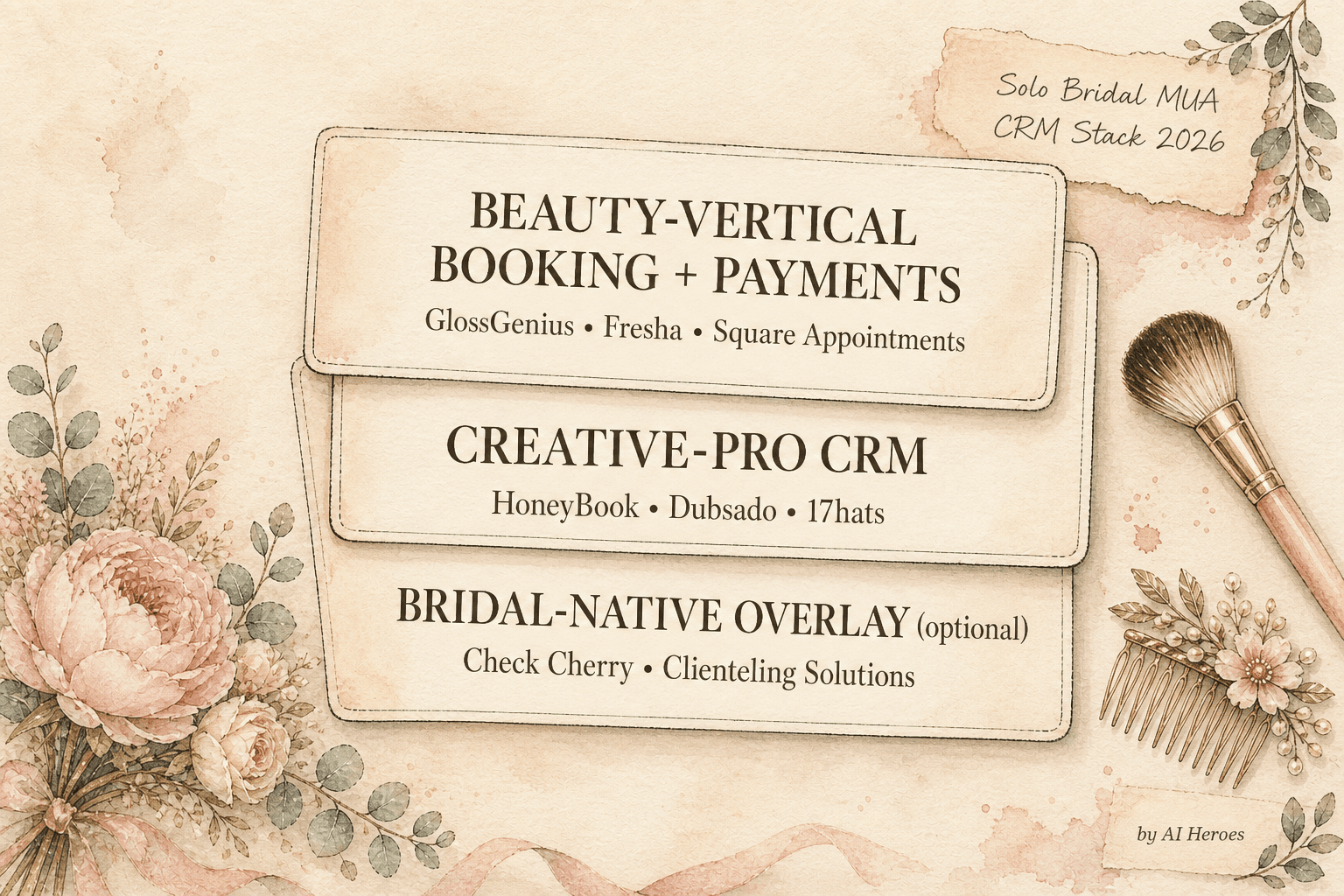
Solo bridal hair and makeup artists don't actually run a CRM. They run a 2-3 tool stack — a beauty-vertical booking + payments layer (GlossGenius, Fresha, Square Appointments, Vagaro, Booksy), a creative-pro CRM layer (HoneyBook, Dubsado, 17hats), and an optional bridal-native overlay (Check Cherry, Clienteling Solutions). Picking one platform and hoping it covers all three is the most-common mistake — and the one HoneyBook's 89% Feb 2025 Starter price hike forced thousands of artists to revisit. GlossGenius's 2026 AI Growth Analyst is now the strongest AI-native feature in the category. Dubsado 3.0 (Nov 2025) shipped without AI. Inside: a seven-question decision framework, a recommended default stack for each of four revenue tiers, and the four most-common stack-design mistakes solo bridal artists make.

What Is Entity Resolution? How It Actually Works, and Why It Matters in 2026
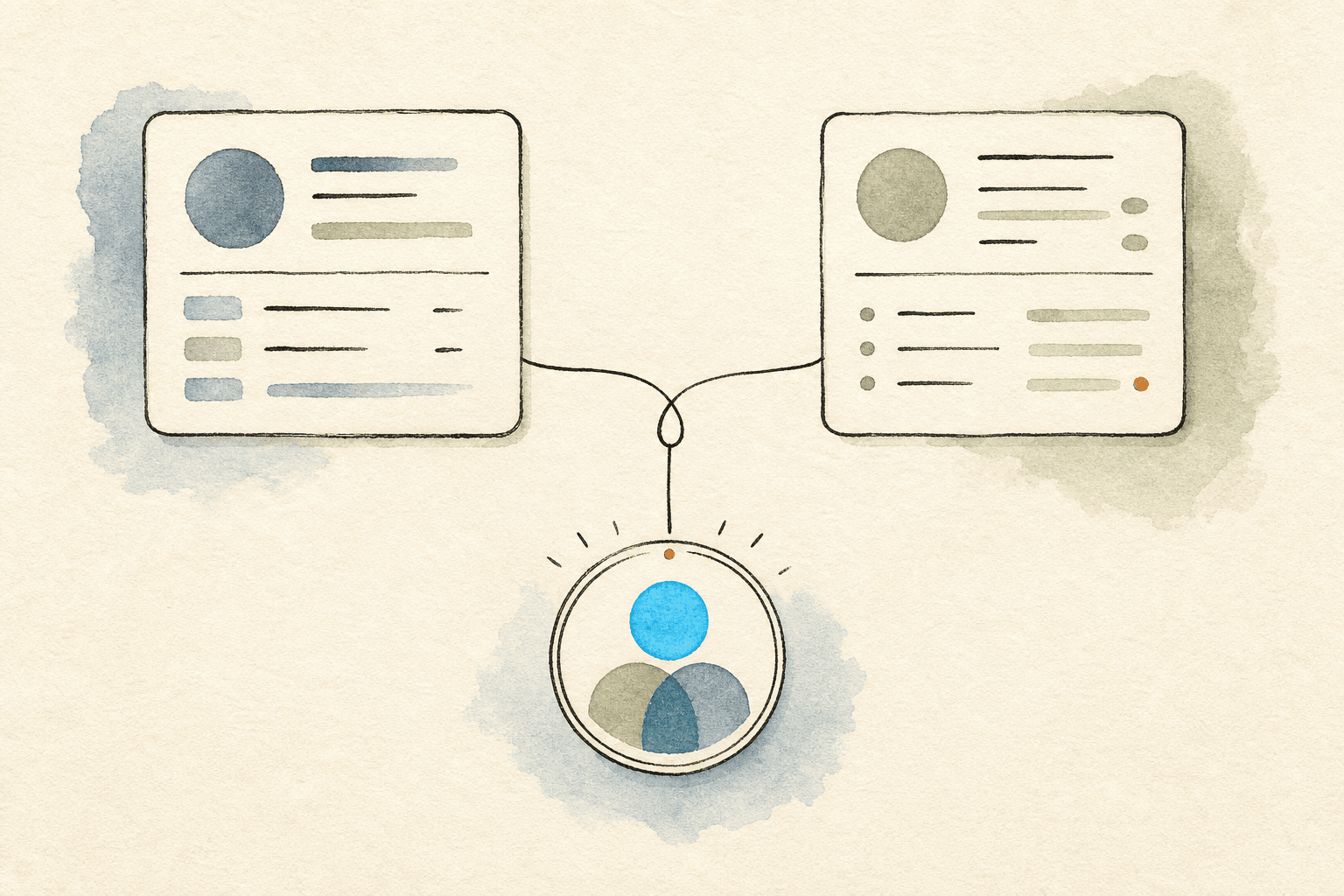
One agent broke in the quietest way possible. The same customer lived in both systems as two different records.
Can You Really Build a Website Through WhatsApp? What's Actually Possible in 2026
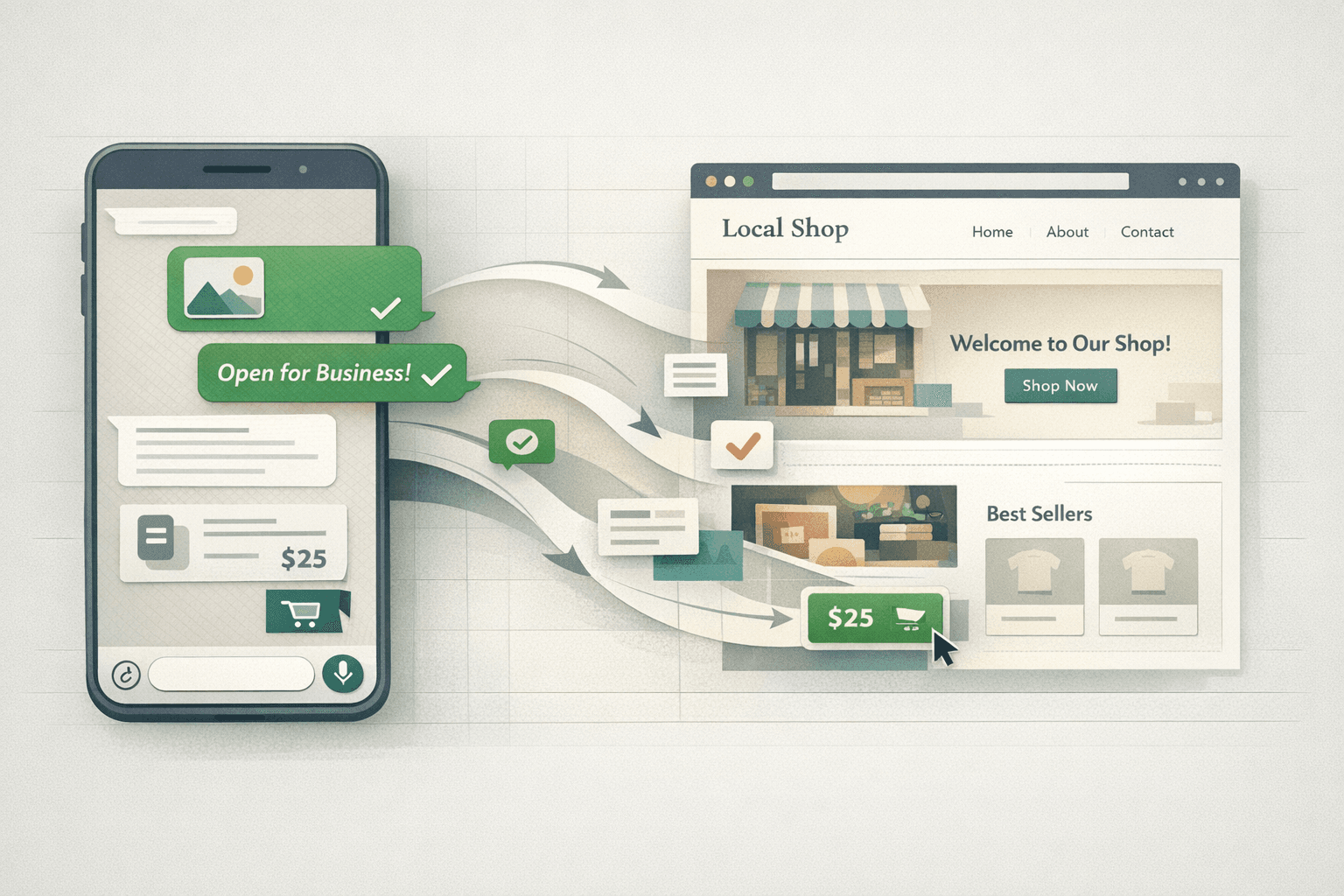
A handful of tools now let you build and edit a fully hosted website by chatting on WhatsApp, no dashboard required. Here's an honest look at what's actually possible, what breaks, and how to protect yourself before you commit.