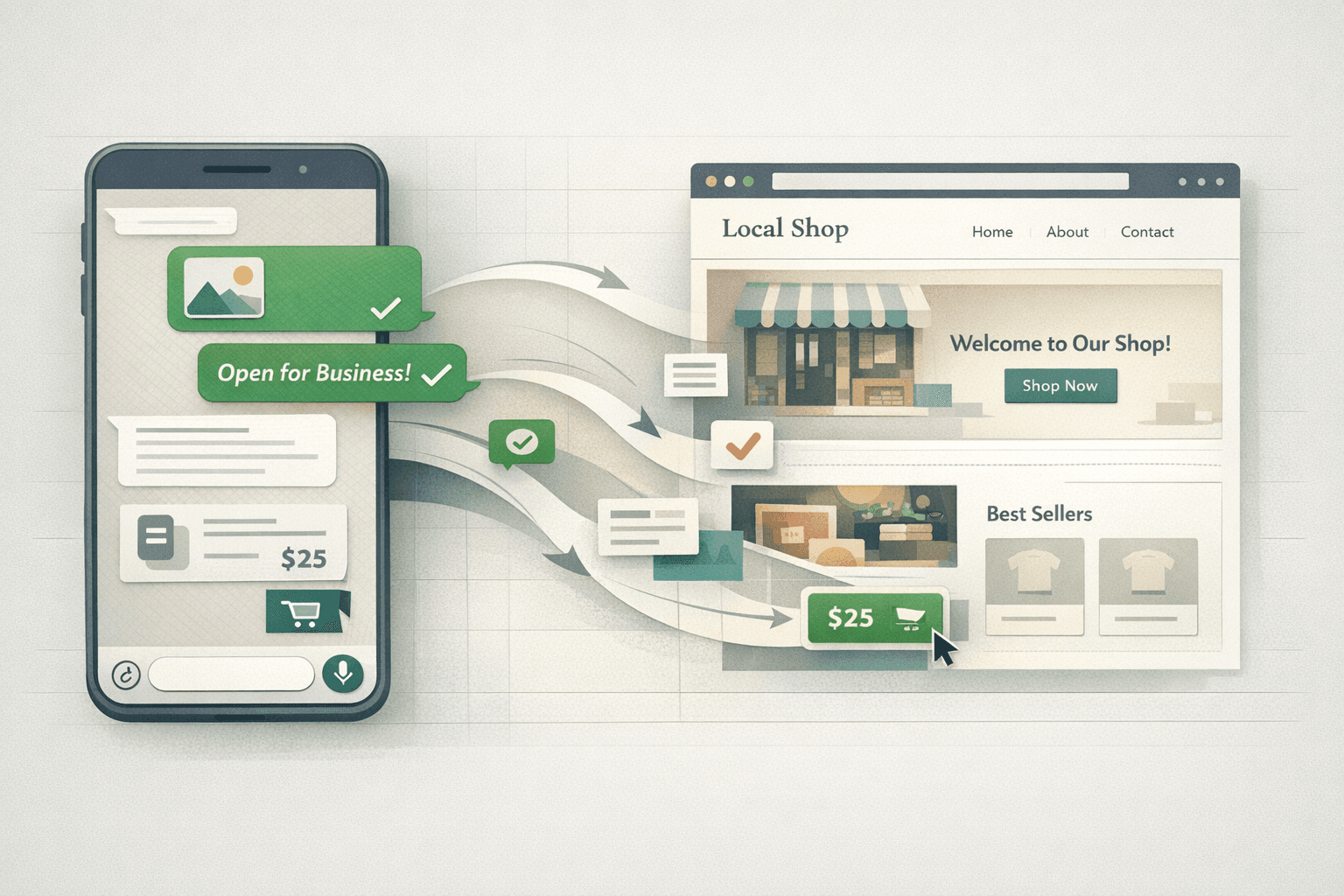
Can You Really Build a Website Through WhatsApp? What's Actually Possible in 2026

Yes, but with real limits. A handful of tools now let you build and edit a live, hosted website entirely by chatting on WhatsApp, no dashboard, no drag-and-drop editor, just messages back and forth with an AI that writes and publishes the code. Most "AI website builders" still drop you into a visual editor after the first draft. The genuinely chat-native, WhatsApp-based tools are a smaller, newer category, and they vary a lot in what you actually own at the end.
Why WhatsApp, specifically?
WhatsApp is where a huge share of the world already runs its business conversations, so building where people already are removes a step rather than adding one. A 2026 report from Caribou and Turn.io, drawing on an Ipsos survey of 7,000 adults across India, Kenya, Nigeria, and Pakistan, found that 94% of mobile-internet users in those markets have WhatsApp installed. The same research estimates that between 80 million and 98 million women across those four countries now use WhatsApp to support their income.
In India specifically, WhatsApp and WhatsApp Business together reach 97% of retail MSMEs, according to PayNearby's 2024 MSME Digital Index, a survey of over 10,000 small merchants. Meta's own numbers back this up at global scale: as of June 2026, the company reports more than one billion daily message threads between people and businesses across WhatsApp, Messenger, and Instagram.
Put simply, for a huge number of small business owners, WhatsApp is not a marketing channel bolted onto their business. It is the operating system of their business. A tool that meets them there, instead of asking them to learn a new one, has a real usability edge.
What does "building a website through WhatsApp" actually mean?
It means you message a phone number or a bot with a description of your business, and an AI model generates a live, hosted website from that conversation, then keeps editing it as you send follow-up messages. No separate login, no visual page builder, no code.
This is a distinct category from the much larger group of "AI website builders" like Wix's ADI, Durable, 10Web, or Hostinger's AI tools. Those genuinely use AI to generate an initial draft from a prompt or questionnaire, often in under a minute. But once the draft exists, editing happens in a conventional dashboard: drag-and-drop blocks, a WordPress-style editor, or a "regenerate this section" button. The chat is the front door, not the whole house.
Chat-native, WhatsApp-based builders keep the conversation as the only interface, before and after launch. You never graduate to a separate editor. If you want the hero image changed or a new services page added, you send another message.
Which tools actually do this on WhatsApp right now?
Coverage of this space moves fast and some tools are regional or narrowly scoped, so treat this as a snapshot rather than an exhaustive index. Below is what is verifiably live and WhatsApp-native (or, in one case, SMS-native) as of mid-2026.
| Tool | Chat channel | Starting price | Notable feature | Best fit |
|---|---|---|---|---|
| ChilledSites | From £9/month | Built on Claude; country-specific landing pages for several markets | Small businesses wanting a fast, low-cost site | |
| VPS.org WhatsApp Builder | From $4.99/month | Tiered plans by number of sites and e-commerce features | Budget-conscious users who might want multiple simple sites | |
| Nansi | Not publicly listed | Accepts voice notes, not just text, for building and edits | Non-technical users who would rather talk than type | |
| Sonara | SMS (not WhatsApp) | $29/month | Real backend database for bookings and sign-ups, not just a static page | US-based service businesses that need working forms |
| Schmitdy | WhatsApp, Slack, or Microsoft Teams | From £150 setup, then £50/month | Chat-built pages up to a full product page with working checkout; site structured to be cited by AI search engines | Businesses that want a professionally designed site and care about AI-search visibility |
| Repaint | Proprietary in-app chat (not WhatsApp) | Flat monthly, no per-edit credits; free to start | Writes real, editable code rather than filling a template | Anyone who has outgrown template builders but still wants a chat workflow |
A few deserve context beyond the table. Sonara works over SMS, not WhatsApp, which matters outside the US, where SMS is expensive and WhatsApp is closer to universal. Repaint, a Y Combinator company, uses its own in-app chat rather than WhatsApp, so it fits the chat-native pattern but not the on-WhatsApp one specifically.
Schmitdy sits at the more done-for-you end of the range. Its chat-based building goes as far as a working checkout page, and it structures the sites it builds so they can be cited when someone asks ChatGPT, Perplexity, or Google's AI Overviews for a recommendation. That second part matters more than it used to, for reasons covered below.
What can you actually build this way, versus what you can't?
Simple, content-led sites (a landing page, a services page, a menu, a booking page) are squarely within reach of every tool listed here. This is the sweet spot: a business with a clear, static offer that mostly needs to look credible and load fast.
Sites with real backend logic, like bookings tied to a calendar, a searchable catalogue, or checkout, are where the tools diverge sharply. Sonara and Schmitdy both explicitly support this: a database for bookings, or a live checkout flow. Simpler builders like the entry tiers of ChilledSites or VPS.org are closer to brochure sites, good for information, not built for transactions out of the box.
Highly custom interactions, like a bespoke calculator or an integration with a niche third-party tool, are hit or miss. Repaint's pitch is that it writes real code rather than filling in a template, which is what lets it attempt this. Template-based chat builders generally cannot.
What is the catch? (Because there is always a catch)
Lock-in is the biggest one. Several of these tools do not let you export your site's code. If a hosted, chat-built site is all you have and the company behind it disappears or pivots, you can lose everything overnight. This is not hypothetical. Hocoos, an AI website builder, announced in 2026 that it was shutting down, giving users a 30-day window (23 March to 23 April 2026) to export their files before the service went offline and its forms were switched off.
A separate, bigger collapse sharpens the question of who is actually doing the work. Builder.ai, backed by Microsoft and valued around $1.5 billion on the promise that AI could assemble software from a chat interface, filed for bankruptcy in 2025. Reporting found the product leaned heavily on human developers rather than the autonomous AI its marketing implied, and Bloomberg reported that the company had inflated its revenues.
Ownership is worth pinning down before you commit, not after. Ask directly: is the domain registered in your name or the platform's? Can you export the site's underlying code, not just a static snapshot? What happens to your bookings and customer data if you cancel? A monthly fee that includes hosting can be entirely reasonable, but it is a lease, not a purchase, unless you have confirmed otherwise.
Visibility has quietly become a second front, beyond traditional SEO. SOCi's 2026 Local Visibility Index found that ChatGPT currently recommends only about 1.2% of local businesses when asked for a suggestion, compared with 35.9% of businesses appearing in Google's local three-pack. Ranking well on Google no longer guarantees a business gets mentioned when someone asks an AI assistant instead.
How does this compare to the older "done-for-you" website model?
Done-for-you services like UENI and Jottful predate the chat-native trend and take a different approach: a human team builds your site, typically over about a week, from a short questionnaire or a call, rather than you chatting it into existence yourself. UENI's pricing starts around $79 setup plus roughly $21 to $25 a month depending on plan. Jottful charges about $99 to start plus a monthly plan from roughly $65, or about $55 a month billed annually, for hosting, support, and edits made by its team.
The trade-off is speed and control versus outside judgment. A done-for-you service puts a human's design sense between your rough idea and the finished site, which can produce a more polished result if your own brief is vague. A chat-native builder puts you directly in the loop for every change, faster for small tweaks but reliant on the AI's design judgment unless a human reviews the output somewhere in the process.
Is a WhatsApp-built website good for SEO or AI search visibility?
It depends entirely on the tool, not the channel. WhatsApp is just the interface. What determines whether a page ranks or gets cited is the code and content structure the AI actually generates, the same as any other website.
Most chat-native builders default to fast, functional output rather than search-optimised structure, because their main promise is speed. The general pattern across this category is that first-draft speed comes first, with structured markup, clear headings, schema, and answer-first copy checked only if you know to ask for them.
Because roughly a third of local businesses show up in Google's map results but under 2% get mentioned by ChatGPT, per the SOCi data above, this gap is worth raising directly before you pick a tool. Does the generated site use clean semantic HTML, does it answer likely customer questions directly in the text, and can both traditional search engines and AI crawlers read it easily.
Frequently asked questions
Do I need to download a special app to build a website through WhatsApp? No. If the tool is genuinely WhatsApp-native, you use WhatsApp itself, the same app already on your phone. You message a business number, describe what you want, and the AI replies with a live link to your site as it builds. Some tools, like Repaint, use their own in-app chat instead of WhatsApp, so check which channel a specific tool actually uses before assuming it works inside WhatsApp.
Can I take payments on a site I built through WhatsApp? Some tools support this and some do not. Sonara includes a real backend database for bookings and sign-ups. Schmitdy's chat-building extends as far as a full product page with a working checkout. Simpler, template-first builders are generally geared toward informational pages rather than transactions, so confirm this explicitly before you build around the assumption that checkout is included.
What happens to my website if the company that built it shuts down? This is one of the biggest risks in this category, and it is not hypothetical. Hocoos, an AI website builder, announced its closure in 2026 and gave users a 30-day window to export their files before the service went offline. Before you commit to any chat-native builder, ask specifically whether you can export your site's code and whether you own the domain outright.
Is a website built through chat as good as one built by a professional designer? It depends on the tool and how much design judgment goes into what it generates by default. Template-based chat builders tend to produce serviceable, generic-looking sites quickly. Tools that write custom code, or that pair AI generation with actual design review, can produce something closer to a professionally designed site. Ask to see real, live examples of sites the tool has produced for other businesses before judging based on marketing screenshots alone.
Will building a site this way help it show up when people ask ChatGPT or other AI tools for recommendations? Only if the tool specifically structures the site for that. Being built through chat has nothing to do with whether the resulting site is easy for AI systems to read and cite. That comes down to the code and content structure, the same as it would with any website. Given that AI search engines currently recommend a small fraction of local businesses compared with how many show up in ordinary search results, it is worth asking a builder directly whether their output is structured for AI crawlers, rather than assuming it.
Is WhatsApp website building only relevant in emerging markets? No, though adoption is currently strongest where WhatsApp is already the default way people communicate and do business, which includes large parts of South Asia, Africa, and Latin America. Tools built for those markets, like ChilledSites, reflect that with country-specific landing pages. But WhatsApp-native building is spreading into other markets too, alongside SMS-based alternatives like Sonara for regions where WhatsApp is not the default.
Frequently Asked Questions

Founder, AI Heroes
I build AI companies and the systems inside them. At AI Heroes, we give businesses the functional capacity to grow without the headcount growth normally demands — sales that follows up, marketing that runs, content that ships, ops that handles itself. We audit where you're leaving growth on the table, build the team that captures it, and hand it over completely.
I've built at scale before. Leading product and GTM at SlideSpeak AI (1M+ monthly users, profitable, bootstrapped). CPO at Disperse — the AI construction platform that went from 3 to 200+ people on $35M raised. I also co-founded LOBOMAR, a luxury fashion label featured in Elle, Cosmopolitan, and the LA Times, with shows at the London Design Museum, Wereldmuseum, and Amsterdam Fashion Week.
Related Articles

7 Ways to Get a Website Built For You in 2026 (Without Touching a Builder)
You don't have to learn a website builder to get a site made. Here's an honest comparison of seven ways to get a website built for you in 2026, with real prices and real limitations.

The Best AI Search Agencies in 2026 (GEO and AEO), Compared
The agencies that get brands cited inside ChatGPT, Gemini, Perplexity, and Google AI Overviews, compared on model, market, and method, with the criteria to pick one. The most useful fact for choosing: around 85 percent of AI citations come from third party domains, not your own site, so an agency whose whole offer is on-site content is mismatched to where citations come from.
AEO vs GEO vs SEO: The Difference, and Which One You Need in 2026
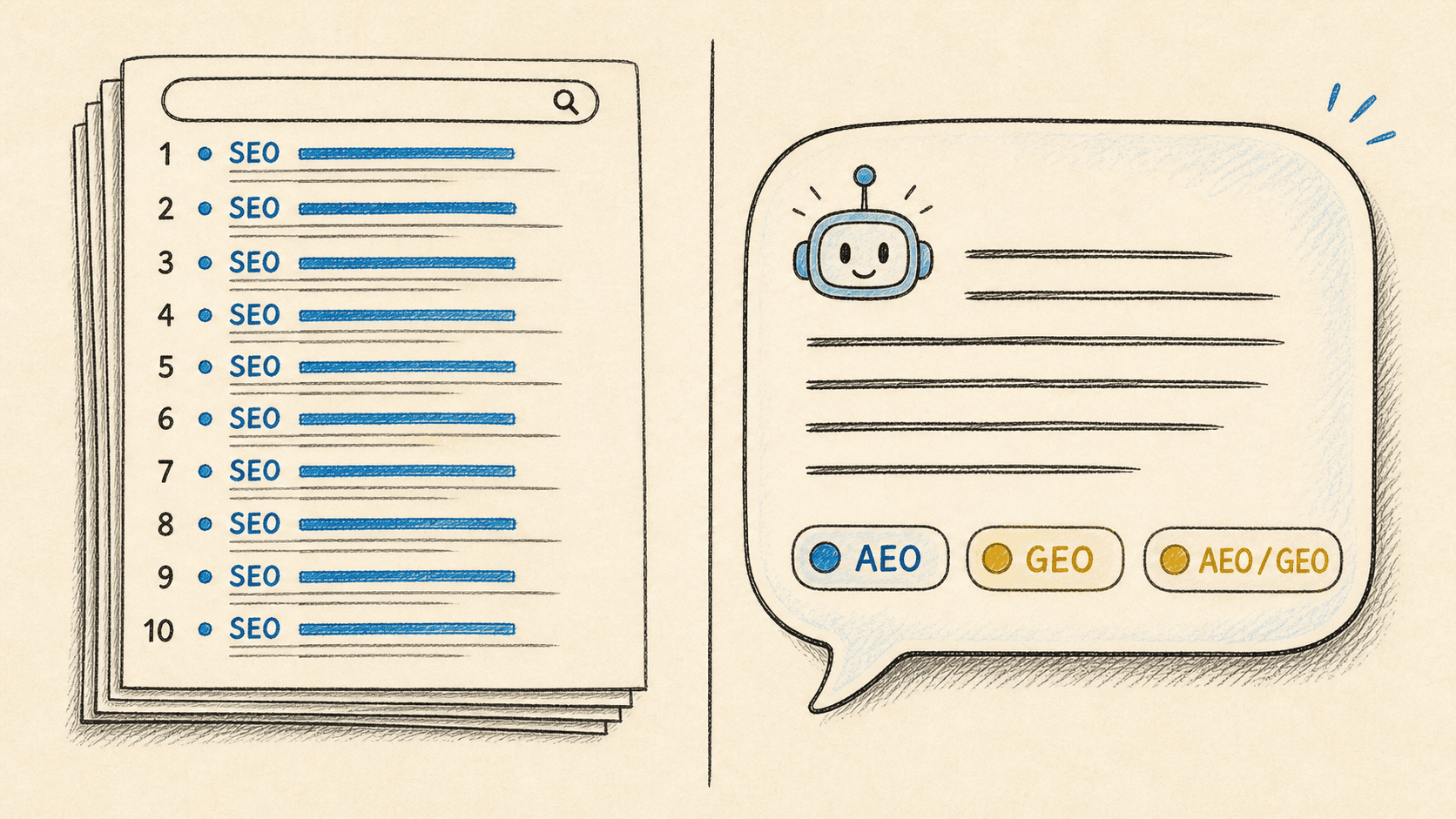
SEO ranks links in classic search. AEO (Answer Engine Optimization) and GEO (Generative Engine Optimization) optimise to be cited inside the AI-generated answer in ChatGPT, Perplexity, Google AI Overviews, Gemini and Copilot. AEO and GEO are near-synonyms for the same goal; SEO is a separate, still-necessary discipline that feeds the retrieval pool. The practical answer in 2026 is that you do all three, but you measure AEO/GEO on citation share, not blue-link position, and the winning levers (off-site footprint, entity authority, content shape, freshness) sit mostly off your own site.
See what AI could do for your business
Book a free call — no commitment. You'll leave with a clear picture of exactly where AI can move the needle.