Inside Anthropic's Finance Team: How They Actually Wire Claude Into Board Decks and Month-End Close (2026)

TL;DR
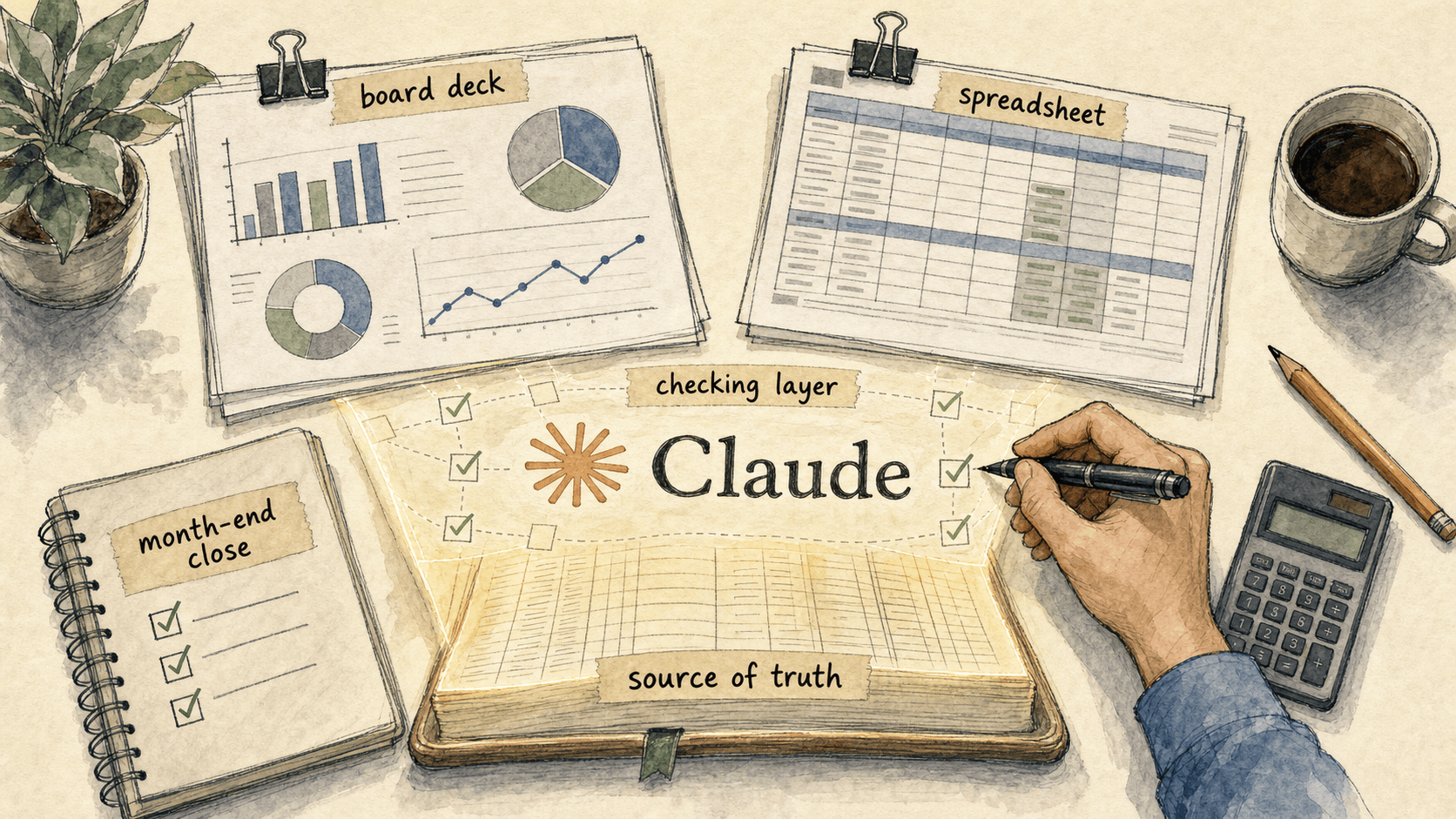
- Anthropic's own corporate finance team uses Claude as a checking layer underneath the numbers — it reconciles every figure in a board deck to a single source of truth and reads the narrative the way a skeptical board member would, before a human finance reviewer signs off.
- The interesting signal is the gap between the marketing and the practice: Anthropic's sold finance surface (Claude for Financial Services) is data-partnership-heavy and skews institutional — investment analysis, underwriting — while its own finance team runs lightweight corporate FP&A on a minimal stack of Claude Cowork projects, Claude for Excel and a Google Workspace connector.
- The repeatable operating model is the citable thing, not the product: pick the workflows that recur (board cycles, the month-end close), use Claude to reconcile-and-flag rather than to write the story, and keep a human reviewer on the approval step every time.
Most "AI for finance" coverage describes a product. The more useful question is what a finance team that lives next to the model actually does with it on a Tuesday — which numbers it lets Claude touch, which it doesn't, and who signs the thing at the end.
Anthropic's corporate finance and strategy team published exactly that account in May 2026: a first-person walkthrough by Alice Fong, who joined the team in March 2025, of how she wires Claude into the board cycle and the monthly close. It is worth reading not as a capability demo but as an operating model — and one that quietly contradicts how Anthropic markets finance to everyone else.
What does a finance team actually use Claude for?
A corporate finance team uses Claude to keep one coherent financial story for the CFO and board while the numbers underneath it move every week. Anthropic's team frames the job plainly: prepare the narrative the CFO and board need to see — how revenue performed, what is happening to margins, how cash is being deployed, and what it means for the rest of the year. The hard part is that the narrative has to stay coherent while the business changes underneath it: product launches, model launches, pricing changes and shifts in the sales motion, often all in the same week.
That is the work AI is pointed at — not "write the deck," but "keep the deck honest as the inputs churn." Anthropic's team reports the approach frees up 10 to 20 hours a week for higher-impact work. Treat that figure with care: it is self-reported by the practitioner's own employer's blog, with no baseline or methodology, and independent coverage of the same expansion does not carry the number. The defensible takeaway is the workflow, not the hours.
The work breaks into four recurring jobs, each with a different cadence and a different Claude surface:
| Workflow | Cadence | Claude surface | What Claude does | Who signs off |
|---|---|---|---|---|
| Board deck | Quarterly | Claude Cowork project | Validates every number and claim reconciles to a single source of truth; reads the narrative like a board member and flags where it contradicts itself or assumes missing context | Finance reviewer / CFO |
| Monthly review | Monthly | Claude Cowork project | Writes the first-pass commentary in the team's existing voice: "revenue was A versus B, off by C%, driven by D" | Finance reviewer |
| Financial model | As needed | Claude for Excel | Traces references across tabs and diagnoses model issues — e.g. tracing a balance sheet that won't balance through multiple tabs to find the root cause | Analyst / modeller |
| Context capture | Continuous | Cowork projects + connectors | Pulls the conclusion and reasoning out of docs, email and Slack via Google Workspace and Slack connectors, and commits the relevant decisions to project memory | N/A (retrieval) |
Two design choices make this an operating model rather than ad-hoc prompting. First, separate projects per audience — one for the monthly review, one for the board deck — so context and voice don't bleed. Second, project memory: relevant decisions and their reasoning get committed once, so the next board cycle starts richer than the last.
How does a finance team use Claude for board decks?
For a board deck, Claude runs as a reconciliation-and-review pass before a human approves it — not as the author of the story. Anthropic's team uses a Claude Cowork project to do two specific things on the quarterly deck. It validates that every number and claim reconciles to a single source of truth. And it reads the narrative the way a board member would, flagging where the story contradicts itself or assumes context the reader doesn't have.
That second job is the underrated one. Anyone can check arithmetic; the harder failure in board reporting is a narrative that is internally inconsistent — a margin story on slide 7 that quietly disagrees with the cash story on slide 12. Pointing an AI reader at the whole deck to surface those contradictions, before the CFO sees it, is a genuinely different use from "summarise this document."
This is what we'd call the financial narrative integrity layer: using an AI assistant to verify that every figure reconciles to one source of truth and that the written narrative doesn't contradict itself, before a human finance reviewer signs off. The integrity layer sits underneath the numbers as a checker; it is deliberately not the layer that writes the story on top of them. That distinction is the whole safety argument, and we'll come back to it.
What does Claude actually do in the month-end close?
In the month-end close, Claude drafts the first pass of variance commentary and reconciliation work, and a human finance reviewer validates and approves it. On Anthropic's own team, the monthly review uses a Cowork project to write the first-pass commentary in the voice the team already uses — "revenue was A versus B, off by C%, driven by D" — which the team then edits rather than composes from scratch.
The pattern generalises beyond Anthropic. Independent reporting from CFO.com in May 2026 describes Claude's rapid expansion across corporate finance specifically into the close: month-end close and forecasting, journal entries, variance analysis, annual planning, reconciliations, valuation reviews and earnings analysis. And the accounting-adjacent version Anthropic describes for its own other teams is the same shape — running GL-to-subledger and bank reconciliations, with breaks classified and reviewer commentary drafted as a first pass.
Across the function, Anthropic reports the same template repeating: corporate development screens three to four acquisition targets a day from notes and public data, rolled into memos; tax and treasury answers transfer-pricing, R&D-credit and nexus questions with primary-source citations; and finance analysts build interactive forecasting and cohort dashboards from a prompt, with no SQL or engineering involvement. The per-day target figures are single-source productivity claims, so read them as illustrative rather than as benchmarks — but the structure (Claude drafts, a specialist reviews) is consistent everywhere it appears.
Is it safe to let AI touch financial numbers?
It is safer in the reconcile-and-flag mode than in the write-the-narrative mode, and the operating model above is deliberately built around that distinction. The standard objection to AI in financial reporting is hallucination: independent governance literature is blunt that AI errors in finance are harder to spot because the output often looks completely plausible, and that anything touching internal controls over financial reporting needs audit controls. The recommended safe structure, repeated across independent sources, is "AI drafts → finance review → approval → publish."
Read it back against the workflow and the counter-argument turns into reinforcement. Anthropic's team uses Claude to validate that numbers reconcile to a single source of truth, to draft a first pass, and to classify breaks with reviewer commentary drafted as a starting point — with analysts and reviewers retaining sign-off throughout. That is precisely the AI-drafts-then-human-reviews structure the risk literature prescribes. The financial narrative integrity layer is the risk-mitigated use of AI in finance: it points the model at checking the numbers, not at inventing the story.
The practical guardrail is the same one good controls already enforce: an AI first pass is an input to a reviewed deliverable, never the deliverable. Where the model is configured to reconcile against a defined source of truth and flag breaks, it is reinforcing the control; where it is asked to author conclusions a human then rubber-stamps, the control is theatre. The difference is entirely in which job you give it.
Claude for Financial Services vs how Anthropic's own finance team uses Claude
These are two different things, and conflating them is the most common mistake in this conversation. Claude for Financial Services is Anthropic's marketed, institutional-grade finance surface — built around market and enterprise data integrations and aimed at investment analysis and underwriting. The way Anthropic's own finance team works is lightweight corporate FP&A on a minimal stack. The product is sold to Wall Street; the internal operating model is closer to what a normal company's finance function actually needs.
| Marketed: Claude for Financial Services | Practised: Anthropic's own finance team | |
|---|---|---|
| Primary user | Institutional / markets — investment analysis, underwriting, equity research | Corporate FP&A — board narrative, month-end close, modelling |
| Data posture | Heavy external integrations (market + enterprise data providers) via MCP connectors | Minimal: a Google Workspace / Slack connector to the team's own docs |
| Headline proof points | AIG reported compressing its business-review timeline by more than 5x and improving data accuracy from 75% to over 90% in an early rollout | Reconcile-to-one-source-of-truth, board-member-style review, first-pass commentary |
| Stack | Purpose-built financial-services tooling and data partnerships | Claude Cowork projects + Claude for Excel + Google Suite Connector |
| What it's optimised for | Analysing other companies' financials at scale | Keeping one company's own narrative coherent |
The institutional numbers are real but they belong to institutional work. AIG's more-than-5x and 75%-to-90% figures are about underwriting review, not the month-end close — don't transplant them onto a corporate-FP&A workflow. The independent read is the same: an analyst quoted by CFO.com argued the May financial-services release targets institutional workflows more than general corporate finance — "without the pantry, you're making a lot of the same dishes Claude could already make." Both things are true at once, and the gap between them is the point. A finance team copying Anthropic should copy the operating model, not the data-partnership shopping list.
Does Claude actually outperform other AI on finance work?
Claude leads general-purpose assistants on financial-modelling reasoning, though a purpose-built tool can edge it out. On Excel work, an Excel agent built by FundamentalLabs reported that Claude Opus 4 passed 5 of 7 levels of the Financial Modeling World Cup and scored 83% accuracy on complex Excel tasks. Among general assistants, a 2026 Wall Street Prep comparison scored Claude at 5.5 out of 10 on financial-modelling tasks, well ahead of Microsoft Copilot (4.4) and ChatGPT (2.5) — though a specialised modelling tool, Shortcut, led at 5.9.
The honest reading: for a finance team picking a general AI partner to live across board decks, commentary and model debugging, Claude is the strongest of the broad assistants, which is the relevant comparison. A single purpose-built modelling agent outscoring it on one benchmark doesn't undercut that — it just means the best tool for a narrow, heavy-modelling task may be a specialist, which is a fair nuance rather than a contradiction. The corporate-FP&A operating model doesn't depend on Claude being best at everything; it depends on one capable assistant being good enough across the recurring jobs to hold the narrative together.
How would a normal finance team build this?
Start with one recurring workflow, run it reconcile-and-flag first, and let the project memory get richer each cycle. Anthropic's own advice is to start simple — ask Claude to read a document and summarise it — then keep pushing the boundaries, focusing on workflows that recur, like board cycles and monthly reviews, where consistency compounds and project memory gets richer every pass. The stack is deliberately small: Claude Cowork projects, Claude for Excel and a Google Suite Connector, with no elaborate tooling.
If you're standing this up deliberately rather than by accident, the cadence that works is short. Spend a 2-week build sprint wiring one workflow — say, the monthly variance commentary — into a single Cowork project: connect the source documents, define the one source of truth Claude reconciles against, and give it the team's voice. Then run a 2-week test-and-iterate cycle on a live close, where the reviewer keeps full sign-off and you tighten the prompts and project memory against what actually broke. Repeat the pair for the board deck. Two short cycles beat a long pilot, because the value compounds in the project memory, which only gets richer by being used on real cycles — and the only way to find the contradictions Claude misses is to run it against a real deck a human still owns.
Authoritative sources & related reading
- Anthropic / Claude — How Anthropic's finance team uses Claude to shape the narrative behind the numbers (primary source, May 2026)
- Anthropic / Claude — Claude for Financial Services (institutional finance surface, partnerships and benchmarks)
- Anthropic / Claude — Claude Cowork product page (the desktop surface the workflows run on)
- CFO.com — Inside Anthropic: Claude's rapid expansion across corporate finance (independent corroboration, May 2026)
- FundamentalLabs — Financial Modeling World Cup results for the Claude-powered Excel agent (5 of 7 levels, 83% accuracy on complex Excel tasks)
- AI Heroes: Claude for small business: a 2026 implementation guide — picking the right Claude surface for the actual job.
- AI Heroes: AI agent workflow automation: from chat to repeatable workflow — turning a recurring finance task into a repeatable workflow.
- AI Heroes: Claude Microsoft 365 connectors on every plan — connecting Claude to the documents your finance team already lives in.
- AI Heroes: Harness debt: your AI agent scaffolding is quietly fighting the model — why a minimal stack often beats an elaborate one.
The agent built for this

Gina
Turns your Round, Xero, and QuickBooks data into board packs, cash briefs, and runway calls — with every number traced back to source.
Meet GinaFrequently Asked Questions

Founder, AI Heroes
I build AI companies and the systems inside them. At AI Heroes, we give businesses the functional capacity to grow without the headcount growth normally demands — sales that follows up, marketing that runs, content that ships, ops that handles itself. We audit where you're leaving growth on the table, build the team that captures it, and hand it over completely.
I've built at scale before. Leading product and GTM at SlideSpeak AI (1M+ monthly users, profitable, bootstrapped). CPO at Disperse — the AI construction platform that went from 3 to 200+ people on $35M raised. I also co-founded LOBOMAR, a luxury fashion label featured in Elle, Cosmopolitan, and the LA Times, with shows at the London Design Museum, Wereldmuseum, and Amsterdam Fashion Week.
Related Articles

What Is Claude Tag? How Anthropic's Slack AI Teammate Works (2026)
Anthropic launched Claude Tag on 23 June 2026: a way to work with Claude inside Slack as a shared, always-on teammate. Tag @Claude and it plans a task, uses the tools you grant it, and replies in-thread. It is multiplayer, learns from the channel, can take initiative, and works asynchronously over hours or days. It runs on Opus 4.8, is in beta for Enterprise and Team, and replaces the old Claude in Slack app.

How to Get Started with Claude Cowork: A Decision Framework for Knowledge Workers (2026)
Claude Cowork is where you delegate a whole task instead of asking a question — point it at your files and apps, describe the outcome, get finished work. The hard part isn't the prompt, it's knowing which tasks to hand it. Here's a 5-signal fit test, the three shapes a Cowork task can take, and how to get your first deliverable in ten minutes.

How Claude Managed Agents Actually Work: Dreaming, Outcomes, Multiagent Orchestration, and Webhooks (2026)
Anthropic gave Claude Managed Agents four new mechanics at Code w/ Claude: Dreaming, Outcomes, Multiagent Orchestration, and Webhooks. The one that changes how you build is Outcomes — a separate grader that loops the agent until a rubric is met. Here is how each one works, and when to reach for it.