What Is Claude Tag? How Anthropic's Slack AI Teammate Works (2026)

TL;DR
- On 23 June 2026 Anthropic launched Claude Tag, a way to work with Claude inside Slack as a shared, always-on teammate.
- Anyone in a channel types @Claude to delegate a task. Claude breaks it into stages, uses the tools you grant it, and replies in-thread with the result.
- Four things make it more than a chatbot: it is multiplayer (one Claude per channel, shared by the whole team), it learns from the channel over time, it takes initiative in optional ambient mode, and it works asynchronously over hours or days.
- It runs on Opus 4.8, is in beta for Claude Enterprise and Team customers, and replaces the old Claude in Slack app (admins opt in to migrate within 30 days).
Last updated: 23 June 2026
What is Claude Tag?
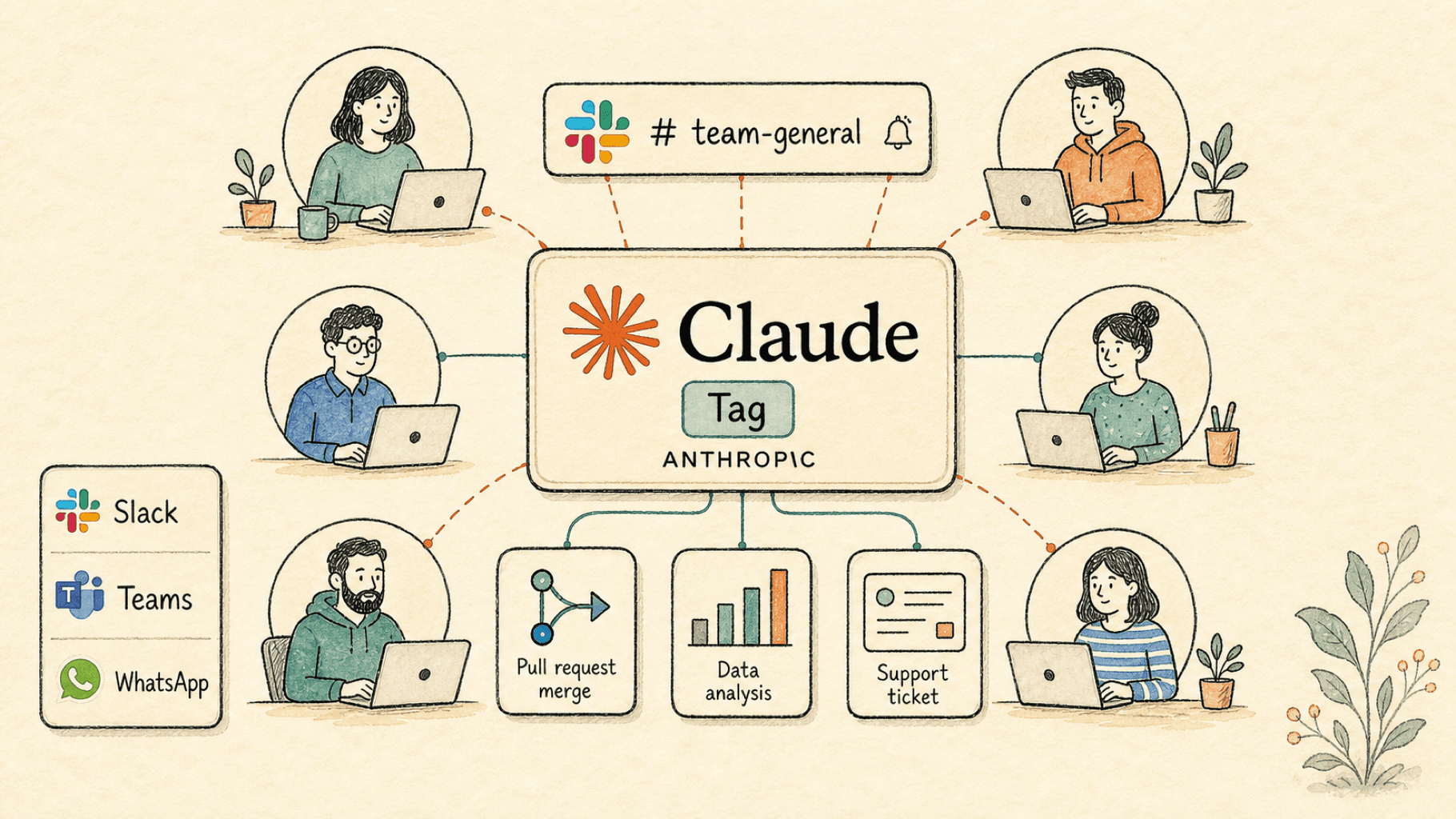
Claude Tag is a way to work with Claude directly inside Slack, where the model joins a workspace as a team member rather than a chat window you open on the side.
You grant it access to specific channels and connect it to the tools, data, and codebases you choose. After that, anyone in a channel can type @Claude with a request and delegate the work. Claude plans the task, works through it with the tools it has, and posts back in the thread with what it produced.
Anthropic frames it as an evolution of Claude Code: the same agentic engine, made more proactive and built to work with a whole team instead of one person. The company says tagging @Claude is now one of the main ways it gets work done internally, and that 65% of its product team's code is created by its internal version of the tool (Anthropic, 23 June 2026).
How does Claude Tag work?
You tag @Claude with a request in plain language. The agent decomposes the task into stages, works through them in turn using its connected tools, and replies in a Slack thread with the output. In practice that means writing or merging pull requests, running data analysis, working through support tickets, or helping find the root cause of a bug.
Four properties separate it from a normal chatbot:
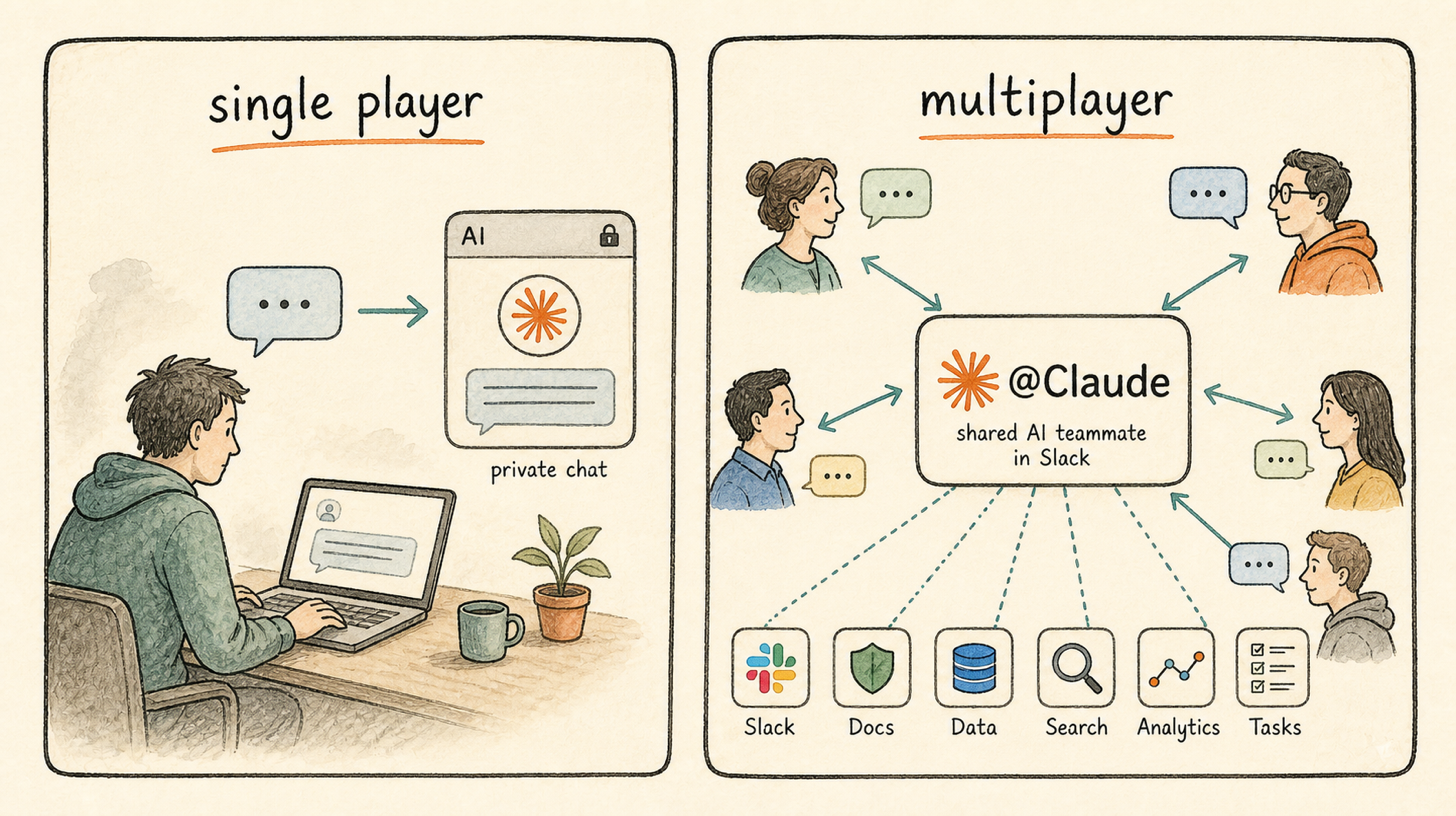
- It is multiplayer. There is one Claude per channel that interacts with everyone. Anyone can see what it is working on and pick up where a colleague left off, so it behaves more like a shared teammate than a private session.
- It learns over time. As Claude follows a channel it builds context about the work, so people do not re-explain things from scratch. With permission it can learn from other channels and data sources too. It does not report from private channels.
- It takes initiative. Turn on "ambient" behavior and Claude proactively flags relevant information from the channels and tools it can see, and follows up on threads or tasks that have gone quiet without being resolved.
- It works asynchronously. Set a task and carry on with your own work while it runs. It can also schedule tasks for itself and pursue a project autonomously over hours or days.
You can also DM Claude directly. It replies privately using the personal tools and connectors you have set up, separate from the shared channel identity.
How is Claude Tag different from the old Claude in Slack app?
This is the practical question for anyone who already had Claude in Slack. The short version: the previous app was a connector you queried; Claude Tag is a standing teammate that persists, learns, and acts.
| Claude in Slack (old app) | Claude Tag (2026) | |
|---|---|---|
| Model of interaction | Request and response, per query | Persistent teammate in the channel |
| Memory | Per-session, no channel context | Builds context from the channel over time |
| Who it works with | The individual asking | Everyone in the channel (multiplayer) |
| Initiative | Reactive only | Optional ambient mode, proactive follow-ups |
| Duration of work | Single turn | Asynchronous, can run over hours or days |
| Admin controls | Basic app permissions | Scoped identities, per-channel spend caps, full audit log |
| Underlying model | Prior Claude models | Opus 4.8 |
Claude Tag replaces the existing Claude in Slack app. Anthropic says administrators can opt in to migrate within 30 days, and is issuing an introductory launch credit to eligible Enterprise and Team organizations so a whole company can trial it (Anthropic, 23 June 2026). Reporting around the launch points to the legacy app switching over to the Claude Tag experience in early August 2026 (VentureBeat), so existing users should plan the migration rather than wait for it to happen to them.
Who can use Claude Tag, and what does it cost?
Claude Tag is in beta from 23 June 2026 for Claude Enterprise and Team customers. Anthropic has said it intends to expand availability to more places teams work over time.
Cost is metered rather than bundled per seat. Administrators set token spend limits both for the organization and for individual channels, and the introductory launch credit lets teams trial it before committing real budget. The practical implication: spend scales with how much work you delegate, so the channels where Claude does the most expensive work are the ones to watch.
Is Claude Tag safe to give access to company data?
Access is designed to be tightly scoped, which matters because a multiplayer agent that learns from channels is also a new surface for data exposure if it is set up carelessly.
System administrators define which tools and information the model can reach, in which channels. Anthropic describes this as creating separate Claude identities for different uses, with memories scoped to their channels. A Claude configured for sales work will not pass memories to one configured for engineering, and engineers do not inherit access to sales data or tools through it. Claude does not report from private channels, and administrators can view a log of everything @Claude has done along with who requested each task.
That audit trail is the control that makes the rest defensible. If you cannot answer "who asked Claude to do this, and what did it touch," you cannot govern an autonomous teammate.
How do you roll out Claude Tag without creating a mess?
Anthropic's setup is four steps: pair Claude Tag with your Slack workspace, give it access to tools, set a monthly spend limit, then test it in a private channel before going wider. That is the mechanical path. The harder part is governance. Here is the framework we use with teams adopting agents in shared workspaces.
- Scope by identity, not by convenience. Decide up front what each channel's Claude is for, and grant only the tools that job needs. A general-purpose Claude with access to everything is the configuration you will regret.
- Start in one private channel. Prove value on a real, bounded workflow before you switch ambient mode on across the company. Ambient initiative is powerful and noisy, so earn the trust first.
- Set spend caps before you scale, not after. Put organization and per-channel limits in place on day one. Token spend tracks delegation, and delegation is the whole point, so the bill grows with success.
- Assign an owner per channel. Someone has to read the audit log, tune permissions, and decide what Claude should and should not pick up. An unowned agent drifts.
- Treat memory as a data-governance question. What Claude learns from a channel becomes context it acts on. Be deliberate about which channels feed which identity.
Teams that treat the rollout as a permissions and ownership exercise get value fast. Teams that drop a powerful agent into every channel and hope tend to spend the first month walking it back.
What does Claude Tag signal about where work is going?
The bigger shift is from single-player AI to multiplayer AI. For two years the dominant pattern was one person, one chat window, one task. Claude Tag, and the wider move toward proactive agents inside Slack from across the industry, points at something different: a shared agent that sits in the room, holds context, and acts without being asked each time.
That changes the unit of work. Anthropic says its own teams now spend much more time delegating to many Claudes in parallel rather than doing the work directly. If that pattern holds, the skill that matters is less "how do I prompt" and more "what do I delegate, to which agent, with what access, and how do I check it." That is an operating-model question, and it is the one most organizations are not ready for yet.
Authoritative sources
- Anthropic, "Introducing Claude Tag," 23 June 2026
- VentureBeat, "Anthropic launches Claude Tag, replacing its Slack app with a persistent AI teammate," 23 June 2026
- TechCrunch, "Anthropic's Claude Tag is learning your company, one Slack message at a time," 23 June 2026
Related reading
Frequently Asked Questions

Founder, AI Heroes
I build AI companies and the systems inside them. At AI Heroes, we give businesses the functional capacity to grow without the headcount growth normally demands — sales that follows up, marketing that runs, content that ships, ops that handles itself. We audit where you're leaving growth on the table, build the team that captures it, and hand it over completely.
I've built at scale before. Leading product and GTM at SlideSpeak AI (1M+ monthly users, profitable, bootstrapped). CPO at Disperse — the AI construction platform that went from 3 to 200+ people on $35M raised. I also co-founded LOBOMAR, a luxury fashion label featured in Elle, Cosmopolitan, and the LA Times, with shows at the London Design Museum, Wereldmuseum, and Amsterdam Fashion Week.
Related Articles
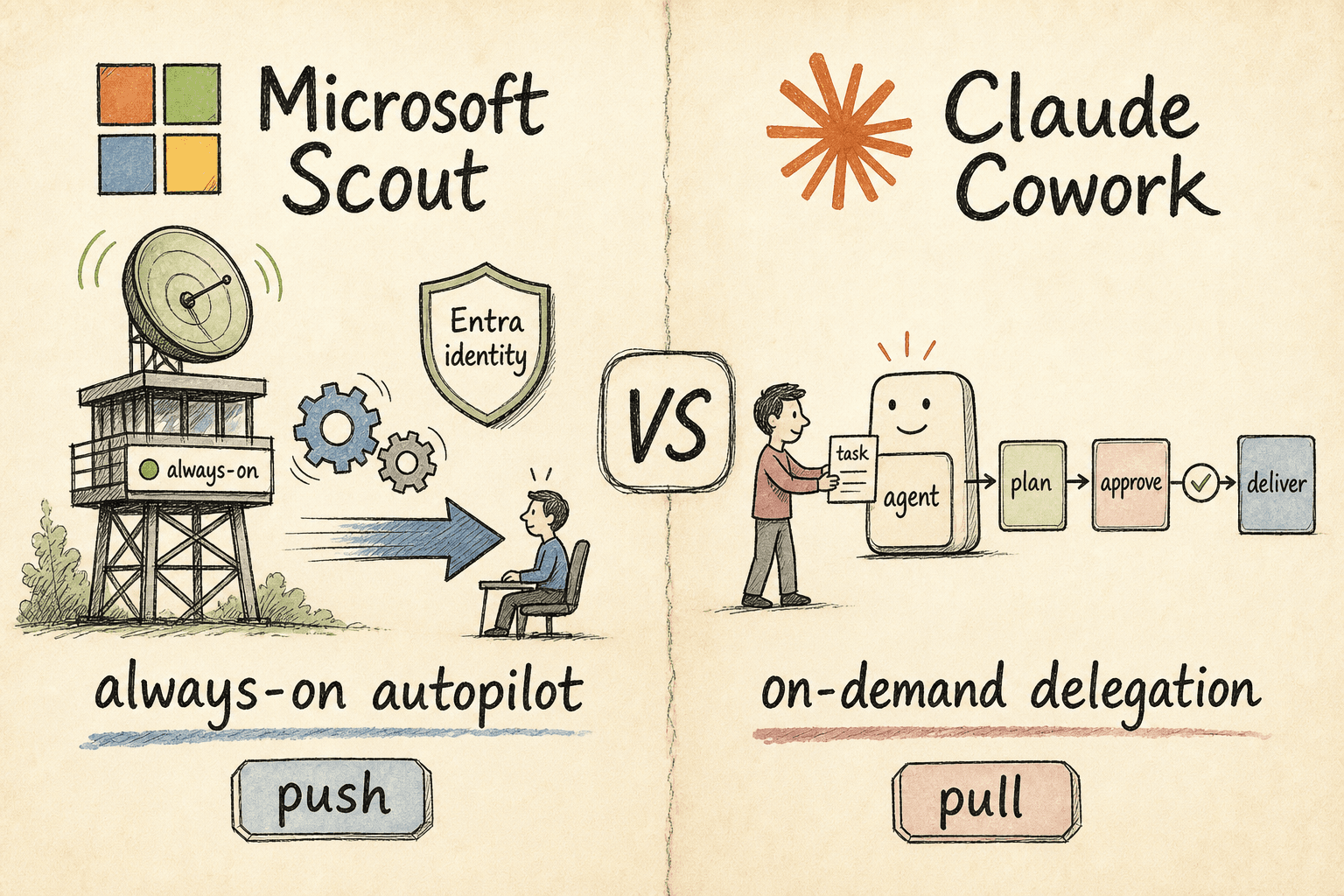
Microsoft Scout vs Claude Cowork: Autopilot or Delegation?
Two of 2026's biggest agent launches make opposite bets. Microsoft Scout is a desktop autopilot that runs in the background and acts on your behalf; Claude Cowork waits for you to hand it a task, then delivers. One is push, the other pull — here's which fits your team.

How to Get Started with Claude Cowork: A Decision Framework for Knowledge Workers (2026)
Claude Cowork is where you delegate a whole task instead of asking a question — point it at your files and apps, describe the outcome, get finished work. The hard part isn't the prompt, it's knowing which tasks to hand it. Here's a 5-signal fit test, the three shapes a Cowork task can take, and how to get your first deliverable in ten minutes.
How Claude Managed Agents Actually Work: Dreaming, Outcomes, Multiagent Orchestration, and Webhooks (2026)
Anthropic gave Claude Managed Agents four new mechanics at Code w/ Claude: Dreaming, Outcomes, Multiagent Orchestration, and Webhooks. The one that changes how you build is Outcomes — a separate grader that loops the agent until a rubric is met. Here is how each one works, and when to reach for it.