
The House Keys Problem: What OpenClaw and Claude Code Are Really Fighting About

A comparison of two competing visions of what AI should be allowed to do — and where each one quietly wins.
There is a story that Peter Steinberger, the creator of OpenClaw, tells about the moment the project clicked for him. He was sitting at his Mac, watching an early version of his agent autonomously scan his inbox, draft a reply, check his calendar for conflicts, book a restaurant, and then ping him on Telegram with a summary — all while he was asleep. The agent hadn't asked permission for any of it. It had simply done the work, the way a very competent and slightly terrifying assistant would if you handed them your house keys and said, "I'll be back Tuesday."
That image — the house keys — is still the most honest way to understand what separates OpenClaw from Claude Code. But in the months since that story started circulating, something interesting has happened: Claude Code has quietly started asking for a small keyring of its own.
Anthropic added an internal scheduler, /loop, that lets Claude Code set up background cron jobs inside a session. It can now wake itself up at 9am, check on your build, rerun a test suite or review last night's commits, and drop a report into your repo — no human prompt required.
On paper, this makes OpenClaw and Claude Code look more similar than ever. In practice, it makes their differences sharper.
They are still not really competitors. They are two very different answers to two very different questions. And getting that wrong will still cost you time, money, and a lot of confused debugging at 11pm.
The Two Questions Nobody Asks
The standard comparison article will tell you that OpenClaw has become the default open-source personal AI stack, that Claude Code is built by Anthropic and lives in your editor and terminal, and that one is "self-hosted" while the other is "hosted." All of that is technically true and almost entirely beside the point.
The real question is simpler: What part of your world is the agent supposed to control?
Claude Code was built to answer one question: How do we get a model to work inside a codebase the way a senior engineer would? It needs to read files, run tests, make changes, and understand how a pull request from Tuesday broke something in a module that was last touched in 2021 — and now, with cron-like tools, it can also run those analyses on a schedule without being asked.
OpenClaw was built to answer a completely different question: How do we get a model to work inside a life the way a chief of staff would? It needs to watch your email, handle your Slack, ping your WhatsApp, book your travel, monitor your servers, and post your tweets — all while you're in a meeting or asleep — and it needs to do that in channels and systems you control, on infrastructure you own.
One agent gets access to your repository, plus a growing set of tools and timers inside that context. The other gets access to everything else — shells, browsers, calendars, inboxes, webhooks, voice notes, Discord, Telegram, Slack, cron jobs, and whatever new channel you decide to wire in tomorrow.
That surface-area decision — the size and shape of the world each agent is allowed to touch — is the architectural choice that every other difference still flows from.
The Brain That Never Sleeps
OpenClaw's architecture, when you diagram it out, looks like the control room of a small airline. There is an Input Layer — messages arriving from WhatsApp, Telegram, Discord, Slack, your terminal, webhooks, or a scheduled cron lane. There is a Gateway that normalizes all of those inputs, routes them by session, and enforces order so that one noisy integration doesn't drown everything else.
Below that sits the Lane Queue, which remains the single most important piece of engineering in the whole system, and the one thing that separates OpenClaw from every "just vibe code an agent" weekend project.
The queue is lane-aware: there is a global main lane, and inside it, strict-serial session lanes for each user or conversation. Cron jobs run in their own lane, sub-agents in another, and — in newer builds — hooks like Gmail push notifications are being split into their own lanes so a storm of webhooks can't starve your direct messages. In plain English: if you have an agent monitoring your email, another agent watching your CI/CD pipeline, and a webhook storm coming from a bulk Gmail operation, they don't step on each other, don't compete for shell access, and don't corrupt your session files. Each run is isolated, queued, serialized, with every step written to a JSONL transcript so you can inspect exactly what happened and why.
Below the queue sits the Agent Runner — the actual brain. It resolves which model to use (Claude, GPT-4-class models, Gemini, or local models with your own keys), builds a prompt with tool policies and safety guardrails, plans the next action, calls a tool, observes the result, and decides what to do next. The tools it can reach include your shell, your file system, a browser via automation libraries, email APIs, calendar APIs, STT for audio, and any plugin installed from the community ecosystem.
The result is something that, architecturally, still has more in common with a Unix daemon than a chatbot. It wakes up on a schedule. It watches inputs. It executes actions. It writes logs. It is always running.
The Engineer Who Never Leaves the Office
Claude Code's architecture starts from a different premise entirely. It is a hosted agent runtime built by Anthropic and exposed through a CLI, desktop app, IDE integrations, web UI, and now through agent teams and extended thinking features tied to the latest Claude models. Its job is to understand your codebase so deeply that working with it feels less like using a tool and more like having a senior engineer sitting next to you.
The core insight behind Claude Code is project-level context. When you point Claude Code at a repository, it doesn't just read the file you're working on — it maps the entire project, traces dependencies, understands naming conventions, and learns the architectural patterns in play. You encode your team's preferences into a CLAUDE.md file — code style, testing conventions, preferred patterns — and every change Claude Code makes from that point forward respects them automatically.
And now there's a scheduler inside that world. The /loop skill and a set of internal cron tools (CronCreate, CronList, CronDelete) let you ask Claude Code to "check the build every 10 minutes" or "run this code review every weekday at 9am," and it will set up recurring prompts that fire in the background while your session stays open.
Where OpenClaw's architecture says "serialize actions to keep the world safe," Claude Code's architecture says "parallelize development work and schedule code-centric tasks to keep software moving." Both are the right answer — for their respective problem.
Three Stories Where One Clearly Wins
The Inbox That Empties Itself
It is 6:47am in New York. A founder opens WhatsApp. Above the family group chat is a message from an agent she set up three weeks ago:
"Good morning. I archived 41 newsletters, replied to 9 routine partner inquiries, flagged 3 emails that need your eyes today, drafted 2 responses for your approval, and moved your 9am to 10am because it clashes with your blocked focus time. Your brief is ready."
This is still an OpenClaw story. Under the hood: a cron heartbeat in the OpenClaw gateway woke the agent at 5:30am. A secretary agent launched in its own session lane, connected to Gmail and Google Calendar via OAuth, read every unread message, applied a classification ruleset, drafted responses for anything routine, and staged the sensitive ones.
Claude Code now has a scheduler of its own, but it doesn't live here. Its cron jobs fire inside coding sessions, not inside WhatsApp or Gmail. It was never designed to sit on your server with a key to your personal communications.
The Codebase That Refactors Itself
A different founder is in VS Code at 2pm. He is staring at an async callback chain that someone wrote in 2019 and which has been the source of approximately one third of all production bugs since. It touches 34 files.
He types one line to Claude Code: "Refactor this entire service from callbacks to async/await, update the tests, and fix any broken imports."
Forty minutes later: 34 files changed. Tests passing. PR description written. Every change respects the project's naming conventions because they were encoded in CLAUDE.md eighteen months ago and Claude Code has never forgotten them.
That afternoon, a scheduled job — created with /loop — runs a narrower version of the same analysis every day at 9am, scanning new commits for any reintroduced callback hell and posting a short report into the repo.
The Agent That Manages Other Agents
A developer notices a new GitHub issue labeled "critical bug" in a repo his team maintains. He does nothing. His OpenClaw orchestrator agent does.
It spots the webhook. It reads the issue. It pulls the relevant files and context, then invokes Claude Code as a specialist — via CLI or API. Claude Code spins up an agent team, generates a patch, writes a branch, and produces a PR description. OpenClaw takes the PR, posts it to the team's Telegram channel with a summary and a thumbs-up / thumbs-down prompt. The developer reacts with a thumbs up from his phone. The PR merges.
Total developer input: one emoji.
This is the frontier. OpenClaw as the always-on orchestration layer — the nervous system. Claude Code as the specialized organ that handles deep reasoning about code. They are not competing. They are composable. And the developers who figure that out first are going to build workflows that look, from the outside, like science fiction.
What Everyone Gets Wrong at 11pm
The most common mistake in the OpenClaw vs Claude Code debate is treating them as direct substitutes and then being confused when one fails at what the other was designed to do.
People try to use Claude Code as a full personal assistant now that it has scheduled tasks. They set up /loop jobs and cronified scripts, then get frustrated that it doesn't watch their calendar, answer their WhatsApp, or coordinate across multiple channels. It can schedule prompts and automate coding workflows; it cannot, out of the box, become a life-wide operations fabric.
People try to use OpenClaw as their primary coding tool. They wire it to repos, run tests from agents, and feel clever — until they watch their token usage spike and realize it still doesn't understand their codebase the way Claude Code does, or integrate as deeply with their IDE and CI.
The second most common mistake is to assume that because Claude Code has an internal scheduler, it now "does what OpenClaw does, but safer." OpenClaw's design does come with a wide attack surface — giving an agent access to your shell, browser, file system, email, and calendar simultaneously is not a small decision. But the answer to that isn't to use Claude Code instead. It's to run OpenClaw the way serious users do: on an isolated machine or VM, with audited plugins, rotated keys, and tightened DM allowlists.
The Playbook
Here is the decision framework, stripped of nuance.
If your problem is "my operations are out of control" — this is an OpenClaw problem. You want an always-on agent with a gateway, queues, cron lanes, hooks, and access to the APIs that run your business and your life. Wire Claude Code in as a specialist when any of those agents need to touch a codebase.
If your problem is "we need to ship faster without breaking things" — this is a Claude Code problem. You want deep repo understanding, multi-file operations, agent teams, scheduled code checks, and CLAUDE.md-encoded house style. Layer OpenClaw on top if you eventually want those code changes to be triggered by real-world events.
The one-sentence version:
OpenClaw is the operations nervous system for your digital estate — always on, multi-channel, acting on your behalf across everything you connect it to.
Claude Code is the agentic developer that lives inside your codebase, now with its own clock, turning one sentence into a merged pull request and a nightly health check.
The house keys metaphor is worth returning to one more time. When you give someone your house keys, you're not making a statement about their intelligence. You're making a statement about trust, scope, and what you want them to be responsible for.
OpenClaw still asks for your house keys — and if you're careful about who's holding them, it will do more for you than any assistant you've ever had. Claude Code now asks for the keys to your workshop, and a say in the daily schedule — and inside that boundary, it is the best engineering colleague money can buy.
Give each one the right keys. And don't mix them up.
The agent built for this

Richard
A forward-deployed AI agent that gets your software live and adopted inside every customer.
Meet RichardFrequently Asked Questions

Founder, AI Heroes
I build AI companies and the systems inside them. At AI Heroes, we give businesses the functional capacity to grow without the headcount growth normally demands — sales that follows up, marketing that runs, content that ships, ops that handles itself. We audit where you're leaving growth on the table, build the team that captures it, and hand it over completely.
I've built at scale before. Leading product and GTM at SlideSpeak AI (1M+ monthly users, profitable, bootstrapped). CPO at Disperse — the AI construction platform that went from 3 to 200+ people on $35M raised. I also co-founded LOBOMAR, a luxury fashion label featured in Elle, Cosmopolitan, and the LA Times, with shows at the London Design Museum, Wereldmuseum, and Amsterdam Fashion Week.
Related Articles
Microsoft Copilot Cowork vs Claude Code: The Two Floors Nobody Automated
Marcus is a CTO watching his engineers ship pull requests on Claude Code — and simultaneously reading Microsoft's Copilot Cowork announcement. His VP of Operations wants to know: should the whole company switch? The question is wrong. There are two floors. There are two tools.

Claude Code in Large Codebases: The 2026 Implementation Guide
Claude Code does not win large codebases by swallowing the repo. It wins when you build a navigation and governance layer around it.
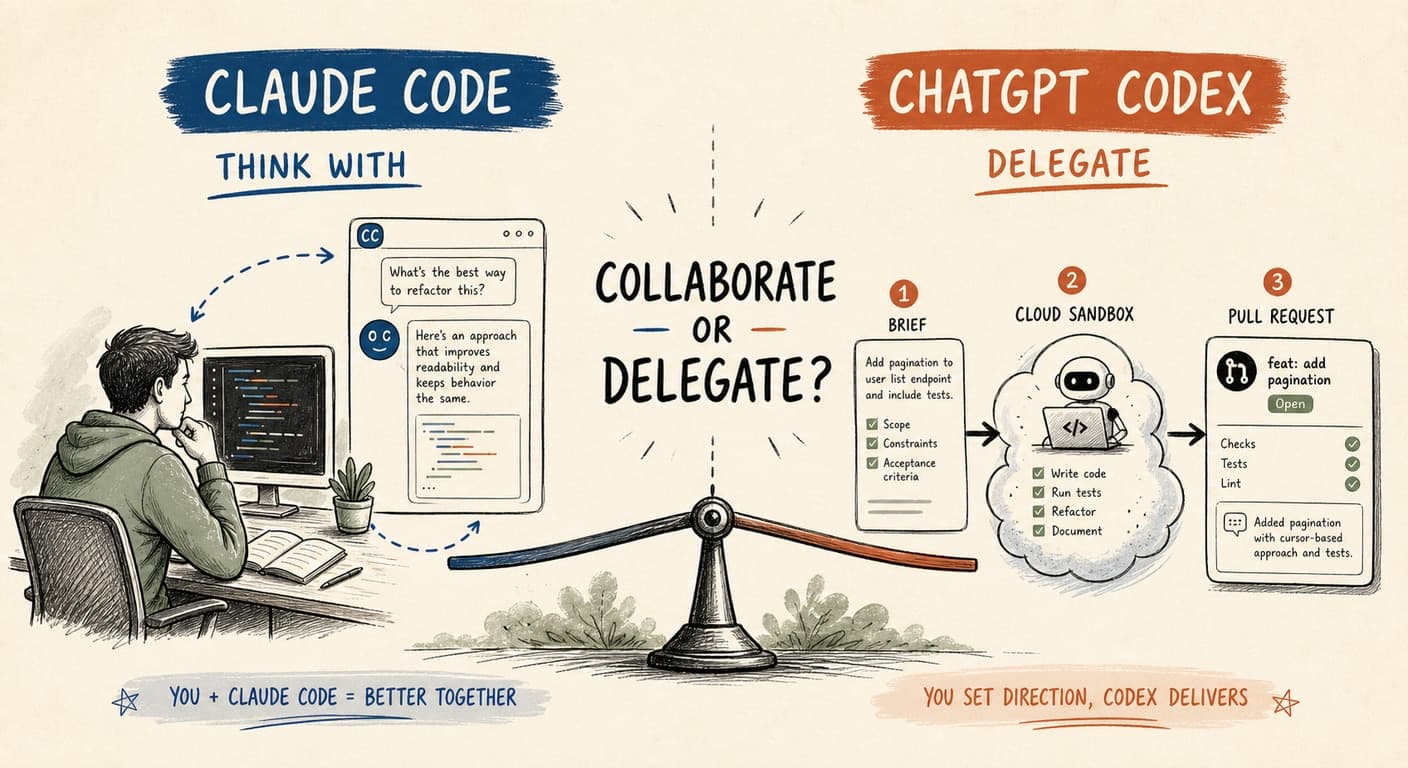
The Colleague or the Contractor: What Claude Code and ChatGPT Codex Are Really Telling Your Business
Two tools. Two philosophies. Haruto closed his laptop at 5:31pm Friday with a production bug unfixed. Monday morning, a PR was waiting. That's ChatGPT Codex. The engineering lead who spent three hours understanding an 11-year-old codebase — and emerged knowing it better than anyone — that's Claude Code. Here's how to tell which problem you actually have.