Anthropic's Sales Team on Claude Cowork: An AI-Augmented Sales Operations Layer in Practice

TL;DR
- Anthropic's own US Mid-Market GTM lead, Travis Bryant, runs a 4,000-account mid-market book on top of Salesforce and BigQuery using Claude Cowork — daily customer call prep, a Friday forecast rollup in leadership's expected format, and overnight territory scoring that historically took hundreds of hours. The team reports roughly 90 minutes a day in micro-optimisations and about 3 hours a week back on the Friday forecast alone.
- The pattern is not "replace your CRM with an LLM." Salesforce stays the system of record, BigQuery stays the data warehouse, and Cowork sits on top as an AI-augmented sales operations layer that handles the briefing, scoring, forecasting, and assembly work that used to live in spreadsheets and human muscle memory.
- The lesson for any sales leader running a mid-market or growth team in 2026 is not "buy Cowork" — it is "decide which weekly sales-ops rhythms are good first targets for AI augmentation, wire them in with connectors and skills you control, and keep human approval on every customer-facing send."
Last updated: 21 May 2026
On 20 May 2026, Anthropic published How an Anthropic sales leader uses Claude Cowork to run a 4,000-account book — a case study walking through how Travis Bryant, Head of US Mid-Market GTM at Anthropic, uses Claude Cowork end-to-end across a 4,000-account mid-market territory. A Partner Series webinar called How Anthropic's Sales Leader Runs His Week With Claude follows on 26 May 2026, with Travis and Brittney Tong (Growth GTM at Anthropic) demonstrating the workflows live. The case study is rare for the genre: it is not a vendor pitching aspirational use cases, it is a real sales leader showing the rhythms his team has already standardised on.
"Sales is full of people who got into the job for the customer conversations. Claude Cowork can give them back the hours to do just that."
— Travis Bryant, Head of US Mid-Market GTM at Anthropic
How does Anthropic's own sales team use Claude Cowork?
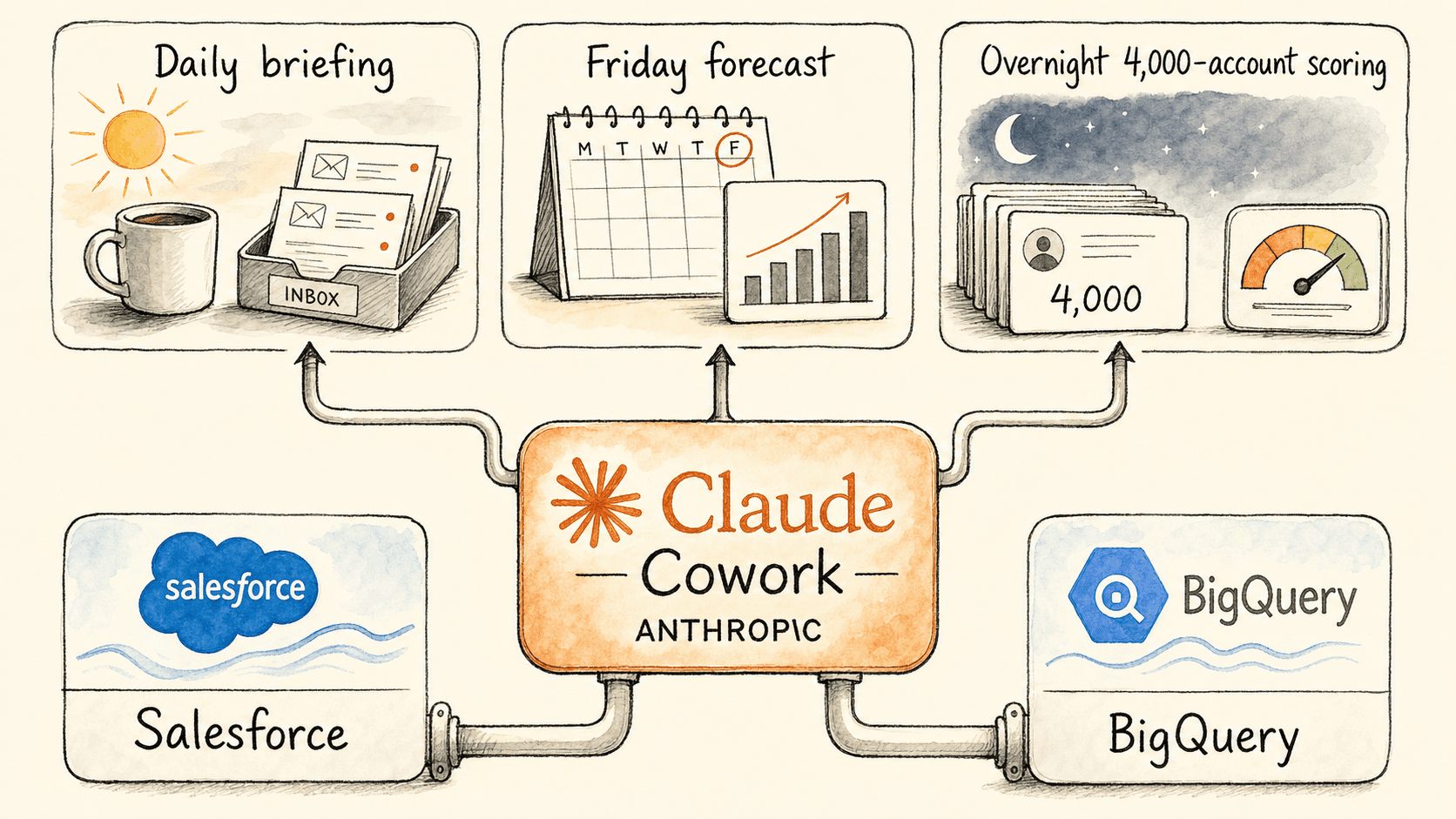
Travis Bryant's team uses Claude Cowork as the weekly operating rhythm on top of Salesforce and BigQuery: daily customer call prep on the next day's accounts, a Friday forecast rollup that ships to leadership in their expected format, and overnight territory scoring across his 4,000-account book that previously took hundreds of hours of analyst time. The CRM and the warehouse stay the system of record; Cowork is the layer that assembles, ranks, and prepares the work for humans.
Travis frames these as workflows that "reclaim time in the week," and the published case study anchors the gain in concrete numbers: roughly 90 minutes a day saved across micro-optimisations and about 3 hours a week back on the Friday forecast alone. Each workflow is wired to the actual Anthropic sales stack — connectors into Salesforce for pipeline and account data, a connection into BigQuery for richer warehouse signals, scheduled skills the team has built that encode their definitions of "good account" and "leadership-ready forecast," and a hard rule that every customer-facing send goes through human approval. A 26 May 2026 Partner Series webinar with Travis and Brittney Tong is the live walkthrough of the same stack.
The shape is important. There is no autonomous SDR firing emails. There is no "AI rep" replacing humans on calls. The reps still own the relationships, the calls, and every send. What Cowork replaces is the spreadsheet-and-tabs assembly work that used to eat the first two hours of every sales day. That is the move worth studying.
What does the daily customer call prep workflow actually do?
The daily customer call prep workflow assembles every piece of data a sales rep needs before their first meeting of the day — the account context, the pipeline state, the recent activity, the open notes from previous calls — into a single morning brief that lands before the first call. Travis runs this as a scheduled Cowork skill against his live Anthropic pipeline.
In a Salesforce-only world, this work is done by humans, badly. The rep opens Salesforce, finds the account, opens the contact, scrolls activity history, switches to email, finds the last thread, switches to Slack, finds the last internal note, opens BigQuery or a dashboard for product usage, then writes a brief to themselves in a notebook or Apple Notes. The honest version is most reps skip steps and walk into the call half-prepared.
Cowork closes that loop because the connectors are already wired. The scheduled session pulls Salesforce account state, the most recent activity, BigQuery usage signals, and any internal notes the team has agreed to expose, then writes the brief in the format the rep's manager has standardised on. Anthropic's Sales plugin bundles this exact pattern as a "daily briefing with pipeline alerts" skill that activates contextually, which is how the rest of Anthropic's customers can replicate the shape without rebuilding it from scratch. Travis credits this category of micro-optimisation — call prep, conference-room bookings, Google Calendar tidying — with about 90 minutes a day of recovered time.
The thing this is not: an AI summarising your inbox. The thing it is: an opinionated, role-shaped brief built from the systems the company has already paid for, in the format the team has agreed on, delivered before the day starts.
What does the Friday forecast workflow do?
The Friday forecast workflow generates the weekly leadership rollup by pulling pipeline data from Salesforce's Forecast tab, augmenting it with warehouse data from BigQuery, and assembling the result into the exact format Anthropic's sales leadership expects to see on Friday. Travis reports about 3 hours a week of his own time back from this workflow alone — time that previously sat in tabs, slide rebuilds, and reformatting passes.
Anyone who has run a sales team knows what this work normally looks like: the RevOps lead spends Wednesday and Thursday pulling reports, the Salesforce admin reformats them, the manager edits the narrative, the leader reformats it again on Friday morning. Days disappear. The forecast itself is rarely the thing that takes time — it is the assembly and the reformatting.
The Claude Sales plugin's /forecast command formalises this: it generates weighted sales forecasts with best, likely, and worst scenarios from CSV or pipeline descriptions. Inside Anthropic, that pattern is wired to live Salesforce and BigQuery sources, so the forecast assembles itself in the leadership-expected format. The human still reviews, adjusts the narrative, and decides which deals get called out — but the assembly cost goes to near zero.
| Phase of the forecast | Manual sales-ops week | Cowork-augmented week |
|---|---|---|
| Pull pipeline data | Salesforce report exported to CSV, hand-formatted | Cowork pulls live via Salesforce connector |
| Enrich with usage data | Manual lookup in BigQuery or a dashboard | Cowork joins BigQuery rows server-side |
| Format for leadership | Slides rebuilt every week | Cowork writes into the agreed template |
| Add narrative | Manager writes, reformats, reformats again | Manager edits an already-drafted narrative |
| Time to ship | Wednesday afternoon to Friday morning | Hours, not days |
The lesson is not "AI does forecasting." The lesson is "the forecast format and the data sources are stable, so the assembly should be code, not weekly human muscle."
What does the overnight territory scoring workflow actually do?
Travis Bryant runs a 4,000-account mid-market book. Scoring that whole territory used to be a quarterly exercise that consumed hundreds of analyst-hours — pulling firmographics, joining usage data, debating which accounts deserved AE attention, and finally producing a ranked list. In the published case study, that work runs overnight as a scheduled Cowork task. By morning Travis has a ranked, opinionated view of the territory plus a short rationale on each account, so the next quarter's prospect list is ready to walk through rather than rebuild.
Account scoring is not new. Salesforce has had Einstein lead scoring for years; HubSpot has predictive scoring; modern data warehouses have machine-learning models bolted on. What is new is that Cowork is doing this with Claude's reasoning model against the team's own definition of "good account" — a 5-dimension rubric the Anthropic team has encoded for both tech and industries accounts — not a black-box score, but a scored list with reasons the AE can read and challenge.
Mechanically: a scheduled Cowork task runs overnight, reads the universe of accounts from Salesforce, joins firmographic and behavioural data from BigQuery, applies the team's scoring skill (which encodes ICP, the 5-dimension rubric, recency, intent signals, and any custom rules the sales team has agreed on), and writes the ranked output back somewhere the rep can use it in the morning. Anthropic's Cowork product page names Scheduled Tasks as a first-class feature — exactly this shape. Four thousand accounts is the size of Travis's mid-market book; the same pattern shrinks or scales with the territory.
The interesting design call is the reasoning trace. A traditional ML score gives a number. A Cowork score gives a number plus a short, readable rationale per account. That changes the conversation between the AE and the model from "trust the score" to "challenge the reasoning." That is the same shift Anthropic's frontend engineers describe between Markdown summaries and HTML artefacts: it moves humans from trust to inspection.
Where does Salesforce stop and Cowork start?
Salesforce stays the system of record for accounts, contacts, opportunities, activity history, and every customer-facing data point that downstream systems depend on. Cowork stops short of writing canonical CRM data and instead sits as the AI-augmented sales operations layer on top — assembling, scoring, briefing, forecasting, and drafting, with Salesforce continuing to own the truth.
This boundary is what Travis Bryant calls out when he describes maintaining control: "plain-language prompts and human approval on every send, with Salesforce and your data warehouse still the system of record." The two-line architecture is unromantic but correct. Cowork reads from Salesforce + BigQuery. Cowork writes drafts, briefs, scores, forecasts, and outreach. Humans review and approve. The CRM mutation, when it happens, happens through the normal Salesforce paths the company already governs.
This matters because the alternative — letting an LLM mutate CRM data unsupervised — is the failure mode that has killed every "agentic CRM" experiment in the last two years. Anthropic and Salesforce have actually formalised this trust boundary as part of their expanded partnership: Anthropic is the first LLM provider fully integrated within the Salesforce trust boundary, with traffic contained inside Salesforce's virtual private cloud for Agentforce customers. The product shape mirrors the architectural shape. The CRM stays the boundary, the AI sits beside it.
| Function | Salesforce owns | BigQuery owns | Cowork owns |
|---|---|---|---|
| Accounts, contacts, opportunities | Yes (canonical) | No | No (reads only) |
| Activity history and notes | Yes (canonical) | No | Reads, drafts new entries for human approval |
| Product usage and behavioural signals | No | Yes (canonical) | Reads, joins to accounts |
| Firmographic enrichment | Sometimes | Often | Reads, never canonical |
| Daily briefings | No | No | Yes (assembles, never mutates) |
| Account scoring | Optional (Einstein) | Optional (ML model) | Yes (with reasoning trace) |
| Weekly forecast format | Reports | Underlying data | Assembles, narrates, drafts |
| Outreach drafts | No | No | Drafts, human approves and sends |
| Customer-facing sends | Logs the send | No | Never sends without human approval |
Read the table the right way: Cowork does not displace Salesforce or BigQuery. It picks up the work that was never in either system to begin with — the spreadsheet work, the morning-prep work, the assembly work, the reformat-for-leadership work, the "where do I focus" work. That is what an AI-augmented sales operations layer is.
How is this different from Outreach, Salesloft, or other sales-engagement platforms?
Outreach and Salesloft are sales-engagement platforms — they own the cadence, the email send infrastructure, the dial pad, the sequence templates, and the rep-to-prospect interaction layer. Cowork is not a sales-engagement platform. It is an AI sales operations layer that sits behind those interactions, doing the briefing, scoring, forecasting, and assembly work the rep used to do in tabs.
The clearest way to see the difference is to ask what each tool replaces in the sales week. Outreach replaces the cadence-management spreadsheet and the email-blasting tool. Salesloft replaces the call-recording and sequence-management stack. Cowork replaces the morning-prep ritual and the Friday-reporting ritual. The first two are about how the rep reaches the prospect; the third is about what the rep knows before the conversation and what leadership sees after the week.
| Layer | What it owns | Best fit | Failure mode if misused |
|---|---|---|---|
| Cowork (AI-augmented sales ops layer) | Daily briefings, account scoring, weekly forecasting, deal context assembly, draft-and-approve workflows on top of Salesforce + BigQuery | Mid-market and growth sales teams who already have a CRM and a warehouse and want the assembly work automated | Bolted on without connectors or skills the team controls; becomes generic chat rather than the team's own ops layer |
| Outreach / Salesloft (sales engagement) | Cadences, sequences, dialer, email send infrastructure, prospect-facing interaction layer | High-volume outbound teams running long, multi-touch sequences | Used as the system of record instead of CRM; cadences run without context Cowork-style briefings would have provided |
| Salesforce (CRM, system of record) | Accounts, contacts, opportunities, activity history, governance, customer-facing canonical data | Every sales team that needs a single source of truth and downstream system integrations | Treated as the place to do briefings or forecasting — both jobs Salesforce can technically do but neither cheaply nor in real time |
| BigQuery / data warehouse | Product usage, behavioural signals, joined firmographic data, model training sets | Teams that need analytics, scoring features, and audit trails beyond what CRM stores | Treated as a CRM substitute; tries to do canonical customer state and ends up out of sync with the live system of record |
The four layers compose. The Anthropic team uses all four. The trap is mistaking one for another — bolting "AI" onto Outreach as the answer to forecasting, or trying to run scoring inside Salesforce because the data sits there.
Which sales workflows are good first targets for AI augmentation?
The best first targets for AI augmentation in a sales week are the ones that are repetitive, format-stable, assembly-heavy, and not customer-facing. Daily customer call prep, weekly forecast rollups, and overnight territory scoring are good first targets exactly because they hit all four. Outreach personalisation and live discovery calls are bad first targets because they require judgement, real-time relationship awareness, and the work is one-shot, not repeated.
This is the same shape we have written about in Claude for Small Business and in the enterprise implementation guide. The pattern repeats: AI augments the back-office and decision-support work first, the customer-facing relationship work last (and with humans firmly in the loop).
| Workflow | Repetitive? | Format-stable? | Assembly-heavy? | Customer-facing? | Good first target? |
|---|---|---|---|---|---|
| Daily customer call prep before first meeting | Yes | Yes | Yes | No | Yes |
| Friday forecast rollup to leadership | Yes | Yes | Yes | No | Yes |
| Overnight territory scoring across a 4,000-account book | Yes | Yes | Yes | No | Yes |
| Pipeline-review prep | Yes | Mostly | Yes | No | Yes |
| Call-summary and follow-up draft | Yes | Yes | Yes | Yes (draft, human sends) | Yes, with approval |
| First-touch cold outreach personalisation | Sometimes | Less | Less | Yes | Risky — needs heavy human judgement |
| Live discovery call coaching | One-shot | No | No | Yes | No — relationship work |
| Negotiation strategy on a six-figure deal | One-shot | No | No | Yes | No — keep human |
| Bespoke proposal writing | Less | Less | Mixed | Yes | Partial — drafting, not framing |
The rule of thumb that comes out of the Anthropic case study is simple: if the workflow is something a sales-ops analyst could do with three hours, a spreadsheet, and clear specs, it is a good candidate for an AI-augmented sales operations layer. If it requires reading the room or owning the relationship, keep humans on it.
What can a 50-person sales team learn from how Anthropic does it?
A 50-person sales team can learn three things from the Anthropic case study without having Anthropic's engineering depth: pick the three or four repeated weekly rhythms that drain time, wire them into Cowork with connectors to the systems you already pay for, and make the AI's outputs reviewable rather than autonomous. The architecture is replicable because the boundary discipline is replicable.
Most sales teams trying to "use AI" start with the wrong unit of work. They try AI for cold outreach (high judgement, customer-facing, low repetition per prospect) and conclude AI does not help. The Anthropic case study points the other way: start with the assembly work that repeats every day or every week in a stable format, where the consequence of getting it wrong is "the human notices and edits" rather than "a customer gets a bad email."
The 50-person version of the pattern:
- Pick the three weekly rhythms. Daily customer call prep, the Friday forecast rollup, and a territory or pipeline-review pass are the obvious three because they map cleanly onto what Travis Bryant's team has standardised on. Add or substitute based on what actually consumes your week.
- Confirm the system of record stays put. Salesforce or HubSpot or whatever CRM you run keeps owning canonical customer data. The warehouse keeps owning usage and analytics. Cowork reads.
- Wire the connectors. Cowork supports MCP-based connections into CRM, call-transcription, enrichment, and chat tools. Get the read paths right before adding write paths.
- Encode your team's definitions as skills. "Good account," "leadership-ready forecast," "AE-ready briefing" are opinionated definitions your team already has implicitly. Make them explicit as Cowork skills.
- Keep approval on every customer-facing send. Drafts and assembly are AI; sends and decisions are human. The Anthropic team's "human approval on every send" rule is not optional decoration; it is the trust mechanic that lets the rest of the system run safely.
- Measure the right thing. Not "did AI write the email." The right metric is hours reclaimed per AE per week, and whether the team consistently walks into Monday with their focus list already done. If those move, the layer is working.
What is the AI Heroes implementation pattern for an AI-augmented sales operations layer?
The AI Heroes implementation pattern for an AI-augmented sales operations layer is a four-phase loop: audit the weekly sales rhythms, wire the read-only connectors into Salesforce and the warehouse first, codify the team's definitions as Cowork skills, then layer in scheduled tasks and approval-gated drafting one workflow at a time.
We treat the AI-augmented sales operations layer as a governed surface, not a chat product. It runs against the team's actual CRM and warehouse, uses the team's actual definitions of "good account" and "leadership forecast," produces outputs in the team's actual leadership format, and crucially keeps a human as the approving signature on every customer-facing artefact. The benchmark we hold ourselves to is the one the Anthropic team has set: three weekly rhythms running cleanly, on top of Salesforce and BigQuery, with the team using the outputs every day.
The phases:
- Audit. Map the actual weekly sales rhythms. Identify the three to five that are repeated, format-stable, and assembly-heavy. Confirm where Salesforce and the warehouse own the data and where teams have improvised spreadsheets.
- Wire. Set up Cowork with read-only connectors to Salesforce, the warehouse (BigQuery or equivalent), and any call-transcription or enrichment systems the team relies on. Do not write to CRM in this phase. Build trust on the read path first.
- Codify. Turn the team's implicit definitions into explicit Cowork skills: "AE-ready daily briefing," "leadership-format forecast," "account scoring with reasoning trace." Skills are the durable IP. Without them the system is a chat window.
- Schedule and approve. Turn the briefings, scoring, and forecasts into scheduled tasks. Add approval-gated drafting for any outreach. Measure hours reclaimed and whether teams actually use the outputs in the morning. Iterate.
This is the discipline the AI-augmented sales operations layer demands: the rhythms are the unit of work, the skills are the IP, the connectors are the infrastructure, and the human is the approving signature on everything customer-facing. The teams that get the most from a Cowork-style layer refuse to skip the codification step. The teams that fail are the ones that run it as ungoverned chat and then conclude AI does not work in sales.
Authoritative sources
- Anthropic: How an Anthropic sales leader uses Claude Cowork to run a 4,000-account book (the published case study, 20 May 2026)
- Anthropic Partner Series webinar: How Anthropic's Sales Leader Runs His Week With Claude (Travis Bryant + Brittney Tong, 26 May 2026)
- Anthropic tutorial: Using Claude Cowork for sales account research
- Claude Cowork product page
- Claude Sales plugin
- Anthropic news: Claude for Small Business
- Anthropic news: Salesforce + Anthropic expanded partnership
Related reading
The agent built for this

Mario
Cuts out the admin for your sales team and gives them razor-sharp info to close deals better and faster.
Meet MarioFrequently Asked Questions

Founder, AI Heroes
I build AI companies and the systems inside them. At AI Heroes, we give businesses the functional capacity to grow without the headcount growth normally demands — sales that follows up, marketing that runs, content that ships, ops that handles itself. We audit where you're leaving growth on the table, build the team that captures it, and hand it over completely.
I've built at scale before. Leading product and GTM at SlideSpeak AI (1M+ monthly users, profitable, bootstrapped). CPO at Disperse — the AI construction platform that went from 3 to 200+ people on $35M raised. I also co-founded LOBOMAR, a luxury fashion label featured in Elle, Cosmopolitan, and the LA Times, with shows at the London Design Museum, Wereldmuseum, and Amsterdam Fashion Week.
Related Articles
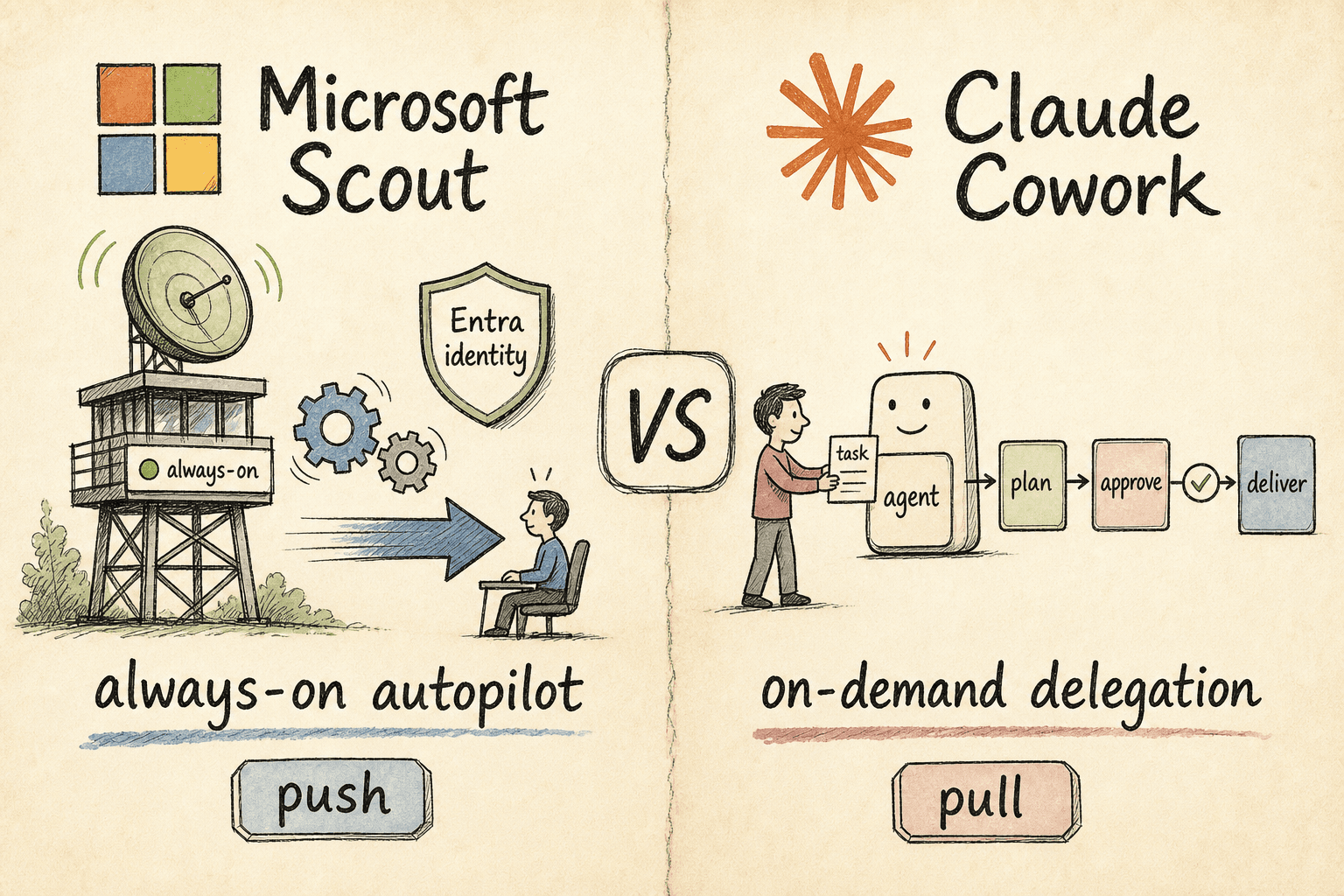
Microsoft Scout vs Claude Cowork: Autopilot or Delegation?
Two of 2026's biggest agent launches make opposite bets. Microsoft Scout is a desktop autopilot that runs in the background and acts on your behalf; Claude Cowork waits for you to hand it a task, then delivers. One is push, the other pull — here's which fits your team.

How to Get Started with Claude Cowork: A Decision Framework for Knowledge Workers (2026)
Claude Cowork is where you delegate a whole task instead of asking a question — point it at your files and apps, describe the outcome, get finished work. The hard part isn't the prompt, it's knowing which tasks to hand it. Here's a 5-signal fit test, the three shapes a Cowork task can take, and how to get your first deliverable in ten minutes.
How Video Post-Production Teams Use Claude Cowork to Audit Brand Assets
Claude Cowork can act as a supervised QA layer for export folders, brand guidelines, captions, and delivery reports.