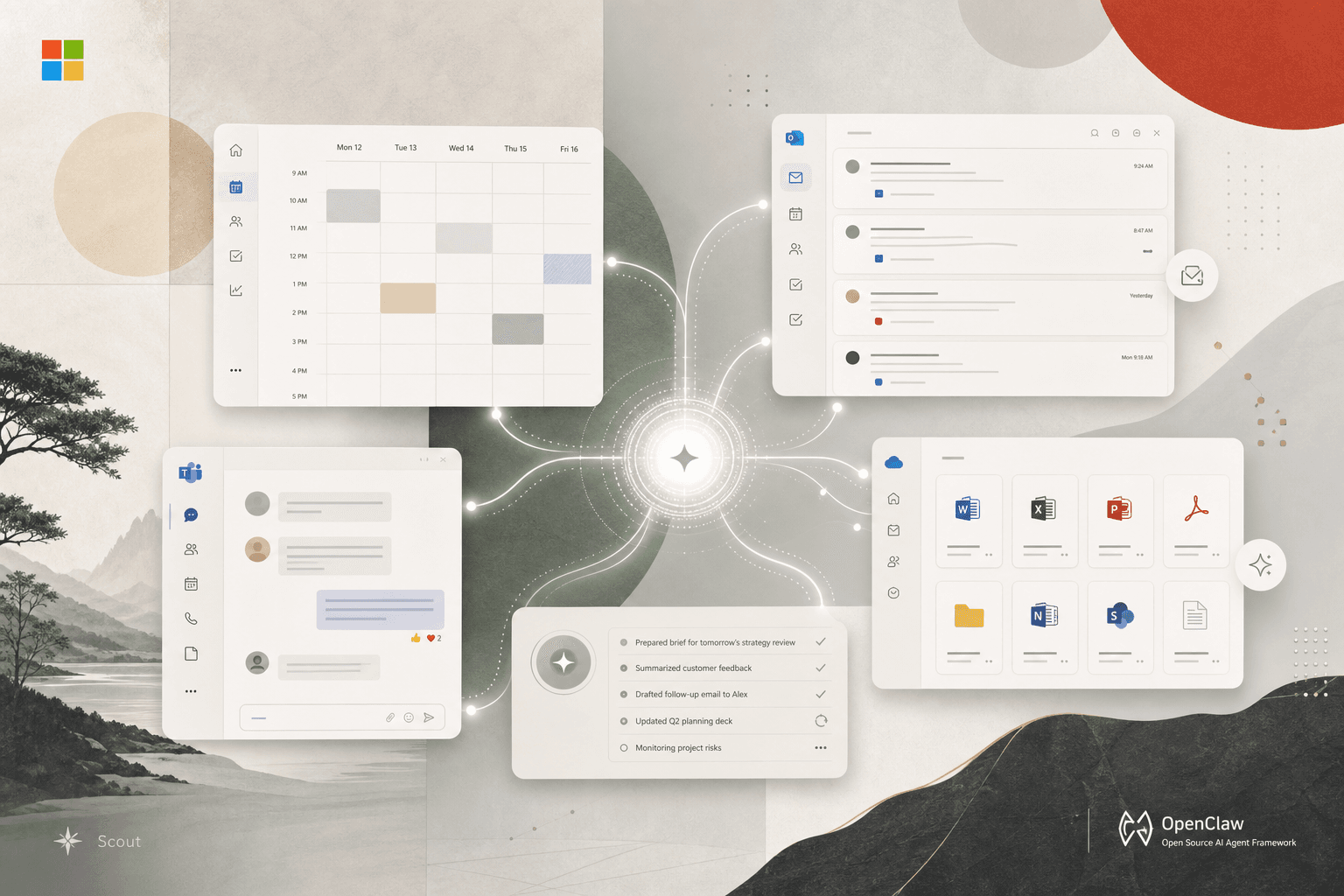
Microsoft Scout, Explained: The Always-On 'Autopilot' Built on OpenClaw

TL;DR
- Microsoft Scout is Microsoft's first "Autopilot": a Windows and macOS desktop AI app that reads and writes files, runs shell commands, drives a browser, queries your Microsoft 365 data, and — the part that makes it an autopilot — works autonomously in the background. It was announced at Build on 2 June 2026.
- What's real vs not: Scout is a gated Frontier preview, not generally available; it's built on the open-source OpenClaw framework; and Microsoft has not confirmed pricing — treat the figures circulating online as unconfirmed.
- Why it matters: Scout is the clearest sign yet of the shift from reactive Copilots (you ask) to autonomous Autopilots (they act). That makes two things urgent for any business — governing agents that act on their own, and being visible to the agents now doing the searching.
What is Microsoft Scout?
Microsoft Scout is an always-on personal agent for work that acts autonomously on your behalf, without needing a prompt for every task. Microsoft calls it its "first Autopilot agent." Per Microsoft's own documentation, Scout is "a desktop AI application for Windows and macOS that takes action on your behalf" — it "reads and writes files, runs shell commands, controls a browser, queries your Microsoft 365 data, and works autonomously in the background."
The distinction Microsoft is drawing is between Copilot and Autopilot. A Copilot is reactive: you ask, it answers. An Autopilot is proactive: it watches the flow of your work and acts. As CEO Satya Nadella framed the category at Build, "Autopilots are always-on agents that work autonomously, with their own identity, and act on your behalf." Scout is the flagship example, led by Omar Shahine, Corporate Vice President of Microsoft Scout, and announced on 2 June 2026.
If you only read the launch headlines, Scout sounds like a smarter assistant for meetings and email. It's more than that — it's a developer-grade desktop agent that happens to be wired deep into Microsoft 365.
What can Microsoft Scout actually do?
Microsoft's documentation lists six core capabilities, and together they're broader than the marketing suggests:
- Acts on your files — creates, edits, and searches documents in your workspace, working with Word, Excel, PowerPoint, code files, and more.
- Runs commands — executes shell commands, builds, tests, and scripts, through a tiered permission system.
- Automates browsers — navigates web pages, fills forms, and interacts with web apps using Playwright.
- Connects to Microsoft 365 — manages your email, calendar, Teams messages, OneDrive files, and meetings.
- Works autonomously — runs in the background on schedules or triggers you define.
- Delegates work — launches specialized sub-agents for parallel research, code review, and complex tasks.
The power is in chaining those together in a single conversation. Microsoft's own example: Scout can "edit code in your workspace, run a build, send the results in an email, and schedule a follow-up meeting — all in one conversation." On the Microsoft 365 side specifically, the launch showed it coordinating meetings across time zones, blocking calendar time for upcoming deliverables, flagging stalled decisions before they become blockers, and — after a Teams meeting — drafting the minutes, extracting action items into Planner, and updating a shared dashboard. Scout can also join Teams group chats and handle email threads as an autonomous participant, the first time Microsoft has placed an agent inside those surfaces rather than beside them.
It ships with bundled skills — Word, Excel, and PowerPoint for Office documents, Loop for Microsoft Loop docs, and a Web Artifacts Builder for interactive HTML dashboards — and, like an open agent framework, it lets you add your own by dropping SKILL.md files into a skills directory. It also keeps persistent memory of your preferences and decisions across conversations, so it gets more useful over time. The organisational context behind all of this is Work IQ, Microsoft's intelligence layer that learns how your organisation works and carries that context forward.
How does Scout stay "always on"?
The feature that makes Scout an autopilot rather than a faster assistant is how it runs unattended. There are two mechanisms:
- Heartbeat — periodic background check-ins that "run prompts while you're away," on a cadence you set: every 15, 30, 60, or 120 minutes, confined to the work hours you define and under a more restrictive permission policy.
- Automations — scheduled or condition-triggered tasks that execute independently.
Microsoft's framing is that the prompt was never the hard part — "the real unlock is in the follow-through, where systems hold your priorities and act on them for you." That's the whole bet behind the Autopilot category: an agent that notices and acts, instead of one that waits to be asked.
What is Microsoft Scout built on — and why is OpenClaw a surprise?
Here's the detail most launch coverage rushed past: Scout is built on OpenClaw, the open-source autonomous-agent framework — and Microsoft is contributing its policy-conformance work directly upstream to the project.
OpenClaw is not a Microsoft invention. It's an open-source agent framework created by Austrian developer Peter Steinberger, launched in November 2025 (originally as "Clawdbot"). It became the fastest-growing open-source AI agent project on record — roughly 9,000 GitHub stars in its first 24 hours and more than 214,000 by February 2026. It runs locally, is deliberately model-agnostic, and orchestrates whichever large language model you point it at. In February 2026, Steinberger joined OpenAI, and an OpenClaw Foundation was set up to steward the project.
So the headline beneath the headline is this: Microsoft's flagship enterprise agent is built on a community framework that began as one developer's side project — and whose creator now works for OpenAI. For a company that historically built its productivity stack in-house, that's a real signal about where agent infrastructure is heading. The open-source framework becomes the substrate; the differentiation moves up the stack to context (Work IQ), governance (identity and policy), and distribution (being inside Windows and Office by default). Microsoft has not disclosed which underlying AI model powers Scout — OpenClaw orchestrates models rather than being one, so that question is still open.
How much does Microsoft Scout cost?
Microsoft has not officially confirmed Scout's pricing. The launch announcement stated no price and did not name the tiers that will include it. That matters, because secondary reporting has filled the vacuum with numbers that don't agree with each other. We're flagging them rather than repeating them as fact:
| Claim circulating in coverage | Status |
|---|---|
| Included in Microsoft 365 E5 / Business Premium at no extra cost | Unconfirmed by Microsoft |
| Paid add-on for Microsoft 365 E3 (a "$12/user/month" figure has appeared) | Unconfirmed — not in official materials |
| Sold within a "Microsoft 365 Governance"-style add-on bundle | Unconfirmed |
| A GitHub Copilot license is required to install the current preview | Confirmed |
The one pricing-adjacent fact Microsoft did confirm is an access requirement, not a price: to install the current preview you need a GitHub Copilot license. Treat any specific per-user Scout price you read today as unconfirmed until Microsoft publishes it.
How do you get Microsoft Scout right now?
Scout is not generally available — it's prerelease software in a private preview. As of June 2026 it's available only to organisations in Microsoft's Frontier early-access programme, and Microsoft's own employees have been using an early desktop version internally.
Getting access today requires all of the following:
- Frontier enrolment — your organisation joins Microsoft's early-access programme and accepts the preview terms.
- Intune policy configuration — IT enables the app on specific devices via policy.
- An opt-in attestation — an explicit admin acknowledgement before turning it on.
- A GitHub Copilot license — required to download and install the experience.
It runs on Windows 11 or later and macOS 12 (Monterey) or later. Microsoft has signalled broader availability later in 2026 — some reporting points to an October 2026 general-availability target as a Microsoft 365 add-on — but those dates and that packaging are not officially confirmed. Track them; don't bank on them.
How is Microsoft Scout governed?
The most enterprise-relevant part of Scout is not what it does but how it's governed — because an always-on agent that acts on your behalf is also a new kind of insider. Microsoft's answer is to treat the agent as a first-class, identifiable, permission-scoped actor:
- Its own governed Entra identity. Each Scout runs under its own Microsoft Entra identity — not a shared, anonymous service account — so every action is attributable to a known actor your directory already understands. This sits inside Microsoft's broader Agent 365 governance framework.
- Granular permissions. You can enable or disable entire capability categories (file system, shell, browser, Microsoft 365), define which shell commands auto-approve and which require permission, and mark sensitive directories that always require explicit approval.
- Human sign-off on sensitive actions. Scout asks for approval before sending email, running commands, or writing files.
- Purview data protection. It enforces Microsoft Purview policies — sensitivity labels and data-loss prevention — and respects existing access controls rather than bypassing them.
- Prompt-injection guardrails. Scout treats content pulled from emails or web pages "as data, not instructions," a deliberate defence against manipulation.
- Policy conformance, contributed upstream. A built-in system continuously checks Scout's behaviour against configured rules and produces an audit trail — and Microsoft is contributing that conformance work back to OpenClaw.
This is a serious governance posture, and it's the right set of questions to be asking. It is not a guarantee. Forrester analyst Jeff Pollard cautioned that an autonomous agent like Scout "amplifies whatever data governance problems already exist," introducing active risk through autonomous tool use and exposure to prompt injection. The honest read: an Autopilot inherits the state of your house. If your permissions and data hygiene are already messy, an always-on agent acting across them doesn't fix that — it operationalises it at speed.
Microsoft Scout vs Microsoft 365 Copilot: what's the difference?
This is the most common point of confusion, so it's worth being precise.
| Microsoft 365 Copilot | Microsoft Scout | |
|---|---|---|
| Interaction model | Reactive — you prompt, it responds | Proactive — always-on, acts without prompting |
| Category | Copilot (assistant) | Autopilot (autonomous agent) |
| Form factor | In-app, in the M365 surfaces | Windows/macOS desktop app + Microsoft 365 |
| Identity | Acts as you, in-session | Its own governed Entra identity |
| Reach | Microsoft 365 content | Files, shell, browser, Microsoft 365, sub-agents |
| Availability (June 2026) | Generally available | Private Frontier preview only |
Scout doesn't replace Copilot; it sits a layer up from it. Copilot is the assistant you reach for. Scout is meant to be the colleague that's already handled it. If the comparison you're actually weighing is Scout against Anthropic's delegation agent, we pulled those apart in Microsoft Scout vs Claude Cowork.
How does Scout compare to other autonomous agents in 2026?
Scout lands in a year when every major lab shipped an always-on agent. The shape of the race:
| Agent | Vendor | Model basis | Status (June 2026) |
|---|---|---|---|
| Scout | Microsoft | Built on OpenClaw; underlying model undisclosed | Private Frontier preview |
| ChatGPT Workspace Agents | OpenAI | OpenAI models | Research preview, credit-based |
| Gemini Spark / Gemini Enterprise | Gemini 3.5 + Antigravity | Available; no-code agent builder | |
| Claude / Cowork | Anthropic | Claude models | Generally available; delegation model |
The differences are less about raw model intelligence and more about posture and distribution. OpenAI and Anthropic lead on model capability and developer mindshare. Google leans on its Workspace footprint and a no-code builder. Microsoft's structural advantage is distribution and governance — an agent baked into Windows, Teams, and Office reaches more people by default than any standalone app, and Entra-based identity gives IT a governance story the others are still assembling. Owning where work already happens is a different bet from owning the smartest model — and for the enterprise buyer, it's often the more decisive one.
What does Microsoft Scout mean for your business?
Two things, and they pull in different directions.
First, adoption is now a governance problem, not just a productivity one. An Autopilot with its own identity, acting across your files, shell, browser, and Microsoft 365, is genuinely useful — and genuinely a new attack surface and audit obligation. The organisations that get value from Scout will be the ones that fix their permissions, sensitivity labelling, and data hygiene before they switch on an always-on agent, not after. Scout's controls reward a tidy house and punish a messy one. (We've written about what that operating discipline looks like in practice in this Cowork case study.)
Second, the rise of always-on agents changes who you're actually visible to. When an agent — not a person — schedules the meeting, drafts the brief, and shortlists the vendor, the question stops being "do humans find us?" and becomes "do the agents and AI engines doing the work retrieve and cite us?" That is the discipline AI Heroes works in: making sure that when AI systems — Copilot, ChatGPT, Gemini, Claude — answer the questions your buyers ask, your business is the answer they surface. Scout is one more reason that being citable by machines is no longer optional.
Frequently Asked Questions

Founder, AI Heroes
I build AI companies and the systems inside them. At AI Heroes, we give businesses the functional capacity to grow without the headcount growth normally demands — sales that follows up, marketing that runs, content that ships, ops that handles itself. We audit where you're leaving growth on the table, build the team that captures it, and hand it over completely.
I've built at scale before. Leading product and GTM at SlideSpeak AI (1M+ monthly users, profitable, bootstrapped). CPO at Disperse — the AI construction platform that went from 3 to 200+ people on $35M raised. I also co-founded LOBOMAR, a luxury fashion label featured in Elle, Cosmopolitan, and the LA Times, with shows at the London Design Museum, Wereldmuseum, and Amsterdam Fashion Week.
Related Articles
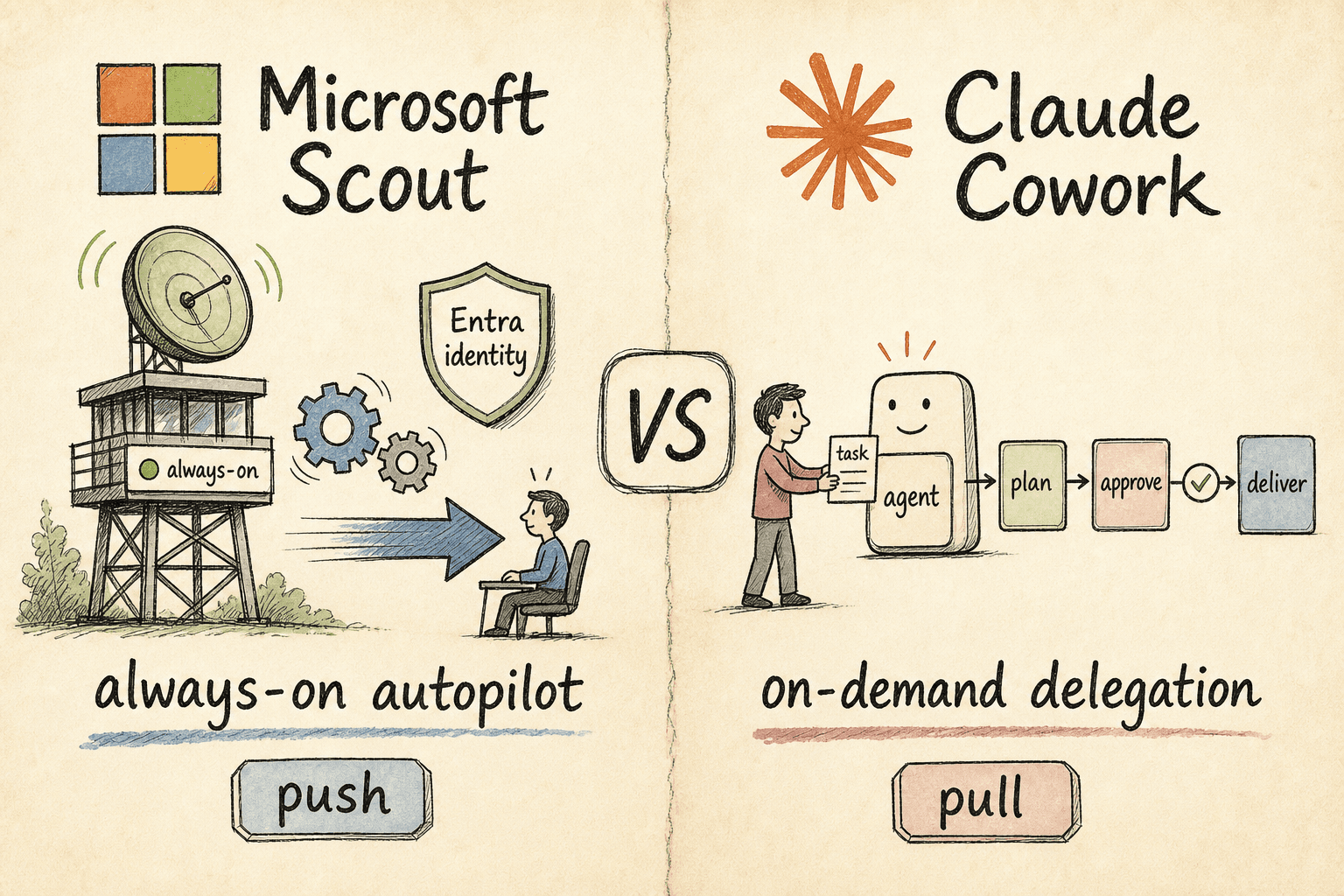
Microsoft Scout vs Claude Cowork: Autopilot or Delegation?
Two of 2026's biggest agent launches make opposite bets. Microsoft Scout is a desktop autopilot that runs in the background and acts on your behalf; Claude Cowork waits for you to hand it a task, then delivers. One is push, the other pull — here's which fits your team.

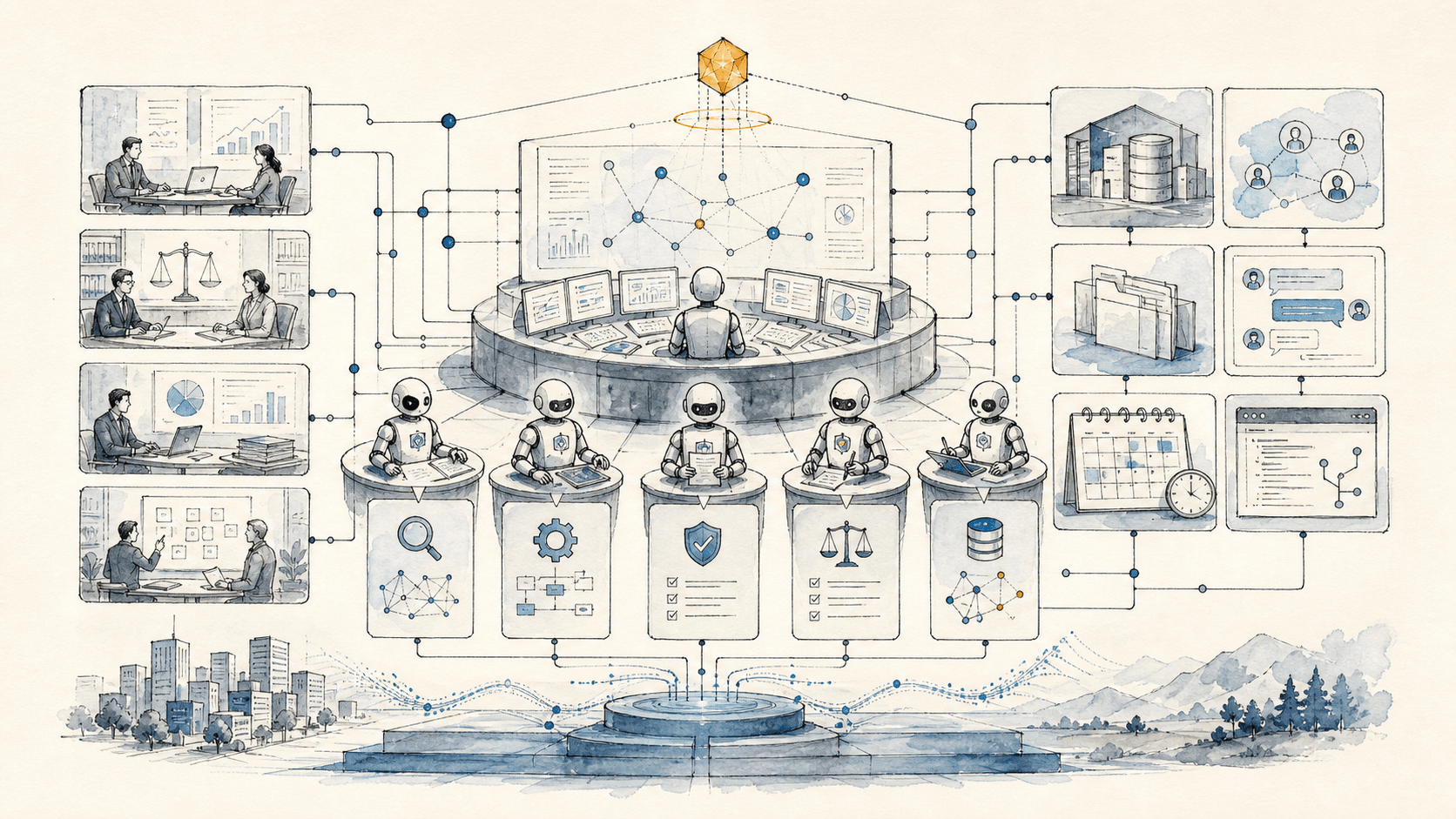
Building AI Agents in the Enterprise: Implementation Patterns for 2026
Anthropic's playbook is right about the enterprise shape. The missing layer is implementation: governed skills, MCP tools, memory, observability, worktree-safe orchestration, and agent fleets that survive contact with a 1,000-person company.

Microsoft Copilot Cowork vs Claude Cowork: The Borrowed Brain
Travis had the tab open for forty minutes before he typed a single word. On one screen: Microsoft Copilot Cowork, announced that morning. On the other: Claude Cowork, which he'd been trialing quietly for six weeks. Both run on Claude. Both claim to do the same thing. The difference is the container — and the container turns out to be the entire decision.