
The Brand That Was Too Beautiful to Post

Fashion & DTC Brands
Content output tripled, marketing hours cut 70%
13-person team couldn't keep up with content demands without burning out
AI content system: brand voice encoding, caption generation, scheduling, and cross-platform publishing
TL;DR
- The fashion label already had a distinctive voice; the bottleneck was turning launch assets into enough on-brand posts every week.
- The system learned approved captions, product context, channel formats, and performance feedback so first drafts were ready before the team arrived.
- Forty-seven product images were drafted and scheduled in three hours, with the creative director editing 11 and approving the rest.
A 13-person East London womenswear label had built one of the sharpest brand voices in independent British fashion. The algorithm had no idea.
Based on a real client engagement. Details changed for confidentiality.
The Post That Wasn't Ready at 11pm
The collection drops Thursday.
Simone Clarke, Head of Marketing at a 13-person womenswear label in East London, knows this. She's known it for three weeks. What she didn't plan for — and somehow never plans for, despite it happening every season — is that it is now Tuesday at 11:14pm, she has forty-seven product images sitting in a Dropbox folder, and not one of them has a caption.
She opens Instagram. She scrolls her brand's grid. The last post was six days ago, a repost of a stylist's story. Before that, a campaign image that took their photographer two days and their art director a full afternoon of retouching. Twelve hundred likes. A spike of traffic to the Shopify store. Then silence for ten days while everyone recovered.
She opens a blank document. She types: New silk gown. Hand-finished. Limited run. She stares at it. Deletes it. Types it again in a different order. Deletes it again.
This is not a creative block. Simone is not short of ideas. She's short of something else — the hours between now and Thursday morning, and the three people who would need to fill them.
The question was not whether the brand had a voice. It unquestionably did. The question was whether a three-person marketing team could carry it at the speed the algorithm now demanded.
The Dirty Secret Behind Every Beautiful Feed
Here is the thing that nobody says at Fashion Week panels or creative director roundtables: independent luxury fashion brands are not content companies, and the ones pretending to be are slowly strangling themselves.
The mathematics of modern social media visibility are brutal. An Instagram Reels algorithm that rewards posting frequency above almost all other variables. A TikTok culture that has trained even luxury consumers to expect multiple touchpoints before they convert. A content cycle — shoot, edit, caption, schedule, analyse, repeat — that now consumes more of a small creative team's bandwidth than the actual work of designing, sampling, and selling the clothes.
For the big houses, this is a budget line. A content team. A social editor. A video producer. For the emerging London labels building a global following on a skeleton crew, it is a slow tax on everything else. Every hour spent writing captions is an hour not spent at a fitting. Every evening scheduling posts is an evening not spent on the editorial relationships that built the brand in the first place.
The structural tension is this: the algorithm doesn't know the difference between a luxury brand and a fast-fashion account. It rewards posting frequency with reach. And reach, for a small brand without a performance marketing budget, is almost entirely dependent on organic content velocity.
But volume content and luxury positioning are instinctively hostile to each other. A brand that posts seven times a week starts to feel like it's trying too hard. A brand that posts once starts to lose cultural relevance against noisier competitors.
Nobody in the industry has a clean answer to this. Most just exhaust their marketing teams until someone leaves, then start again.
The Creative Director Who Said "It'll Sound Like Everyone Else"
Simone didn't pitch Cowork to her creative director as a productivity tool. She knew better than that.
She pitched it as an experiment. A single collection drop. Four weeks. If the content it produced felt off-brand, they'd delete everything and pretend it never happened.
The scepticism was immediate and specific. Their creative director, who had built the brand's aesthetic over seven years of very particular image choices and even more particular language, said exactly what Simone expected: "It'll sound like everyone else. It'll write like a press release."
She understood the concern. The brand's voice had taken years to develop — elliptical, referential, rooted in specific cultural touchstones and a particular way of sitting between high fashion and everyday intimacy. It was not something you could brief in a paragraph.
But she tried anyway. She spent an afternoon writing into the system — in plain English, like describing the brand to a very attentive new colleague — the things that made their voice theirs. The references they reach for. The words they never use. The feeling a post should leave. She connected the Shopify account, uploaded the campaign imagery, and linked the Google Calendar.
The first post Cowork drafted for a new coat was not perfect.
But it wasn't generic either. The creative director read it, made four edits, and posted it.
It outperformed their last five posts by the end of the day.
They kept going.
What Happens in the Three Hours Before Anyone Gets to Work
The most useful frame for understanding what the system actually does is not to think about what it can create, but about what it clears away.
The Overnight Collector
Before Simone arrives at the studio, the first component has already done something she would otherwise spend forty-five minutes doing manually: it has looked at what's new. New products added to the Shopify catalogue overnight. Tags or mentions from stylists and press accounts. Engagement data from yesterday's posts. Any upcoming dates in the content calendar that need feeding — a collab, a pop-up, a restock. It assembles all of this into a single morning context, so the content that gets written isn't disconnected from what the brand is actually doing that week.
The Writer
This is where the time used to go. For each piece of content — a product post, a Reel caption, a story sequence — the writer draws on the brand voice document Simone built, the product data from Shopify, and the memory of which content types have historically driven traffic to the store versus engagement on the feed. It produces a first draft: caption, suggested hashtags, a note on the type of image or video it would pair with. Not finished copy — a starting point that's already 70% of the way there, in the right voice, with the right references. Simone no longer starts from a blank document at 11pm.
The Scheduler
Once content is approved — a process that now takes minutes instead of an afternoon — the third component handles distribution. It posts to Instagram at the times their audience has historically been most active. It monitors early engagement and flags when a post is performing unusually well or unusually poorly. It sends a weekly digest on Friday afternoon with the content calendar for the following week, so the team can see the full picture rather than living post-to-post.
This means that Simone, the Head of Marketing, no longer spends her Tuesday evenings writing captions. She spends them on the things she was actually hired to do: building press relationships, developing the next campaign concept, and occasionally sleeping.
The Post That Shouldn't Have Won
Six weeks in, something happened that nobody expected.
The engagement data told a story nobody had asked for.
The content Cowork had drafted — edited by the team but substantially AI-authored — was performing measurably better on e-commerce conversion than the content the team had written entirely themselves. Not on likes or saves, where the numbers were broadly comparable. On the metric that actually matters: people clicking through to the store and buying.
The hypothesis that eventually emerged was counterintuitive: the AI-drafted content tended to name the product more directly and naturally link to the customer's desire, while the team-authored content — crafted with more artistic intent — sometimes prioritised atmosphere over action.
Neither was better at building the brand. The team-authored content was better at brand-building. But the AI-assisted content was better at converting the audience the brand had already built. Used together, they were doing two different jobs.
| Metric | Before (per week) | After 6 weeks |
|---|---|---|
| Posts published | 2–3 | 6–8 |
| Average engagement rate | 2.1% | 3.6% |
| Social to Shopify traffic | baseline | +41% |
| Marketing team hours on content | 16–20 hrs | 4–6 hrs |
| Time from product shoot to first post | 4–7 days | Same day or next morning |
The follower count grew. The team stopped collapsing after London Fashion Week. And the creative director, who had said it would sound like everyone else, started giving the system harder briefs — just to see what it would do with them.
What a Fashion Brand Actually Sells
What this label discovered wasn't really about content, or AI, or social media scheduling.
It was about the confusion between the work of making a brand and the work of distributing it.
Independent fashion's defining strength — tight creative control, a singular aesthetic, a voice that can't be faked — is also, unintentionally, its operational liability. The same small team that protects the brand's integrity is also responsible for feeding every content channel, every week, at a pace that was designed for organisations ten times their size.
AI content automation for creative businesses doesn't replace creative judgment. A system that doesn't know why a particular archival reference matters, or why a certain caption should feel like it was written at 2am rather than in an office, will always need a human editor. The brands that will use these tools well aren't the ones that hand it the keys — they're the ones that treat it the way a good editor treats a first draft: something to push against, refine, and occasionally overrule.
But the distribution work? The hours spent turning a photographer's beautiful image into a caption, a hashtag set, a scheduled post, a performance report? That was never creative work. It just happened in the same building as the creative work, which made it easy to confuse.
The question every small luxury brand now has to answer isn't whether AI can write like them. It's whether their best people should be the ones doing the writing that happens after the real work is done.
The Same Studio, a Different Tuesday
It is a Tuesday in spring, and Simone Clarke is at her desk at nine in the morning.
The collection drops Thursday. She knows this. She's known it for three weeks.
The forty-seven product images were drafted and scheduled yesterday, in three hours, by a system that knows the brand's voice well enough to draft the first pass without being asked. The creative director made edits to eleven of them. Approved the rest.
Simone is on a call with a stylist in Paris who wants to shoot the new coat for a summer editorial. She's looking at her calendar, not her phone. The weekend is not already lost.
The content will always need someone who cares about the brand enough to make it right — it just no longer needs that person to spend their Tuesday evenings making it exist.
The agent built for this

Dawn
Understands your voice, brand, and markets. Then grows your socials on autopilot. Without the AI slop.
Meet DawnFrequently Asked Questions

Founder, AI Heroes
I build AI companies and the systems inside them. At AI Heroes, we give businesses the functional capacity to grow without the headcount growth normally demands — sales that follows up, marketing that runs, content that ships, ops that handles itself. We audit where you're leaving growth on the table, build the team that captures it, and hand it over completely.
I've built at scale before. Leading product and GTM at SlideSpeak AI (1M+ monthly users, profitable, bootstrapped). CPO at Disperse — the AI construction platform that went from 3 to 200+ people on $35M raised. I also co-founded LOBOMAR, a luxury fashion label featured in Elle, Cosmopolitan, and the LA Times, with shows at the London Design Museum, Wereldmuseum, and Amsterdam Fashion Week.
Related Articles
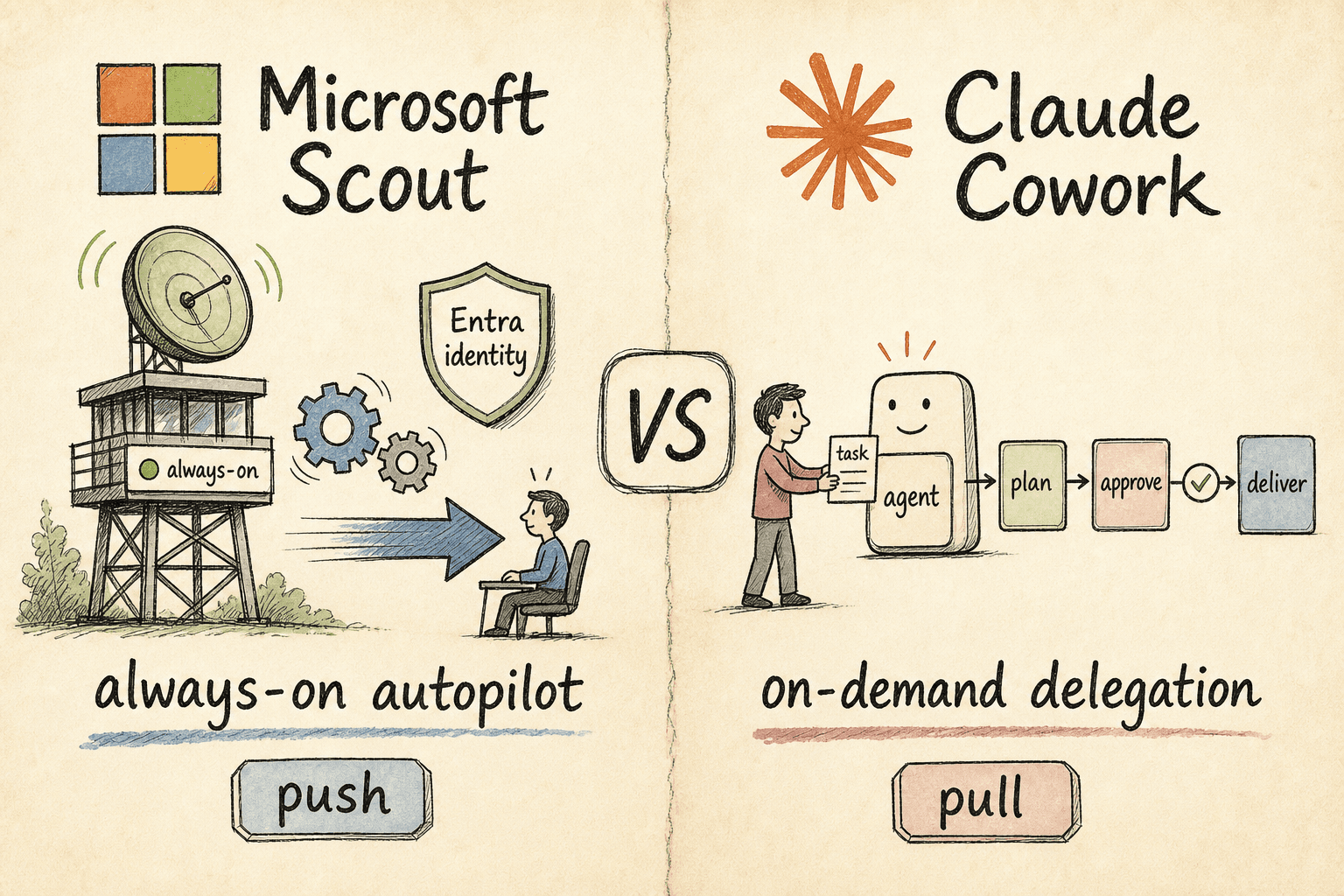
Microsoft Scout vs Claude Cowork: Autopilot or Delegation?
Two of 2026's biggest agent launches make opposite bets. Microsoft Scout is a desktop autopilot that runs in the background and acts on your behalf; Claude Cowork waits for you to hand it a task, then delivers. One is push, the other pull — here's which fits your team.

How to Get Started with Claude Cowork: A Decision Framework for Knowledge Workers (2026)
Claude Cowork is where you delegate a whole task instead of asking a question — point it at your files and apps, describe the outcome, get finished work. The hard part isn't the prompt, it's knowing which tasks to hand it. Here's a 5-signal fit test, the three shapes a Cowork task can take, and how to get your first deliverable in ten minutes.
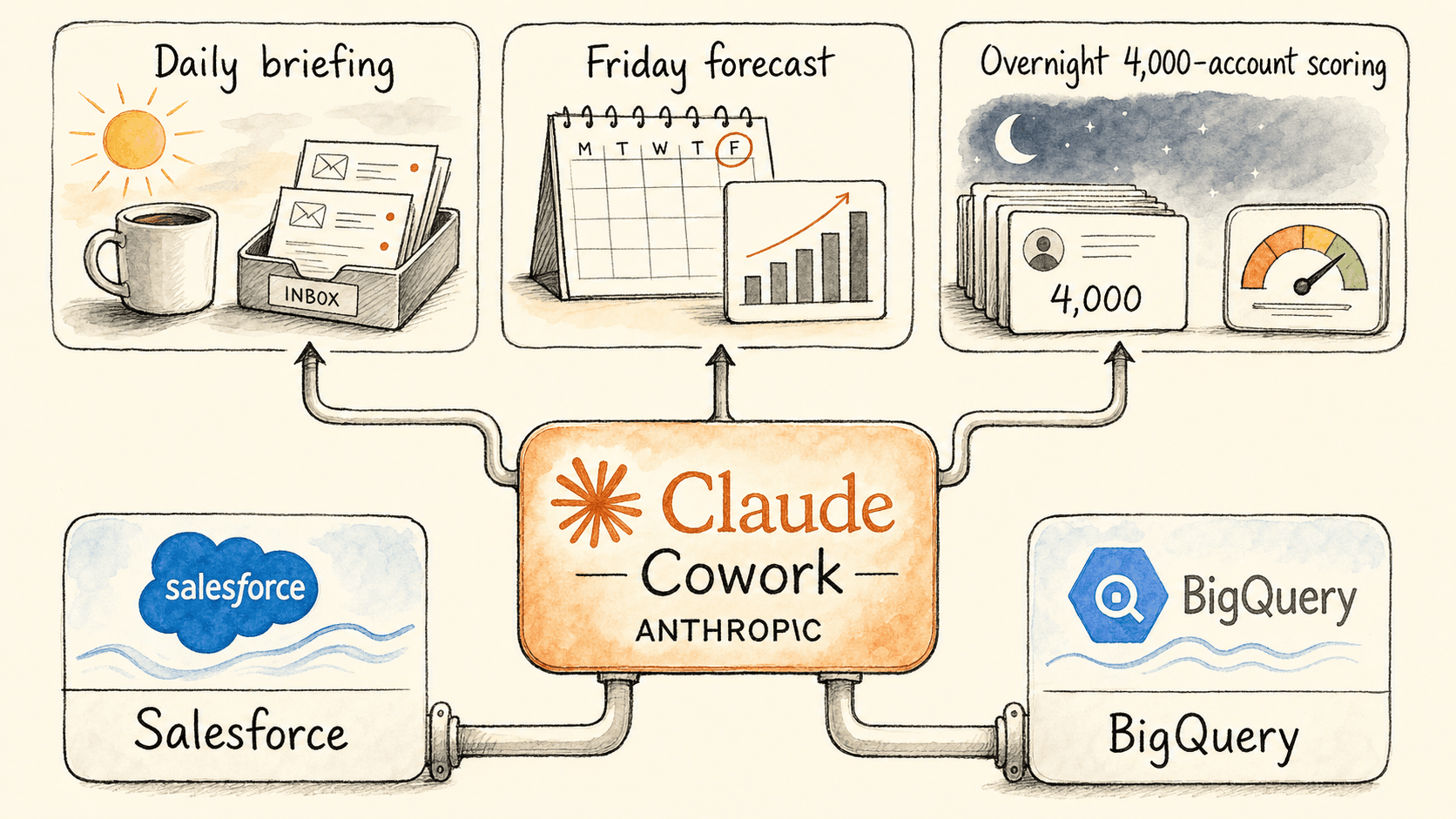
Anthropic's Sales Team on Claude Cowork: An AI-Augmented Sales Operations Layer in Practice
Travis Bryant, Head of US Mid-Market GTM at Anthropic, runs a 4,000-account book using Claude Cowork as the AI-augmented sales operations layer on top of Salesforce and BigQuery. Daily call prep, Friday forecast rollup in leadership's expected format, and overnight territory scoring that used to take hundreds of hours. The lesson is the architecture, not the chat — what an AI-augmented sales operations layer actually looks like when the CRM stays the system of record.