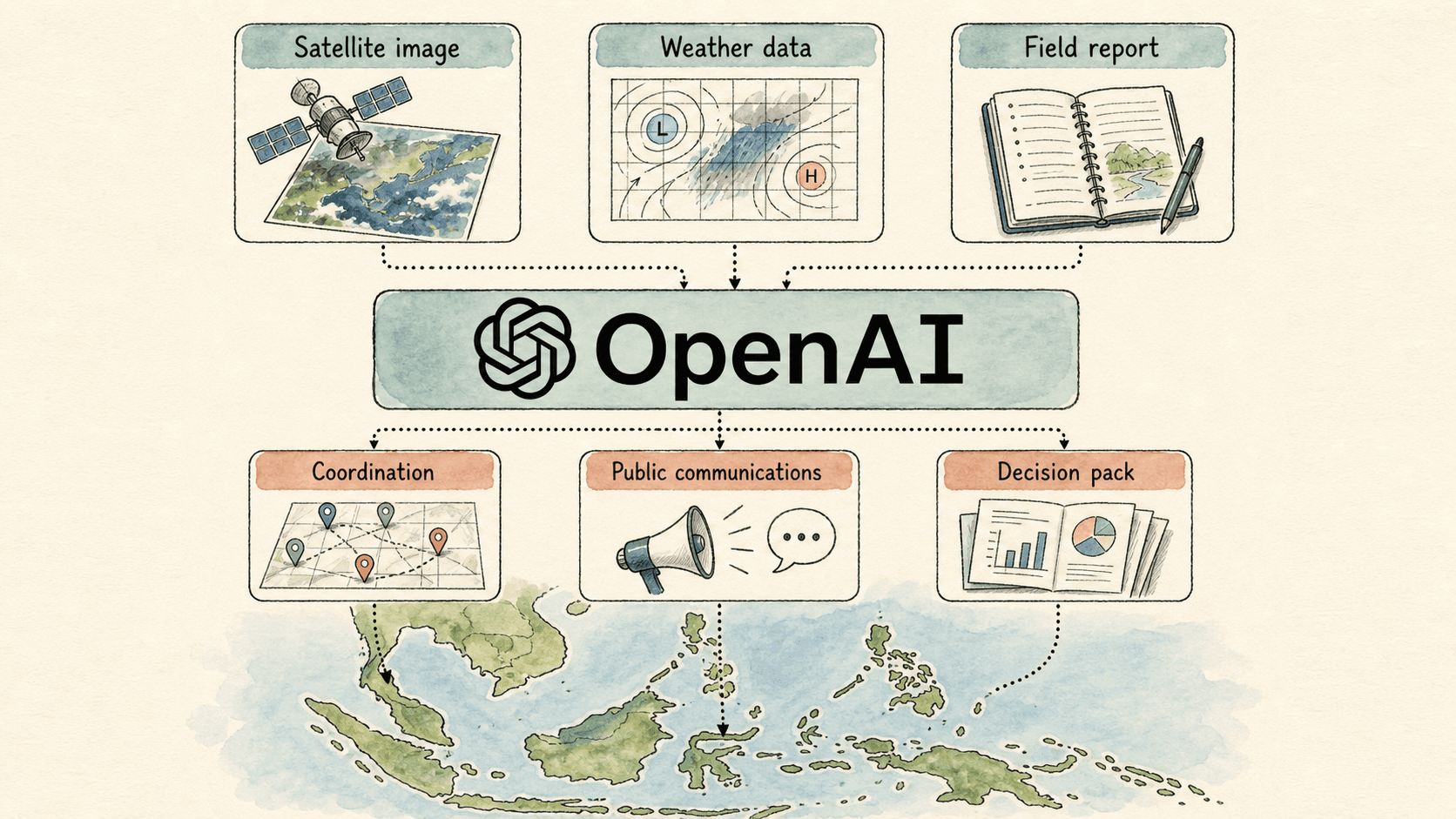
OpenAI's Bangkok AI Jam: What Asian Disaster Agencies Actually Need to Build Next

TL;DR
- OpenAI's March 2026 AI Jam in Bangkok with the Gates Foundation, the Asian Disaster Preparedness Center, and DataKind is a useful signal, not a finished product: it brought 50 disaster-management leaders from 13 Asian countries together to find practical ways to embed AI in situation reporting, needs assessment, and public communications, but the actual implementation work is what each agency, ministry, and NGO does next.
- Asia carries about 75 percent of the world's disaster-affected population and ASEAN disasters have cost the region more than 11 billion dollars in previous years, so the operating question for ministers, country directors, and emergency leads is not whether to use AI but how to govern it across early warning, response coordination, and post-event recovery without losing public trust.
- AI-assisted disaster response orchestration is the implementation discipline buyers actually need: a governed layer of role-specific agents, sovereign skills, MCP-connected tools, human approval gates, and measurable workflows that sits between a general-purpose model like ChatGPT or Claude and the operational reality of a disaster management agency.
OpenAI's Bangkok Jam is the right kind of starting signal. It is also exactly the moment where a serious enterprise or government buyer should stop reading the announcement copy and start asking the implementation questions a model provider cannot answer for them.
The announcement, dated 29 March 2026, describes a first-of-its-kind AI workshop for 50 disaster-management leaders from 13 countries across Southeast and South Asia: Bangladesh, India, Indonesia, Lao PDR, Malaysia, Myanmar, Nepal, Pakistan, the Philippines, Sri Lanka, Thailand, Timor-Leste, and Vietnam. OpenAI ran it in partnership with the Gates Foundation, the Asian Disaster Preparedness Center, and DataKind, with participants building custom GPTs and reusable workflows for situation reporting, needs assessment, and public communications. It also points to a second phase of pilot deployments in the coming months and frames the work as part of OpenAI's expanded country-level engagement programme announced earlier in 2026.
That is the platform direction. The implementation problem is what a national disaster management authority, a multilateral emergency cluster lead, or an international NGO country director does on Monday morning to turn that direction into a controllable capability. This guide is the layer AI Heroes builds for organisations that have decided AI is part of their operational future and need to deploy it without breaking trust, accountability, or the safety of the communities they serve.
What did OpenAI announce in Bangkok about AI for disaster response in Asia?
OpenAI announced an inaugural AI Jam in Bangkok on 29 March 2026 that brought 50 disaster-management leaders from 13 Asian countries together with OpenAI mentors, the Gates Foundation, the Asian Disaster Preparedness Center, and DataKind to build practical AI workflows for situation reporting, needs assessment, and public communications.
The announcement is significant for three reasons that matter to buyers, not just to AI watchers. First, the workshop is explicitly framed as moving organisations beyond interest in AI into real-world applications embedded in operational challenges, which is the gap most disaster agencies actually live in. Second, it positions disaster response as a regional capability problem across South and Southeast Asia, where the operating models, data systems, and political contexts differ sharply between, say, the Philippines' NDRRMC and Indonesia's BNPB. Third, OpenAI cites internal usage data showing a 17× increase in cyclone-related messages on ChatGPT during Cyclone Ditwah in Sri Lanka and a 3.2× increase during Cyclone Senyar in Thailand in November 2025, which signals that the public is already turning to AI assistants during crises whether responders are ready for that surface or not.
For an enterprise or government decision-maker, the announcement is best read as a directional commitment, not a finished platform. The serious follow-on question is what governance, integration, and measurement layer your own organisation needs around tools like ChatGPT, Claude, Gemini, or open models so that AI usage during a disaster is an asset rather than a liability.
Why does AI in Asian disaster response matter more than in most other regions?
Asia is the world's most disaster-prone region: it accounts for roughly 75 percent of people affected by disasters globally, and the World Bank estimates disaster costs in ASEAN countries have exceeded 11 billion dollars in previous years. That concentration of exposure is the reason AI in disaster response in Asia is not a small experimental theme but a material capability question for ministries, multilaterals, and NGOs operating across the region.
Three operating realities reinforce the urgency. Disaster response teams in many Asian jurisdictions work in resource-constrained environments where data is fragmented across ministries, manual reporting still dominates needs assessment, and infrastructure is uneven across districts and islands. Climate-linked event frequency is rising, with the second half of 2025 alone producing a series of typhoons and severe storms that stretched national systems. And public behaviour is shifting in real time: the cyclone-related usage surges OpenAI reported show that affected populations are already using consumer AI to interpret warnings, find help, and translate guidance, which makes the quality of AI-mediated information part of the response system whether agencies opt in or not.
The implementation question for a country lead is therefore practical, not philosophical. Where should AI sit in the existing early-warning, response, and recovery chain so it accelerates coordination and decision-making without weakening accountability, displacing trusted local expertise, or introducing failure modes that only show up under crisis pressure?
Where does AI actually help across the disaster cycle?
AI helps most clearly in tasks that are information-heavy, repetitive under pressure, and currently dominated by manual document and message work: situation reporting, needs assessment synthesis, public communications drafting, translation, satellite and earth-observation analysis, and early-warning interpretation. It helps least in tasks that require accountable judgement, on-the-ground negotiation, or trusted relationships with affected communities.
A useful way to look at where AI fits is by phase, because the governance and risk model differs at each step.
| Disaster phase | High-leverage AI tasks | Hard requirement | Common failure mode |
|---|---|---|---|
| Preparedness | Risk mapping, scenario plans, plain-language guidance drafts in local languages, training simulations, contact-list maintenance | Tools must be auditable and version-controlled before a real event | Models drift from approved policy when nobody owns updates |
| Early warning | Multilingual public messaging, social-media monitoring, satellite/EO signal triage, threshold alert summaries | Human approval before any public-facing warning | Auto-published warnings contradict the official meteorological authority |
| Response coordination | Situation report drafting, incoming-message triage, needs-assessment synthesis, cluster meeting prep, donor briefings | Source attribution and edit history on every output | Briefs cite hallucinated figures the next coordination meeting reuses |
| Public communications | Translated public guidance, FAQ drafts, social messaging variants, accessibility versions | Tone, accuracy, and cultural review before send | AI-generated guidance contradicts local authority or omits caveats |
| Damage and needs assessment | Image classification from drone or satellite, structured intake from field forms, aggregation across districts | Clear ground-truth feedback loop | Model outputs treated as final without district validation |
| Recovery and learning | After-action report synthesis, donor reporting, learning-document drafts, archive search | Owner for memory and version history | Lessons live in chat threads and are lost by the next event |
The same logic applies to multilateral and NGO operating models. Many of the workflows the OpenAI Jam targeted, particularly situation reporting and needs assessment, are exactly the points in the cycle where the time savings are largest and where the governance burden is highest, which is why the implementation layer matters more than the model choice.
What is AI-assisted disaster response orchestration, and why is it the right buyer category?
AI-assisted disaster response orchestration is the implementation discipline that turns general-purpose AI tools into a governed set of role-specific agents, sovereign skills, MCP-connected systems, human approval gates, and measurable workflows that operate across the preparedness, response, and recovery cycle. It is the operational layer that sits between a model like ChatGPT, Claude, or Gemini and the daily reality of a national disaster management authority, a UN cluster lead, or an INGO country team.
Three pieces sit underneath that definition. The first is decomposition: a single all-purpose assistant is the wrong shape for crisis work, because the trust boundaries, source data, and approval rules differ sharply between, for example, a public-facing message generator and an internal needs-assessment synthesiser. The second is portability of judgement: response protocols, sphere standards, IASC guidance, and country-specific procedures need to live inside skills and reference packs that the AI is required to consult, not in someone's head or a personal prompt. The third is measurability: an orchestration layer is only credible if you can show donors, regulators, and affected communities what the AI did, what a human approved, what was overridden, and what improved.
This category matters because it is the layer most disaster agencies are missing today. They have access to capable models. They have pilots in their teams. What they typically lack is the governed structure that lets the second hundred staff use the same capability as the first ten exceptional people without the system silently degrading into shadow automation.
How should a national disaster management agency or NGO scope its first AI deployment?
Scope the first AI deployment around one or two clearly bounded workflows with measurable acceptance criteria, defined data sources, an approval path, and a named owner, rather than launching a department-wide "AI for response" mandate that nobody can govern.
Good candidate first workflows include automated situation-report drafting from verified inputs, multilingual translation of public guidance from a single authoritative source, structured triage of incoming citizen messages during a declared event, donor-report assembly from internal data, and after-action draft generation from approved logs. Bad candidates include open-ended chatbots for affected populations, autonomous public-warning systems, and unsupervised social-media response.
The shape of a controllable first deployment has five fixed pieces. The workflow itself is named and documented, with explicit inputs, outputs, and stop conditions. The data sources are inventoried, including which are authoritative, which require attribution, and which must never enter the model. The tool boundary is set: which systems the AI can read, draft into, write to, send from, or never touch. The approval path is explicit, especially for outputs that reach the public or that influence resource allocation. And the evaluation set is decided in advance, with realistic crisis-like inputs the team uses to test the workflow before, during, and after live use.
This is the same shape the OpenAI Bangkok Jam pointed at when it framed the work around custom GPTs and reusable workflows. The Jam is a useful pattern. The implementation question is whether your organisation can sustain that pattern across many workflows, across rotating staff, across multiple events, and across the scrutiny that comes after a contested response.
How does an enterprise AI assistant compare with a humanitarian AI orchestration layer?
A consumer or enterprise AI assistant is designed for general productivity inside a controlled corporate environment. A humanitarian AI orchestration layer is designed for time-critical, life-safety-relevant work across jurisdictions, languages, and accountability regimes. The differences matter because buying decisions made on consumer-product logic create governance problems under crisis conditions.
| Dimension | General consumer or enterprise AI | AI-assisted disaster response orchestration |
|---|---|---|
| Primary user | Knowledge worker in a corporate setting | Response officer, cluster lead, ministry analyst, NGO country team |
| Operating environment | Stable network, predictable workload | Surge events, intermittent connectivity, multilingual public surface |
| Failure tolerance | Embarrassing if wrong | Can affect safety, public trust, or resource allocation |
| Data sensitivity | Mostly commercial confidentiality | Personally identifying data of affected people, classified operational data, donor reporting data |
| Approval model | Manager review | Multi-level approval with audit trail across agency and partners |
| Public surface | Internal docs and emails | Public warnings, guidance, translated messages |
| Memory needs | Recent project context | Country protocols, IASC standards, donor agreements, lessons from past events |
| Integration surface | Office suite and CRM | EOC tools, GIS, EWS feeds, IM systems, partner platforms via MCP or APIs |
| Procurement context | Software seat purchase | Public-sector or humanitarian procurement with controls and reporting |
| Success metric | Productivity self-report | Time to publish a verified SitRep, accepted-output rate, override reasons, post-event audit |
The point is not that consumer AI is bad. It is that disaster response leadership has to decide deliberately what sits inside the controlled orchestration layer and what stays in general-purpose tools used by individuals. The Bangkok Jam shows OpenAI is willing to invest in that boundary. Implementation is still a buyer responsibility.
What governance does an AI rollout in disaster management actually need?
An AI rollout in disaster management needs governance that lives inside the workflow, not in a policy PDF that no one reads under pressure. The controls have to be visible to the operator, the supervisor, the partner agency, the donor, and the after-action auditor.
A practical minimum has six layers. Tool permissions are explicit and split into read, draft, send, and delete capabilities, with public-facing actions always behind a human approval state. Logs and transcripts are captured for every workflow run, with output, sources cited, model and version, prompt summary, and approver. Evaluations are maintained as a small but realistic set of test cases drawn from past events, run before each major exercise and after each significant model change. Memory and reference files have an owner and a review cycle, so policy updates, sphere standards, and lessons from real events flow back into the AI's instructions rather than evaporating in chat threads. Incident review is part of after-action work, so any AI-mediated decision that contributed to a contested outcome is examined the same way other operational decisions are. And data protection follows the law and the humanitarian principles of the jurisdiction, with explicit rules on what personal data can ever leave a controlled environment.
Practitioners working on the AI Skills Jam approach described by ADPC executive director Aslam Perwaiz emphasise combining AI tools with regional expertise and partnerships to strengthen early-warning systems and risk mapping. That is the right framing. The implementation layer is what turns that framing into something a country office can be audited on.
What is a realistic 90-day plan to operationalise AI for disaster response?
A realistic 90-day plan focuses on one country office or national agency, one or two bounded workflows, a governed pilot with measurable outputs, and an explicit decision point at the end about whether to expand. Anything broader collapses under the operational rhythm of a real response season.
In the first 30 days, name the owner, choose the first workflow, and inventory inputs. Identify which data sources are authoritative, which require attribution, and which can never enter a model. Define the approval path, the tool boundary, and the success measures. Build the initial reference pack: country protocols, partner agreements, language guidance, and any non-negotiable rules. Set up logging from day one.
In the second 30 days, run the workflow against historical events as if they were live, using the evaluation set to spot failure modes before they reach a public surface. Train the operating team in approval discipline, override reasons, and incident reporting. Connect only the tools the workflow needs through MCP or controlled APIs, with read, draft, and send boundaries set explicitly. Start a small change log of every reference-file update.
In the final 30 days, run the workflow during a real but lower-stakes event, such as a seasonal preparedness exercise, a multi-agency drill, or an actual sub-threshold event. Measure cycle-time compression, accepted-output rate, override reasons, and incident rate. Compare against the manual baseline. Hold a structured after-action review that treats the AI workflow as a system to evaluate, not a feature to defend.
At day 90, the decision is not "did the AI perform well in the demo." The decision is whether the orchestration layer is good enough to scale to a second workflow, a second team, and a real event. That is the threshold most pilots fail to articulate, which is why most pilots stall.
Authoritative sources
- OpenAI: Helping disaster response teams turn AI into action across Asia
- OpenAI for Countries Program: Ending the capability overhang
- Asian Disaster Preparedness Center
- Humanitarian Action: Asia and the Pacific 2025
- World Bank: Strengthening financial preparedness in Southeast Asia
- Gates Foundation: Emergency Response
- DataKind
Related reading
- Building AI agents in the enterprise: implementation patterns for 2026
- Claude Cowork in regulated industries: enterprise controls explained
- Claude for small business: a 2026 implementation guide
- Claude skills and agent workflows: why prompts are not enough
- Founder's Playbook implementation guide: operationalising Claude
- AI institutional knowledge: keeping memory inside the organisation
- AI Heroes AI solutions for businesses and public-sector teams
Frequently Asked Questions

Founder, AI Heroes
I build AI companies and the systems inside them. At AI Heroes, we give businesses the functional capacity to grow without the headcount growth normally demands — sales that follows up, marketing that runs, content that ships, ops that handles itself. We audit where you're leaving growth on the table, build the team that captures it, and hand it over completely.
I've built at scale before. Leading product and GTM at SlideSpeak AI (1M+ monthly users, profitable, bootstrapped). CPO at Disperse — the AI construction platform that went from 3 to 200+ people on $35M raised. I also co-founded LOBOMAR, a luxury fashion label featured in Elle, Cosmopolitan, and the LA Times, with shows at the London Design Museum, Wereldmuseum, and Amsterdam Fashion Week.
Related Articles
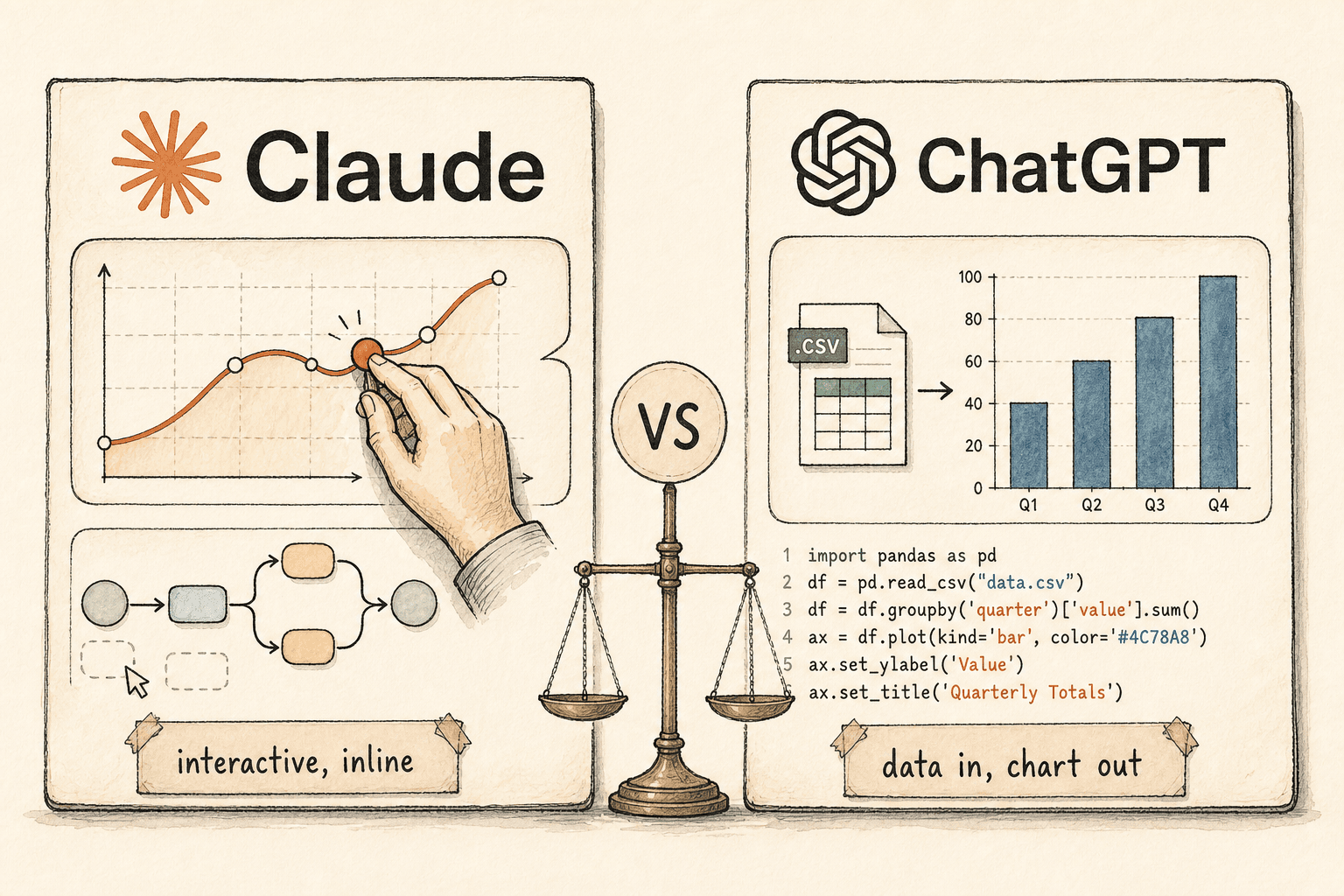
Claude vs ChatGPT for Charts, Diagrams & Visualizations: Which One Should You Use in 2026?
Upload a dataset and need a precise, downloadable chart with the code shown? That's ChatGPT. Want a visual you can poke at, iterate on in conversation, or ship as a shareable interactive tool? That's Claude. The full comparison — capabilities, plans, and where each one quietly loses.

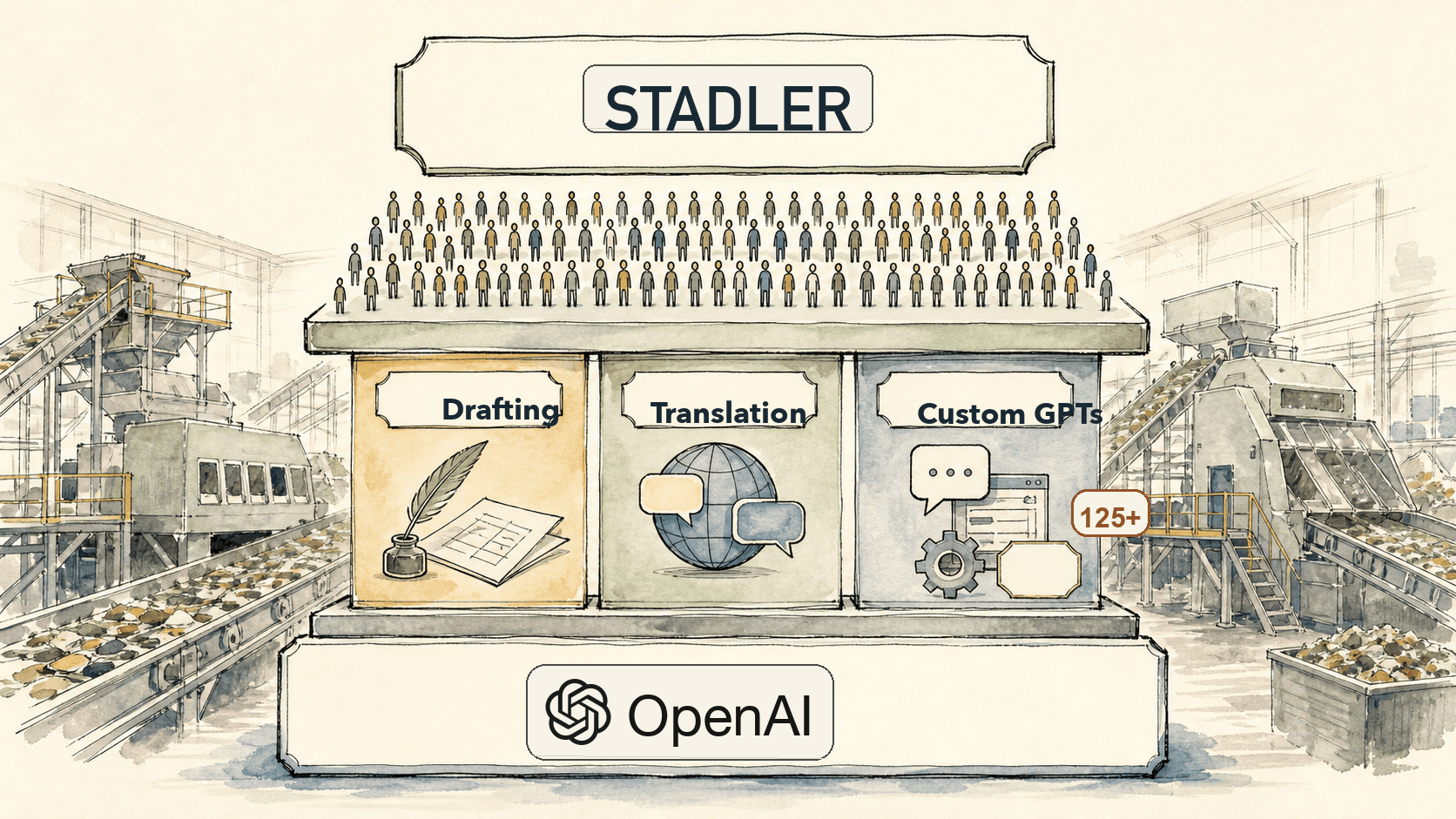
What STADLER's ChatGPT Rollout Teaches About Industrial AI Adoption
OpenAI's STADLER customer story is one of the cleanest enterprise AI cases of 2026: a 650-person, 230-year-old industrial manufacturer reaching >85% daily active usage on a horizontal LLM. The interesting part is the operating layer underneath the numbers — and what it tells European mid-market boards about industrial AI adoption.
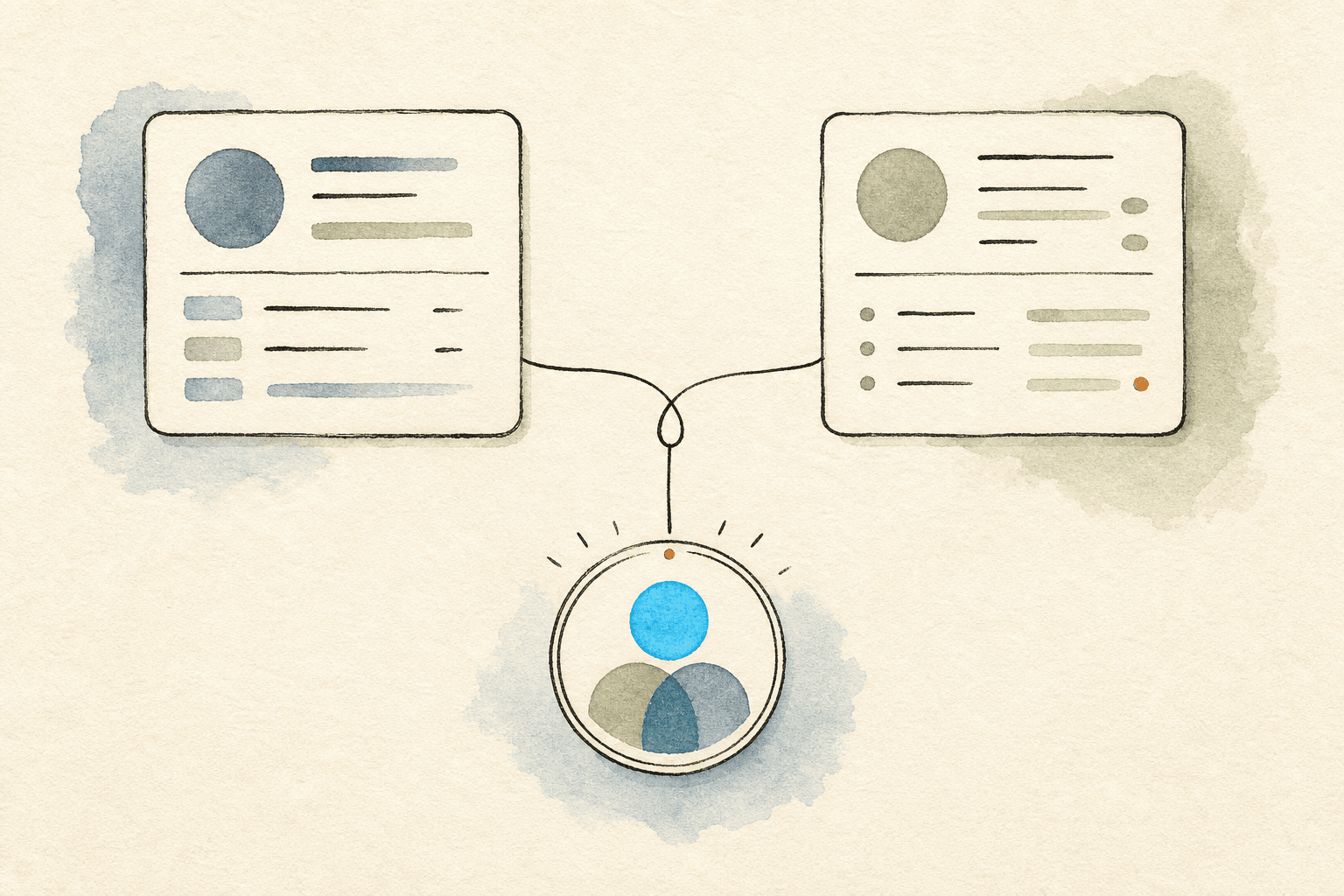
What Is Entity Resolution? How It Actually Works, and Why It Matters in 2026
One agent broke in the quietest way possible. The same customer lived in both systems as two different records.