
How Lettings Agencies Use Claude Cowork Scheduled Tasks to Chase Maintenance and Compliance Admin

Last updated: 13 April 2026
TL;DR
- Lettings agencies should start with recurring maintenance and compliance admin, not a broad automation programme.
- Cowork can check inboxes, folders, portals, calendars, and exports each day, then prepare contractor chases, landlord approvals, tenant updates, and end-of-day summaries.
- The human property manager still approves works, sensitive messages, compliance decisions, and disputes.
Key takeaway
Claude Cowork can help lettings agencies reduce recurring maintenance and compliance admin by checking agreed sources, preparing follow-ups, and summarising open items. It should support property managers, not make final landlord, tenant, contractor, or compliance decisions without review.
For Claude Cowork lettings agencies use cases, the best starting point is not a grand automation project. It is the daily loop that every property manager recognises: repair reported, contractor chased, landlord approval requested, tenant updated, certificate renewal checked, and the same status question answered three times before lunch.
Claude Cowork is useful here because it combines scheduled tasks, computer use, connectors, dispatch, file organisation, and report preparation. That maps cleanly to lettings admin, where the problem is rarely one hard decision. The problem is coordination across inboxes, portals, shared folders, calendars, and people who respond at different speeds.
What can Cowork do for a lettings agency?
Think about a 12-person lettings agency in Leeds managing 600 properties. The team has a property management inbox, a contractor WhatsApp habit, landlord approval chains, renewal dates, gas safety checks, EICR reminders, and maintenance notes scattered across a CRM and email. Nobody is confused about the work. The pain is that the work keeps reappearing.
Cowork can support the repetitive coordination layer.
Schedule the morning maintenance check
Set a Scheduled Task to check the maintenance inbox, connected folders, and agreed property-management exports every morning. The output should be a short list of new issues, overdue contractor replies, landlord approvals still outstanding, and tenant updates that need sending.
This does not replace a property manager. It gives the manager a cleaner starting point.
Use computer use where portals get in the way
Lettings workflows often involve portals with no neat API. Contractor systems, landlord dashboards, compliance portals, and legacy property software can all force manual checking. Computer Use is relevant because Cowork can operate across browser and desktop surfaces when the workflow has been safely scoped.
The right guardrail is simple: Cowork can check status and prepare notes. A human should approve anything that changes money, legal position, tenancy terms, or contractor instruction.
Dispatch overdue items to the right person
A useful maintenance workflow is not just a list. It routes the next action. If a contractor has not replied, Cowork can prepare a chase. If landlord approval is missing, it can draft the landlord message. If the tenant needs an update, it can prepare a plain-language status note.
The agency gets value because the task does not vanish between systems.
Prepare the end-of-day property manager summary
At 4pm, Cowork can prepare a short report: new issues, resolved jobs, overdue approvals, missing certificates, tenant updates waiting for review, and contractor tasks that should roll into tomorrow. That is the sort of report a senior property manager can use immediately.
Where should lettings agencies be careful?
Do not use Cowork as a compliance decision-maker. Do not let it approve works, interpret tenancy disputes, decide deposit matters, or send sensitive messages without review. The strongest use case is supervised coordination: finding what needs attention, preparing the next step, and keeping the status trail clean.
If you manage a busy portfolio, the first pilot should be boring on purpose. Choose one workflow: maintenance intake and follow-up, compliance certificate chasing, or landlord approval tracking. Measure whether managers spend less time asking "where is this up to?"
Problem-solution examples
| Problem | Cowork-supported workflow | Human control |
|---|---|---|
| Tenants keep asking for maintenance status | Scheduled summary of contractor replies and open actions | Manager approves tenant update |
| Landlord approvals are buried in email | Daily list of pending approvals with draft chase messages | Manager checks cost and wording |
| Compliance reminders are missed | Recurring task checks renewal list and missing certificates | Manager confirms compliance action |
| Contractor portals require manual checking | Computer Use checks status where no API exists | Manager approves next instruction |
Bottom line
Claude Cowork is not a property-management system. It is a practical layer for the recurring admin around that system. For lettings agencies, the win is less status fog: fewer forgotten chases, cleaner handoffs, and better property-manager review.
If your lettings team is drowning in maintenance and compliance admin, explore our AI solutions, review pricing, or talk to Marco about a Cowork workflow pilot.
Frequently Asked Questions

Founder, AI Heroes
I build AI companies and the systems inside them. At AI Heroes, we give businesses the functional capacity to grow without the headcount growth normally demands — sales that follows up, marketing that runs, content that ships, ops that handles itself. We audit where you're leaving growth on the table, build the team that captures it, and hand it over completely.
I've built at scale before. Leading product and GTM at SlideSpeak AI (1M+ monthly users, profitable, bootstrapped). CPO at Disperse — the AI construction platform that went from 3 to 200+ people on $35M raised. I also co-founded LOBOMAR, a luxury fashion label featured in Elle, Cosmopolitan, and the LA Times, with shows at the London Design Museum, Wereldmuseum, and Amsterdam Fashion Week.
Related Articles

Claude Cowork Enterprise Controls for Payroll Bureaus: What Changed on April 9
Claude Cowork's enterprise-readiness push matters for payroll bureaus because the work is recurring, sensitive, and full of exceptions. The practical question is where Cowork can reduce admin drag without weakening review control.

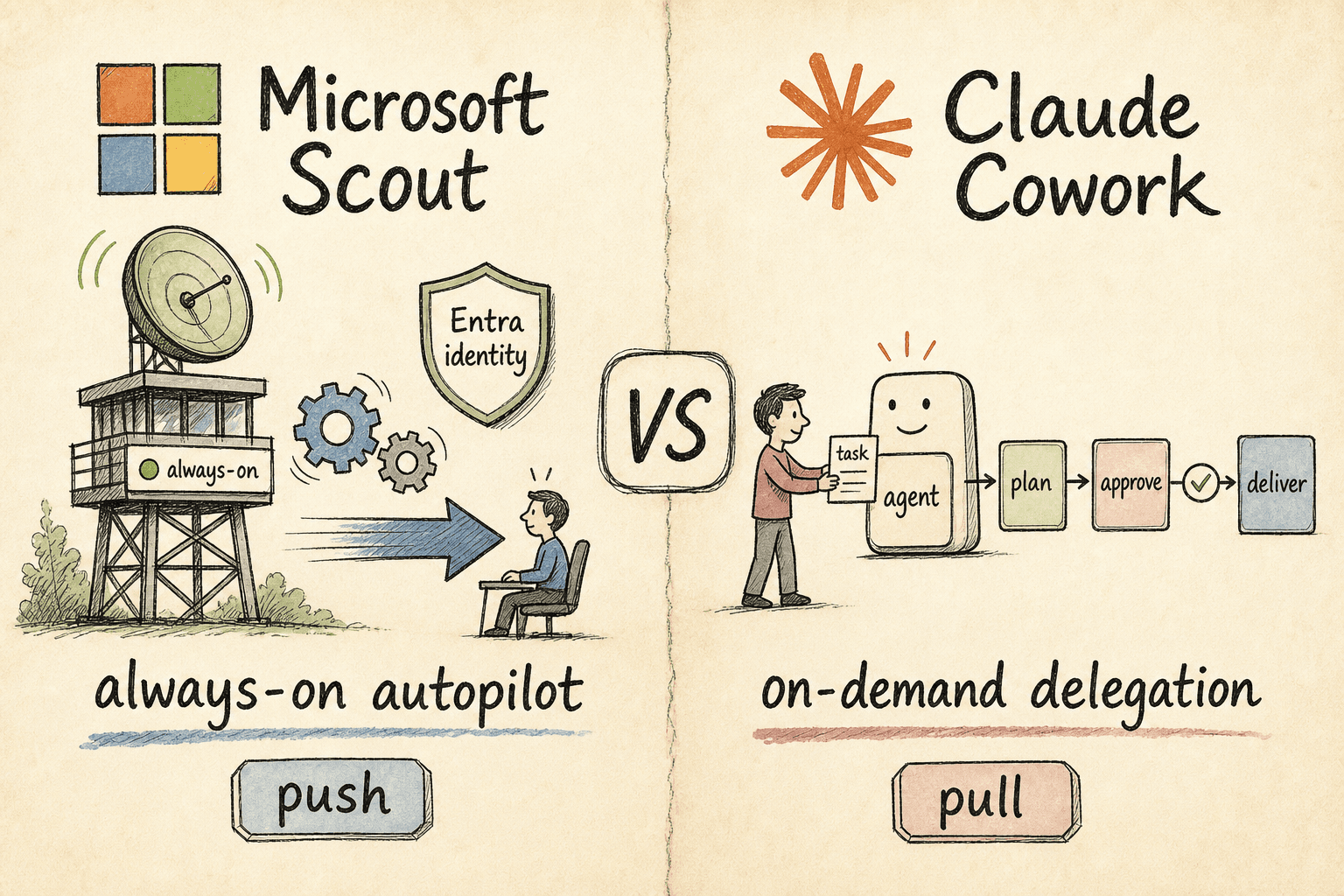
Microsoft Scout vs Claude Cowork: Autopilot or Delegation?
Two of 2026's biggest agent launches make opposite bets. Microsoft Scout is a desktop autopilot that runs in the background and acts on your behalf; Claude Cowork waits for you to hand it a task, then delivers. One is push, the other pull — here's which fits your team.

How to Get Started with Claude Cowork: A Decision Framework for Knowledge Workers (2026)
Claude Cowork is where you delegate a whole task instead of asking a question — point it at your files and apps, describe the outcome, get finished work. The hard part isn't the prompt, it's knowing which tasks to hand it. Here's a 5-signal fit test, the three shapes a Cowork task can take, and how to get your first deliverable in ten minutes.