
Claude Code Desktop Redesign: What Parallel Agents Mean for US Software Teams

Last updated: April 15, 2026
Key takeaway
Claude Code desktop redesign matters because it turns agentic coding into a multi-session operating surface. US software teams can supervise parallel Claude Code work, review diffs, run tests, edit files, and preview outputs from one desktop app instead of scattering that work across terminals, editors, and browser tabs.
Claude Code desktop redesign is Anthropic's April 14, 2026 update to the Claude desktop app for parallel coding agents. Released on April 14, 2026, it adds a session sidebar, drag-and-drop workspace layout, integrated terminal, in-app file editor, faster diff viewer, HTML and PDF previews, CLI plugin parity, local and cloud sessions, and availability for all Claude Code users on Pro, Max, Team, and Enterprise plans. For Claude Code desktop redesign searches, the important point is simple: Anthropic is designing the workflow around multiple active agents, not one linear chat.
What changed in the Claude Code desktop redesign?
Anthropic's official Claude Blog says the redesigned desktop app helps users run more Claude Code tasks at once. The release adds a sidebar for active and recent sessions, filtering by status, project, or environment, side chats for questions that should not pollute the main thread, an integrated terminal, an in-app file editor, a rebuilt diff viewer, expanded HTML and PDF preview, drag-and-drop panes, plugin parity with the CLI, SSH support across Mac and Linux, view modes, keyboard shortcuts, usage visibility, and streaming responses.
That is not a cosmetic update. It changes how an engineering lead can manage agentic work across a product backlog.
Why should US software teams care?
US startups and software teams already run hot. The bottleneck is rarely a lack of tickets. It is the coordination tax around fixing bugs, reviewing changes, moving across repos, and keeping enough context to make good merge decisions. A product engineer in Austin or San Francisco can now start a small refactor, a flaky-test investigation, and a documentation pass, then watch each agent session from the same app.
The business value is not "more AI". The business value is less context switching. If one session is waiting for approval, another is running tests, and another has a diff ready, the lead can keep work moving without opening five disconnected tools.
Is this an IDE replacement?
Not exactly. It has IDE-like surfaces, but the more important unit is the agent session. Traditional IDEs organise work around files, panels, and projects. Claude Code desktop redesign organises work around running agents, their status, their diffs, and the decisions they need from you.
That distinction matters for growing teams. Once you have several Claude Code sessions live, session management becomes part of the delivery system. Without it, parallel agents create hidden work. With it, they become easier to supervise.
What should teams avoid overclaiming?
This update does not remove code review. It does not make all engineering work safe to parallelise. It does not replace CI, branch protection, human approval, product judgement, or a real release process.
The sober read is stronger than the hype. Claude Code desktop redesign reduces orchestration drag for teams already using agentic coding. It gives senior engineers a better workspace for supervising multiple Claude Code tasks, but the team's quality bar still decides what ships.
How does this relate to routines?
Routines let Claude Code automations run on a schedule, from an API call, or from an event. The desktop redesign is for active supervision. Together, they point to a practical operating model: recurring checks can run in the cloud, while judgement-heavy work stays in a supervised desktop workspace.
For US teams, that means backlog hygiene, deploy checks, and routine PR triage can move toward scheduled or event-driven routines. Feature work, migrations, and risky bug fixes still deserve live steering and review.
If you want to turn this into a reliable delivery system, review our AI solutions, see how we build skills and plugins, browse the blog, or talk to Marco.
Authoritative sources
The agent built for this
Richard
A forward-deployed AI agent that gets your software live and adopted inside every customer.
Meet RichardFrequently Asked Questions

Founder, AI Heroes
I build AI companies and the systems inside them. At AI Heroes, we give businesses the functional capacity to grow without the headcount growth normally demands — sales that follows up, marketing that runs, content that ships, ops that handles itself. We audit where you're leaving growth on the table, build the team that captures it, and hand it over completely.
I've built at scale before. Leading product and GTM at SlideSpeak AI (1M+ monthly users, profitable, bootstrapped). CPO at Disperse — the AI construction platform that went from 3 to 200+ people on $35M raised. I also co-founded LOBOMAR, a luxury fashion label featured in Elle, Cosmopolitan, and the LA Times, with shows at the London Design Museum, Wereldmuseum, and Amsterdam Fashion Week.
Related Articles
Claude Opus 4.7 for Claude Code: What US Software Teams Should Change First
Claude Opus 4.7 changes how US engineering teams should brief, budget, review, and reset Claude Code sessions.

Claude Code Routines for Software Teams: What Anthropic's New Automation Preview Means
Claude Code routines give software teams a new way to run repeatable agent work from the cloud. The useful question is not whether to automate everything, but which recurring workflows deserve a governed routine.
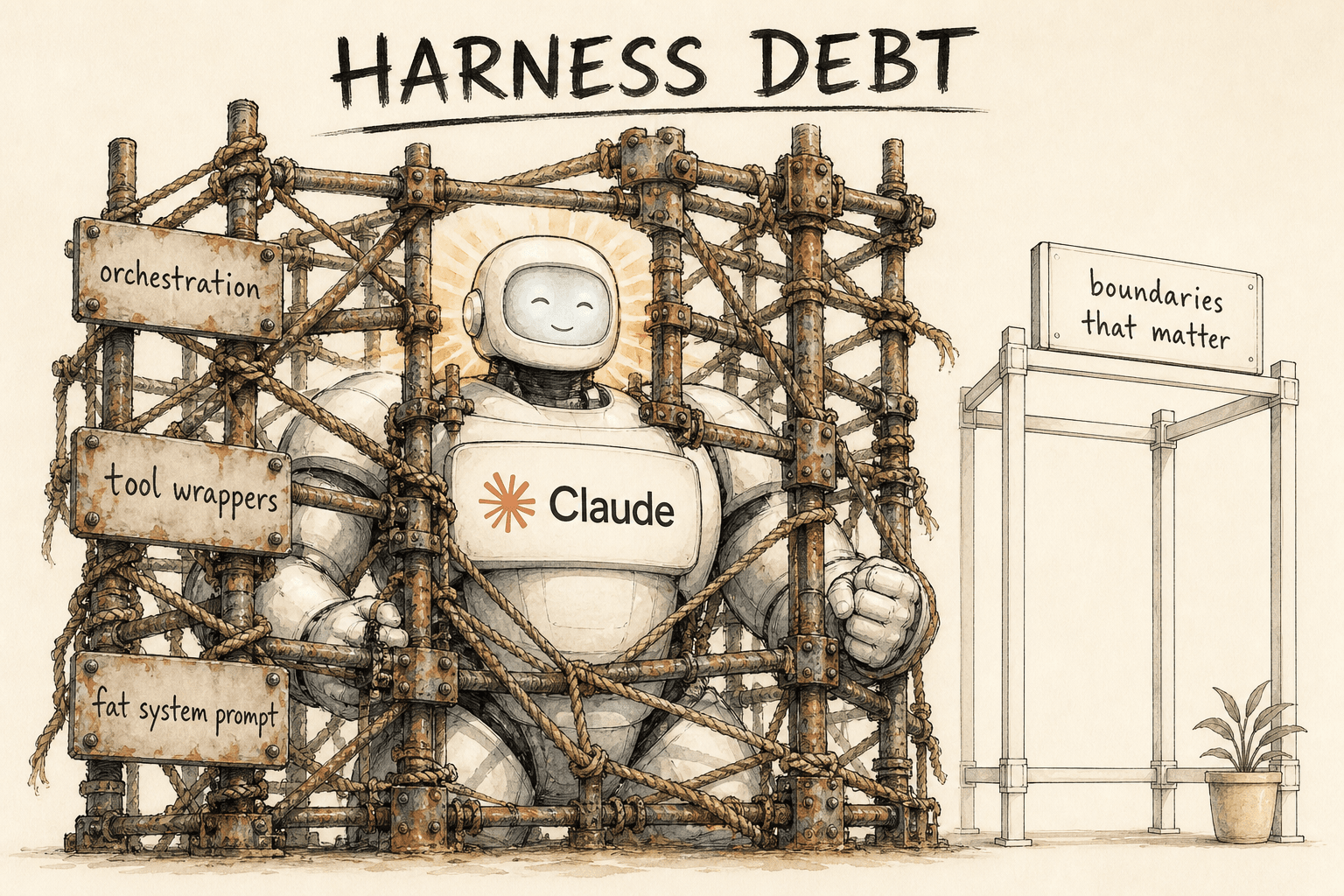
Harness Debt: Your AI Agent Scaffolding Is Quietly Fighting the Model (2026)
Your AI agent is probably worse than the model inside it — and the gap is your own scaffolding. An experimental harness scored over 2x Anthropic's standard one on the same model. The fix isn't a bigger framework; it's deleting the assumptions that went stale the day Claude Opus 4.6 shipped.