Claude Opus 4.7 for Claude Code: What US Software Teams Should Change First

Last updated: April 17, 2026
Key takeaway
Claude Opus 4.7 is Anthropic's newest generally available Opus model for Claude Code. Released on April 16, 2026, it improves advanced coding, long-running agentic tasks, vision, and review workflows for teams using Claude Code.
Claude Opus 4.7 is now generally available across Claude products, the Claude API, Amazon Bedrock, Google Cloud Vertex AI, and Microsoft Foundry. For Claude Opus 4.7 Claude Code searches, the practical answer is not just that the model is stronger. US software teams should change how they brief Claude Code, choose effort levels, manage sessions, and review diffs.
Anthropic says Opus 4.7 is a direct upgrade to Opus 4.6, with stronger advanced software engineering performance, better high-resolution vision, improved instruction following, and better file-system memory use. Developers can call claude-opus-4-7. Pricing remains the same as Opus 4.6 at 5 dollars per million input tokens and 25 dollars per million output tokens, but Anthropic also warns that token behaviour can change because of the updated tokenizer and higher effort settings.
What changed inside Claude Code?
The biggest workflow change is effort control. Opus 4.7 introduces xhigh, an extra high effort level between high and max. Anthropic says Claude Code's default effort is now xhigh across plans and recommends starting Opus 4.7 coding tests with high or xhigh.
That matters because effort is now a management decision, not just a model setting. Use xhigh for difficult bug hunts, cross-file refactors, security-sensitive review, and ambiguous integration work. Use lower effort when the task is small, well-scoped, or mostly editorial. Track /usage during long sessions so a useful agent does not quietly become an expensive one.
The second change is review. /ultrareview starts a dedicated review session that reads through changes and flags bugs or design issues a careful reviewer should catch. Treat it as a pre-human review pass. It can raise the floor before a senior engineer looks at the diff, but it does not replace tests, CI, branch rules, or code ownership.
The third change is session discipline. The Claude Code session-management guidance is now more important because Opus 4.7 is better at long work, which means teams will be tempted to keep sessions alive too long.
What should a US software team change first?
Picture a 38-person SaaS team in Austin or Denver using Claude Code for bug fixes, PR review, and integration work. Their problem is not access to coding agents. Their problem is that long interactive sessions get expensive, context drifts, and senior engineers still need a reliable review pass before merge.
Start with the first turn. Opus 4.7 follows instructions more literally, so a vague prompt can create a surprisingly literal implementation. The first brief should name the repo area, the objective, the constraints, the tests to run, the files to avoid, and what a good final report should contain.
Then set an effort rule. For substantial agentic work, start with high or xhigh. For small edits, do not pay for more reasoning than the task needs. If a session has moved from exploration into implementation, tell Claude Code to restate the plan and expected files before editing.
Finally, add a review ritual. Run tests where practical, call /ultrareview for serious diffs, then have a human reviewer decide what ships. That sequence gives the model a chance to catch its own mistakes without pretending the model is accountable for production.
When should you compact, rewind, or start fresh?
Use the session-management tools deliberately.
If the same task is still active and the context is useful, continue in the same session. If Claude went down the wrong path, use /rewind so the useful reads stay and the bad attempt disappears. If the session is long but still on the same task, use /compact with a specific hint. If the task changes, use /clear and start a fresh session with a short handoff written by the human lead. If a chunk of work will produce lots of tool output that the main session will not need again, delegate it to a subagent.
This is where 1M context helps but does not remove discipline. More context gives you more room before compaction, but stale context still lowers clarity. The best teams will not ask how long one Claude Code session can survive. They will ask when a fresh context produces better work.
What should teams avoid overclaiming?
Do not tell the team Opus 4.7 is simply cheaper. Anthropic says the pricing is unchanged, but token behaviour depends on content, effort, and interaction pattern. Measure real work.
Do not treat /ultrareview as a code-owner replacement. It is a model-assisted review pass, not accountability.
Do not run risky cybersecurity work casually. Anthropic says Opus 4.7 includes safeguards for prohibited or high-risk cybersecurity requests. Legitimate security work still needs permission, scope, logging, and review.
The best migration plan is operational: better briefs, explicit effort rules, cleaner session boundaries, /usage checks, and a review pass before human sign-off.
If you want Claude Code to become a reliable delivery system rather than a pile of clever sessions, review our AI solutions, see pricing, browse more launch coverage on the blog, or talk to Marco.
Authoritative sources
Frequently Asked Questions

Founder, AI Heroes
I build AI companies and the systems inside them. At AI Heroes, we give businesses the functional capacity to grow without the headcount growth normally demands — sales that follows up, marketing that runs, content that ships, ops that handles itself. We audit where you're leaving growth on the table, build the team that captures it, and hand it over completely.
I've built at scale before. Leading product and GTM at SlideSpeak AI (1M+ monthly users, profitable, bootstrapped). CPO at Disperse — the AI construction platform that went from 3 to 200+ people on $35M raised. I also co-founded LOBOMAR, a luxury fashion label featured in Elle, Cosmopolitan, and the LA Times, with shows at the London Design Museum, Wereldmuseum, and Amsterdam Fashion Week.
Related Articles

Claude Code Desktop Redesign: What Parallel Agents Mean for US Software Teams
Claude Code desktop redesign turns the desktop app into a parallel agent workspace. For US software teams, the question is whether this cuts coordination drag enough to change shipping velocity.


Claude Code Routines for Software Teams: What Anthropic's New Automation Preview Means
Claude Code routines give software teams a new way to run repeatable agent work from the cloud. The useful question is not whether to automate everything, but which recurring workflows deserve a governed routine.
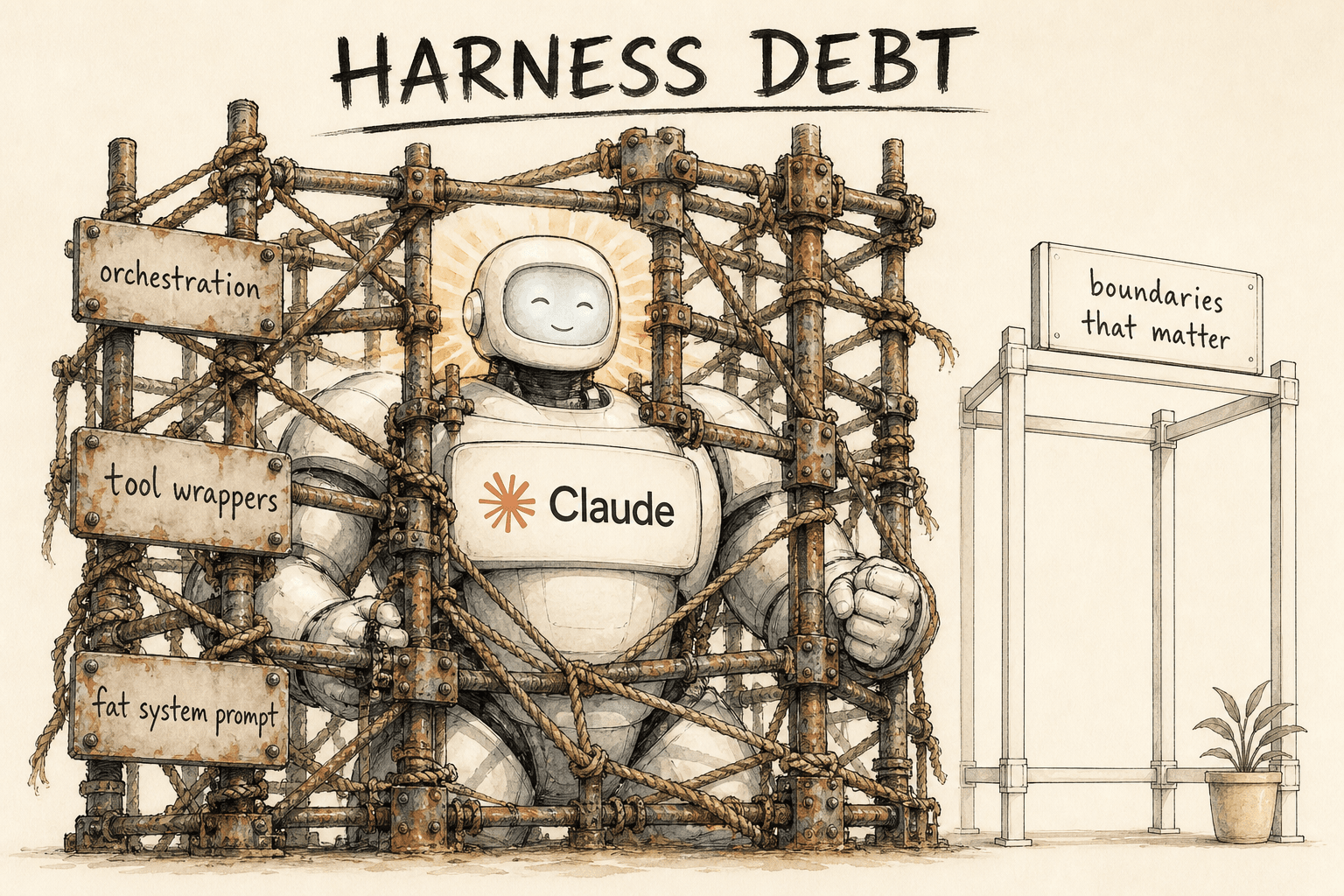
Harness Debt: Your AI Agent Scaffolding Is Quietly Fighting the Model (2026)
Your AI agent is probably worse than the model inside it — and the gap is your own scaffolding. An experimental harness scored over 2x Anthropic's standard one on the same model. The fix isn't a bigger framework; it's deleting the assumptions that went stale the day Claude Opus 4.6 shipped.