
Claude Code Routines for Software Teams: What Anthropic's New Automation Preview Means

Last updated: 14 April 2026
Key takeaway
Claude Code routines turn repeatable engineering prompts into cloud-run workflows. Software teams should treat them as automation infrastructure that still needs clear ownership, review rules, and incident boundaries.
Claude Code routines are Anthropic's new repeatable automation layer for Claude Code. Released on April 14, 2026, they let teams configure a prompt, repository, and connectors once, then run that work on a schedule, through an API call, or from GitHub events. For a software team, the practical value is not "AI runs the engineering department". It is a cleaner way to package recurring work such as backlog triage, docs drift checks, deploy verification, and PR review into governed cloud sessions that do not depend on a laptop being open.
What are Claude Code routines?
Anthropic describes routines as saved Claude Code configurations: a prompt, one or more repositories, and connectors, packaged so they can run unattended on Anthropic-managed cloud infrastructure. The official launch post says routines are in research preview and can be triggered by schedules, API calls, or GitHub repository events. The docs also state that routines are available for Pro, Max, Team, and Enterprise users with Claude Code on the web enabled.
That makes this a real product feature, not just a workflow tip. It also changes the shape of Claude Code adoption. Instead of asking a developer to remember a recurring prompt every Friday, a team can define the routine once, attach the right trigger, and review the resulting Claude Code session when it runs.
Why should software teams care now?
Because most small engineering teams do not lose momentum on one spectacularly hard task. They lose it across the recurring glue work nobody owns properly: checking stale tickets, re-running release smoke checks, chasing documentation after merged PRs, reviewing predictable risk areas, and turning incident alerts into the first useful triage note.
The original insight here is simple: routines are most valuable when the work is boring enough to repeat but consequential enough to require review. An eight-person SaaS team should not use a routine to bypass engineering judgement. It should use one to make sure the same judgement is applied every time a deployment fails, a PR touches authentication, or support feedback points at a known fragile area.
Can Claude Code routines replace cron jobs?
Only partly. A cron job is good when the task is deterministic. Claude Code routines are more interesting when the task requires judgement inside a repeatable frame. The official examples include backlog maintenance, alert triage, bespoke code review, deploy verification, docs drift, and library porting. Those are not simple scripts. They are bounded engineering decisions that benefit from context, repo access, and a clear prompt.
For teams working under privacy rules, client confidentiality, and tight delivery promises, the decision should be workflow by workflow. Put low-risk, reviewable routines first. Keep destructive changes, production permissions, and customer-impacting actions behind human sign-off.
What changed with API and GitHub triggers?
The API trigger is the most commercially useful part for teams that already have delivery infrastructure. Anthropic's API documentation says each routine can expose a per-routine HTTP endpoint with a bearer token, so a CI pipeline, alerting system, or internal tool can start a Claude Code session and receive a session URL. GitHub triggers make the same idea event-driven for repository activity.
That matters because agent work can now sit closer to the event that created the need. A failing deploy can call a verification routine. A PR touching billing can trigger a stricter review checklist. A support escalation can start a docs or code investigation session without waiting for someone to open a terminal.
Where should teams start?
Start with one routine that has a clean success condition and low blast radius. Good first candidates are weekly docs drift checks, PR summaries for a sensitive module, nightly backlog labelling, or post-deploy smoke-check summaries. Bad first candidates are anything that can merge code, change billing logic, or message customers without review.
Anthropic's launch screenshot is useful because it shows the practical shape of a routine: a named automation with trigger rules, repository context, and a prompt. Treat that screen as the governance checklist. Before you create the routine, decide who owns it, which repositories and connectors it can access, what it is allowed to change, and what proof a human reviews after each run.
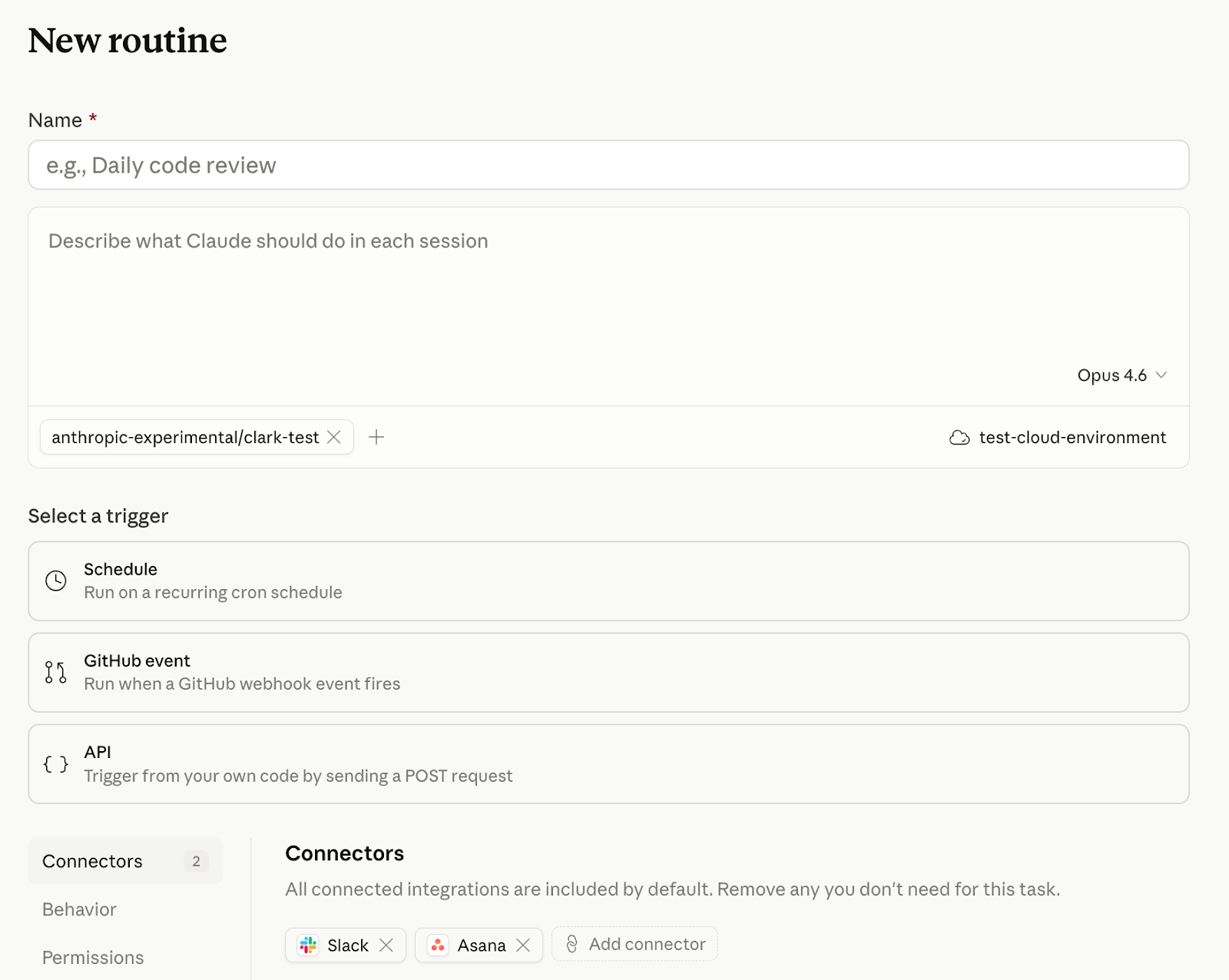
Source: Claude Blog: Introducing routines in Claude Code
If you want these routines to become part of a real operating system rather than another clever demo, map them into your AI solutions, define reusable prompts and safeguards through skills and plugins, then talk to Marco about where agent automation should sit in your delivery process.
Authoritative sources
The agent built for this

Richard
A forward-deployed AI agent that gets your software live and adopted inside every customer.
Meet RichardFrequently Asked Questions

Founder, AI Heroes
I build AI companies and the systems inside them. At AI Heroes, we give businesses the functional capacity to grow without the headcount growth normally demands — sales that follows up, marketing that runs, content that ships, ops that handles itself. We audit where you're leaving growth on the table, build the team that captures it, and hand it over completely.
I've built at scale before. Leading product and GTM at SlideSpeak AI (1M+ monthly users, profitable, bootstrapped). CPO at Disperse — the AI construction platform that went from 3 to 200+ people on $35M raised. I also co-founded LOBOMAR, a luxury fashion label featured in Elle, Cosmopolitan, and the LA Times, with shows at the London Design Museum, Wereldmuseum, and Amsterdam Fashion Week.
Related Articles

Claude Opus 4.7 for Claude Code: What US Software Teams Should Change First
Claude Opus 4.7 changes how US engineering teams should brief, budget, review, and reset Claude Code sessions.


Claude Code Desktop Redesign: What Parallel Agents Mean for US Software Teams
Claude Code desktop redesign turns the desktop app into a parallel agent workspace. For US software teams, the question is whether this cuts coordination drag enough to change shipping velocity.
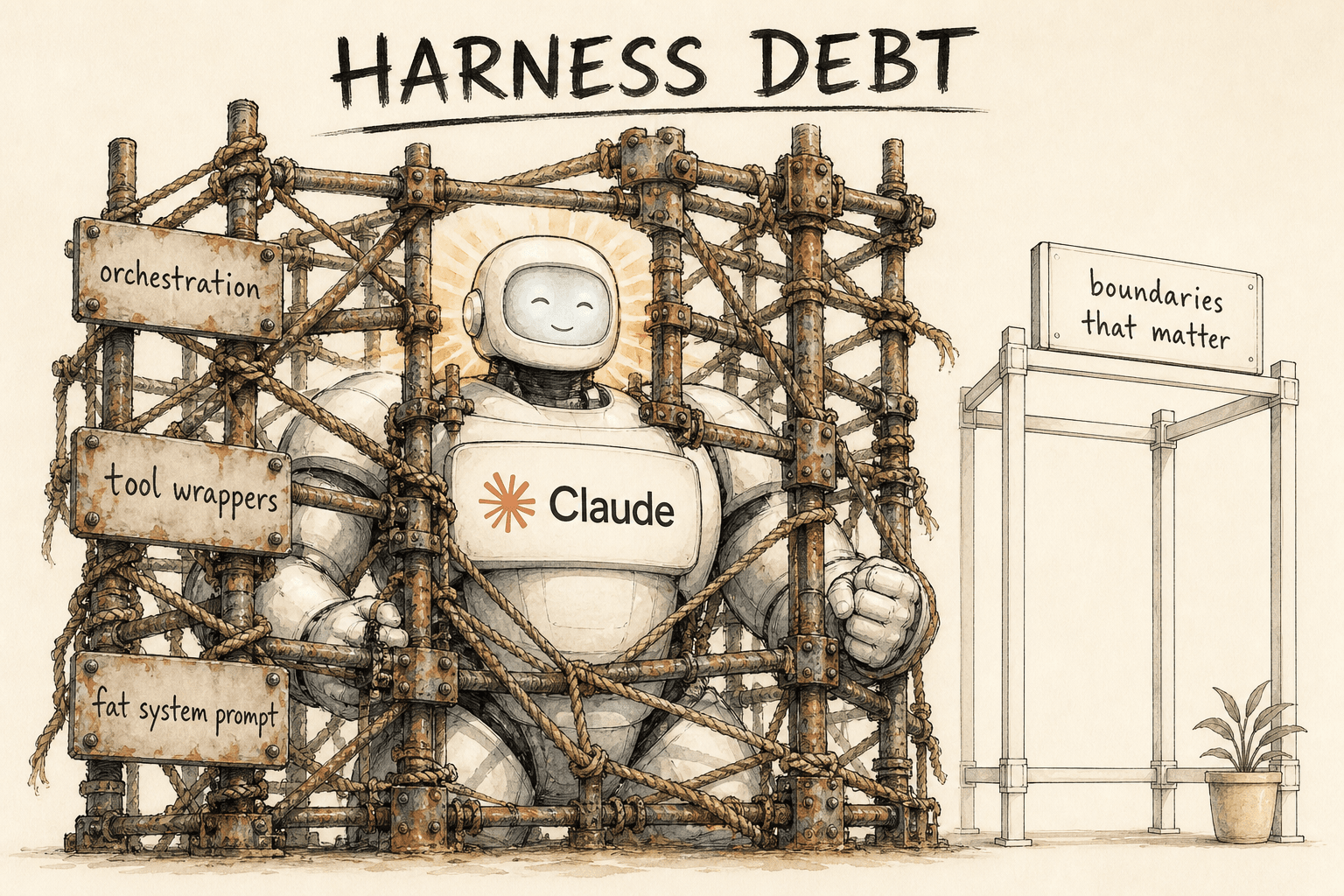
Harness Debt: Your AI Agent Scaffolding Is Quietly Fighting the Model (2026)
Your AI agent is probably worse than the model inside it — and the gap is your own scaffolding. An experimental harness scored over 2x Anthropic's standard one on the same model. The fix isn't a bigger framework; it's deleting the assumptions that went stale the day Claude Opus 4.6 shipped.