Agent-First GTM in 2026: The Real Landscape, the Pricing Tell, and the Stage Nobody Owns

TL;DR
- "Agent-first GTM" is no longer a slide: HubSpot, Salesforce and Microsoft are shipping AI agents across the funnel, and the numbers are real, though almost all vendor-reported.
- The field divides on three things that matter: how autonomous the agents are, whether they own the system of record or just overlay it, and whether they charge per action or per result.
- One GTM stage sits almost unclaimed by the big suites: making your brand the answer AI assistants give. That's the stage we built for.
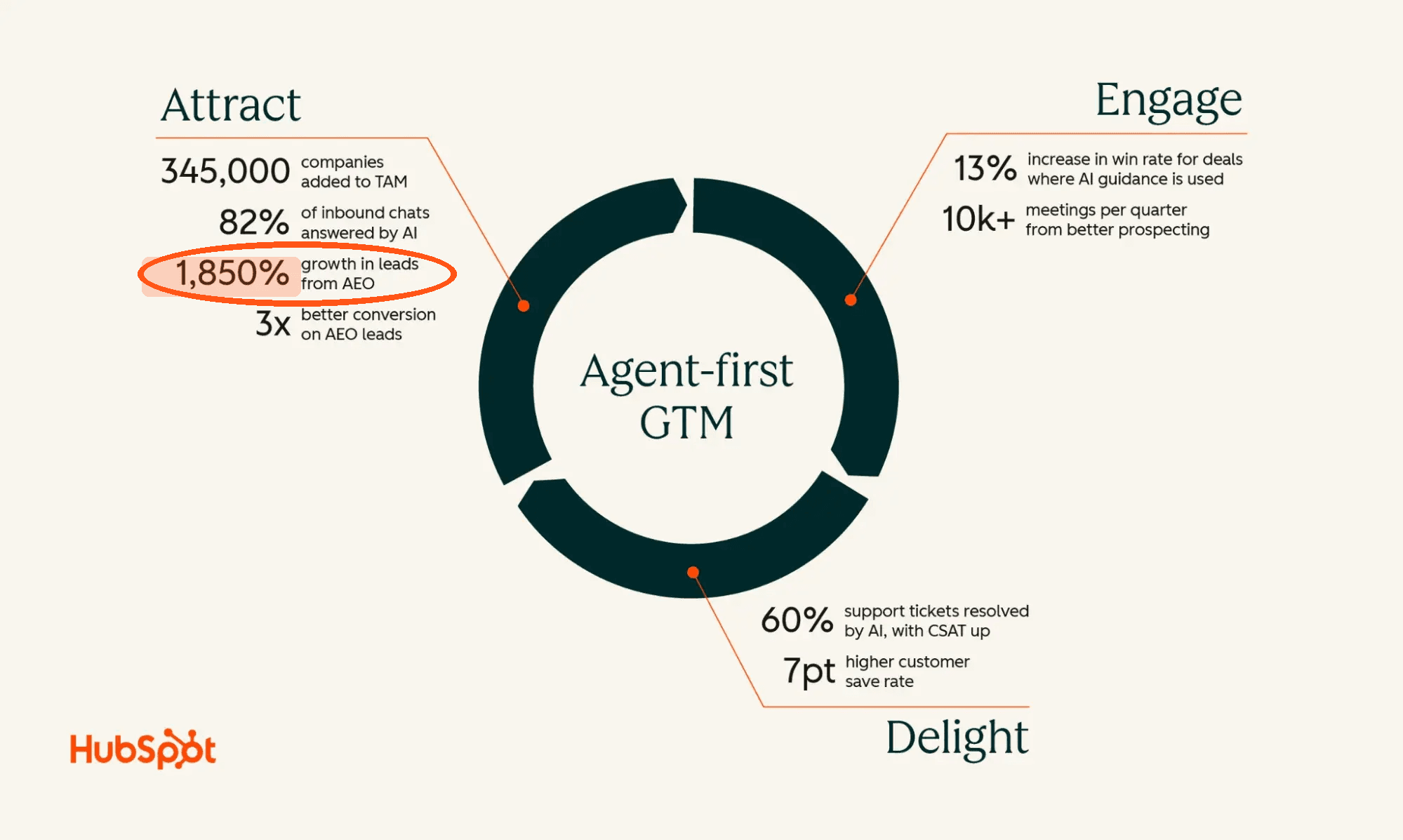
The cover visual is HubSpot's agent-first GTM flywheel and its reported results, as published by HubSpot. All figures are HubSpot's own.
What does "agent-first GTM" actually mean?
Agent-first GTM is a go-to-market model in which AI agents perform real work at every stage of winning and keeping customers, while people concentrate on the decisions that move revenue. In a 2026 essay, HubSpot CEO Yamini Rangan described rebuilding the company's go-to-market engine over three years into "a flywheel where agents are doing real work at every stage" — Attract, Engage, Delight.
What changed is not the funnel diagram; it's who does the work inside it. The old model captured a form-fill and handed a rep a name. The agent-first model enriches, qualifies, answers, schedules and follows up continuously — and reserves human attention for the moments judgment changes the outcome.
HubSpot is the clearest worked example because it dogfoods its own product, Breeze, and publishes the results. The same caveat applies across the market: these are vendor-reported figures from company posts and earnings calls, not independently audited. Read them as proof the model can work at scale, not as benchmarks to expect on day one.
What results is HubSpot actually reporting?
HubSpot breaks its flywheel into named agents. Per Rangan's post and HubSpot's Q3 2025 earnings call:
- The Inbound Agent — the prospect-facing website chatbot — handles 82% of inbound chats with zero human involvement.
- The Customer Agent — internal support — resolves roughly 60% (62%+ as of Q3 2025) of support inquiries without a human, across about 6,200 activated customers. These are two different agents; the 82% and the 60% are not the same number measured twice.
- The Prospecting Agent books 10,000+ meetings per quarter (6,400 activations, up 94% quarter-over-quarter, 1M+ prospects engaged), and HubSpot reports a 13% win-rate lift on deals where AI guidance is used.
- The AEO Agent — built to win citations in AI answers — is credited with 1,850% growth in qualified leads from AI-generated answers (Q1 2025 to Q1 2026), converting at up to 3x traditional search.
One more datapoint shows where buyer behaviour is heading: HubSpot's ChatGPT Connector was activated by 47,000+ customers and called its fastest-growing app in five years. Hold onto that 1,850% number — it is the most important figure on the whole flywheel, and we'll come back to why.
How do the major GTM-agent players actually differ?
Strip away the marketing and the field separates on three axes: autonomy (does it assist a human, act as a bounded agent, or run a process end-to-end?), system-of-record vs overlay (does it own your CRM data or sit on top of someone else's?), and pricing model (per seat, per action, or per result?). That last axis is the most honest signal of how confident a vendor is that its agent works.
| Player | Where it plays | Autonomy | Owns data? | Pricing model | Headline proof (source) |
|---|---|---|---|---|---|
| HubSpot (Breeze agents) | Full funnel | Agents + assistants | System of record (CRM) | Seat + add-ons | 82% inbound chats; 1,850% AI-answer leads — vendor-reported |
| Salesforce Agentforce | Full funnel | Agents, bounded autonomy | System of record (CRM) | Per-action consumption (Flex Credits ~$0.005/credit; ~$0.10/action; or $2/conversation) | $800M ARR (+169% Y/Y), 29,000 deals — vendor-reported, Q4 FY26 |
| Microsoft (Copilot for Sales / Copilot Studio) | Engage; bounded outbound | Assistant + bounded agents | Overlay on M365 + Dynamics | Per-action "Copilot Credits" (~$0.01/credit; agent action = 5 credits) | 2026 Wave 1 roadmap; ships Sales Development & Qualification agents — vendor docs |
| Sierra (Bret Taylor) | Delight / support (+ sales) | Higher-autonomy resolution | Overlay on support | Outcome-based — pay only on full resolution; escalations free | 70–90% case automation; Ramp 90% — founder/vendor |
| Profound / HubSpot AEO / Peec | Answer-engine (off-site, pre-funnel) | Dashboard — measures, doesn't act | Overlay | Subscription (HubSpot AEO $50/mo beta) | Profound $96M at $1B valuation — third-party confirmed |
Salesforce: the scale player, and the metric that gives the game away
Salesforce Agentforce is the revenue-scale incumbent. Per its FY26 Q4 earnings (quarter ended 31 January 2026), Agentforce reached $800M ARR, up 169% year over year, with combined Agentforce + Data 360 ARR above $2.9B and 29,000 Agentforce deals closed since launch. To show momentum, Salesforce introduced a metric called Agentic Work Units — 2.4 billion delivered to date, 19 trillion tokens processed.
That metric is the tell. As Salesforce Ben and Constellation Research analyst Rebecca Wettemann both noted, an Agentic Work Unit counts actions taken, not problems solved — "a throughput measure rather than an outcome indicator." It pairs with Agentforce's pricing: Flex Credits at roughly half a cent each, where a standard action burns about 20 credits (≈$0.10), or a flat $2 per conversation. Salesforce frames this as "value-aligned," but it is metered per action, whether or not the action worked.
Microsoft: the assistant that's quietly growing agents
Microsoft positions Microsoft 365 Copilot for Sales explicitly as an "AI assistant for sellers" inside Outlook and Teams — recommendations, less data entry, personalised engagement. Alongside it, a "Copilot agents" layer completes some sales processes autonomously (qualifying and prioritising leads), and Microsoft already ships bounded autonomous agents — a Sales Development Agent and a Sales Qualification Agent — that work within admin-set filters and hand qualified leads back to a human. Billing runs through per-action Copilot Credits (an agent action costs 5 credits; renamed from "messages" in September 2025). The shape is the same as Salesforce: you pay per action the machine takes.
Sierra: the one that bets on itself
Then there is Sierra, the customer-experience agent company co-founded by Bret Taylor. In a 2026 interview, Taylor described a pricing model that inverts the others: customers pay a pre-negotiated rate only when the agent fully resolves a case with no human; escalations are free; in sales the equivalent is a commission. Sierra claims 70–90% case automation, with fintech Ramp resolving about 90% of cases through it.
Pay-per-action versus pay-per-result is not an accounting footnote. It is the clearest statement a vendor can make about whether it believes its own agent. When a company charges only when the work is actually done, it is taking the risk off your desk. When it charges per action, the risk stays with you.
Is the agent hype real, or is this demoware?
Both, and the line between them is where the money is being lost. Gartner predicts that over 40% of agentic-AI projects will be canceled by the end of 2027, citing escalating costs, unclear business value and inadequate risk controls — and separately warns of "agent washing," estimating only around 130 of thousands of self-described agentic-AI vendors are the real thing.
The sharpest cautionary tale is in autonomous outbound. The "AI SDR" category promised armies of self-driving sellers; the reality has been bumpier. In March 2025, TechCrunch reported that the well-funded AI-SDR startup 11x had been listing customers it did not have — a story that hardened a broad practitioner skepticism that "fully autonomous outbound" was oversold. The pattern that survives scrutiny is narrower and less glamorous: bounded agents with a clear human handoff, priced on outcomes, doing one job well — support resolution, lead qualification, meeting booking — rather than a robot that "runs sales." The flywheel works where the agent's job is concrete and its success is measurable.
So where's the stage nobody owns?
Look again at HubSpot's flywheel and the single biggest number on it: 1,850% growth in leads from AI answers. That growth did not happen inside the CRM. It happened upstream of the entire funnel — in the moment an AI assistant decides which handful of brands to name when a buyer asks it a question. Every agent in the comparison table above operates after that moment, on people who already found you. None of them changes whether the AI mentions you in the first place.
That stage — answer engine optimization (AEO), also called generative engine optimization — is now its own venture-backed category, not a CRM feature. Profound raised a $96M Series C at a $1B valuation in February 2026 (confirmed not just by Profound but by Fortune and the deal's counsel, Wilson Sonsini), to track how AI engines talk about brands. Peec AI raised $21M for the same problem, reported by TechCrunch in November 2025. And the incumbents are noticing: HubSpot launched a beta AEO product in April 2026 at $50/month, tracking brand visibility, sentiment and competitor share-of-voice across ChatGPT, Gemini and Perplexity — motivated, in HubSpot's own framing, by customers seeing organic traffic fall as much as 27%.
But here is the gap inside the gap. Profound, HubSpot AEO and Peec are dashboards. They measure how visible you are in AI answers. They are very good at telling you that you're losing. What almost none of them do is the work of winning — the continuous content, the earned publication mentions, the authentic presence in the communities where buyers actually ask their questions. Measuring your AI visibility is not the same as changing it, any more than a bathroom scale is a diet.
Source note: HubSpot, Salesforce and Sierra performance figures are vendor or founder-reported and not independently audited; Microsoft figures come from Microsoft Learn's Copilot for Sales 2026 Wave 1 and Copilot Studio billing docs; Profound's February 2026 funding was independently corroborated by Fortune and Wilson Sonsini; Gartner's cancellation forecast is an analyst prediction; TechCrunch reported Peec AI's November 2025 raise and the 11x customer-listing story.
Meet Schmidty — the agent for the stage everyone is measuring and nobody is working
At AI Heroes, we've built our own AI search agent, already deployed across more than 10 customers. He lives in your Slack or Teams like a teammate and does the legwork to get you found across ChatGPT, Google AI Overviews, Claude, Gemini and Grok.
He writes the content that fills the gaps actually moving your category, reaches out and books you real publication mentions, and puts authentic, on-brand perspective where your buyers are already asking — on Reddit, LinkedIn and Facebook. He works around the clock toward one goal: making you the answer the AI gives.
That's the difference that matters as agent-first GTM matures. The suites will keep automating the funnel, and the AEO dashboards will keep grading your visibility. Schmidty is the agent that does something about it — turning the stage with the highest reported upside on the entire flywheel from a number you watch into a number you move.
The agent built for this

Schmitdy
Turns ChatGPT, Claude, Gemini, and Perplexity into your next growth channel.
Meet SchmitdyFrequently Asked Questions

Founder, AI Heroes
I build AI companies and the systems inside them. At AI Heroes, we give businesses the functional capacity to grow without the headcount growth normally demands — sales that follows up, marketing that runs, content that ships, ops that handles itself. We audit where you're leaving growth on the table, build the team that captures it, and hand it over completely.
I've built at scale before. Leading product and GTM at SlideSpeak AI (1M+ monthly users, profitable, bootstrapped). CPO at Disperse — the AI construction platform that went from 3 to 200+ people on $35M raised. I also co-founded LOBOMAR, a luxury fashion label featured in Elle, Cosmopolitan, and the LA Times, with shows at the London Design Museum, Wereldmuseum, and Amsterdam Fashion Week.
Related Articles
The Best AI Search Agencies in 2026 (GEO and AEO), Compared
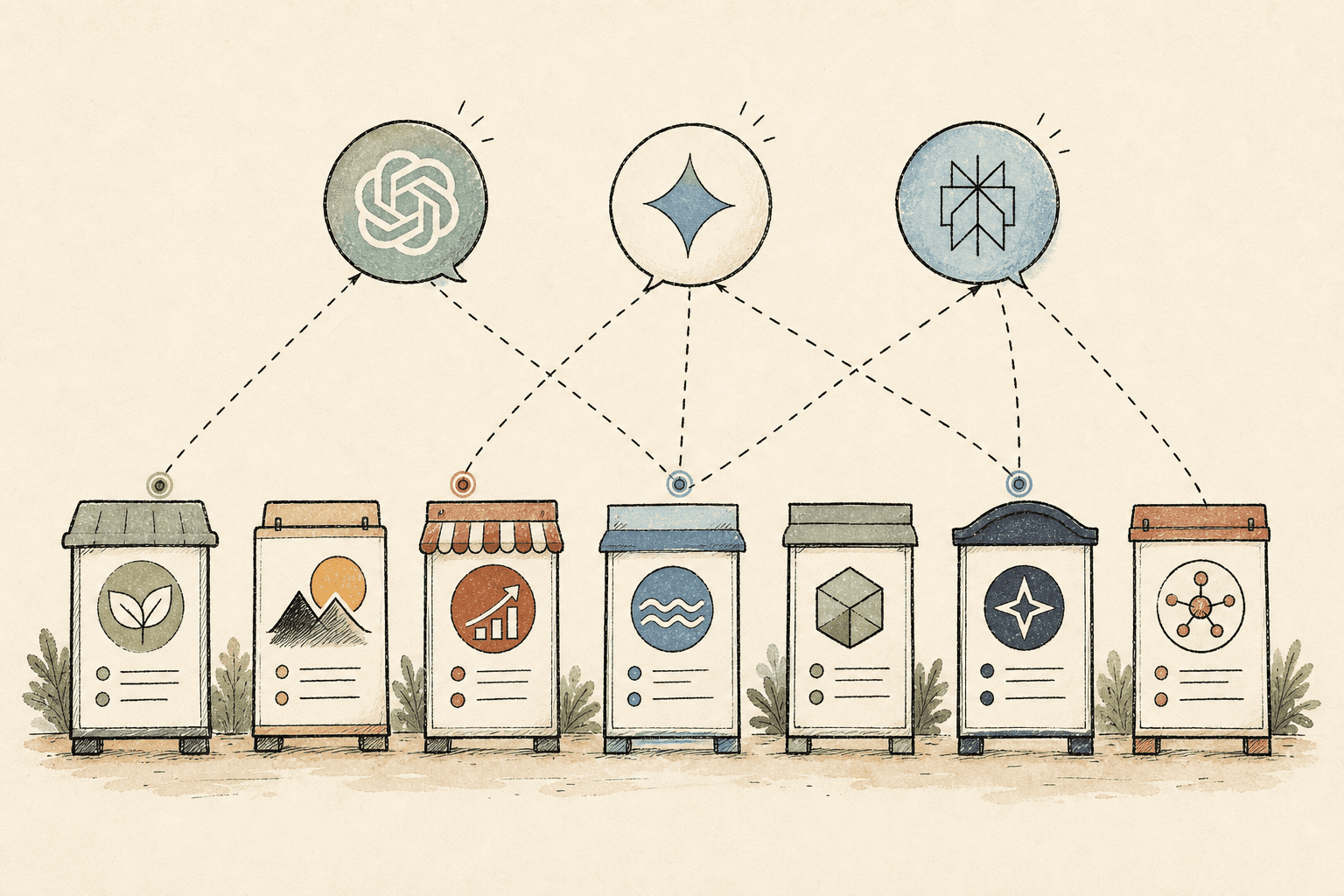
The agencies that get brands cited inside ChatGPT, Gemini, Perplexity, and Google AI Overviews, compared on model, market, and method, with the criteria to pick one. The most useful fact for choosing: around 85 percent of AI citations come from third party domains, not your own site, so an agency whose whole offer is on-site content is mismatched to where citations come from.

AEO vs GEO vs SEO: The Difference, and Which One You Need in 2026
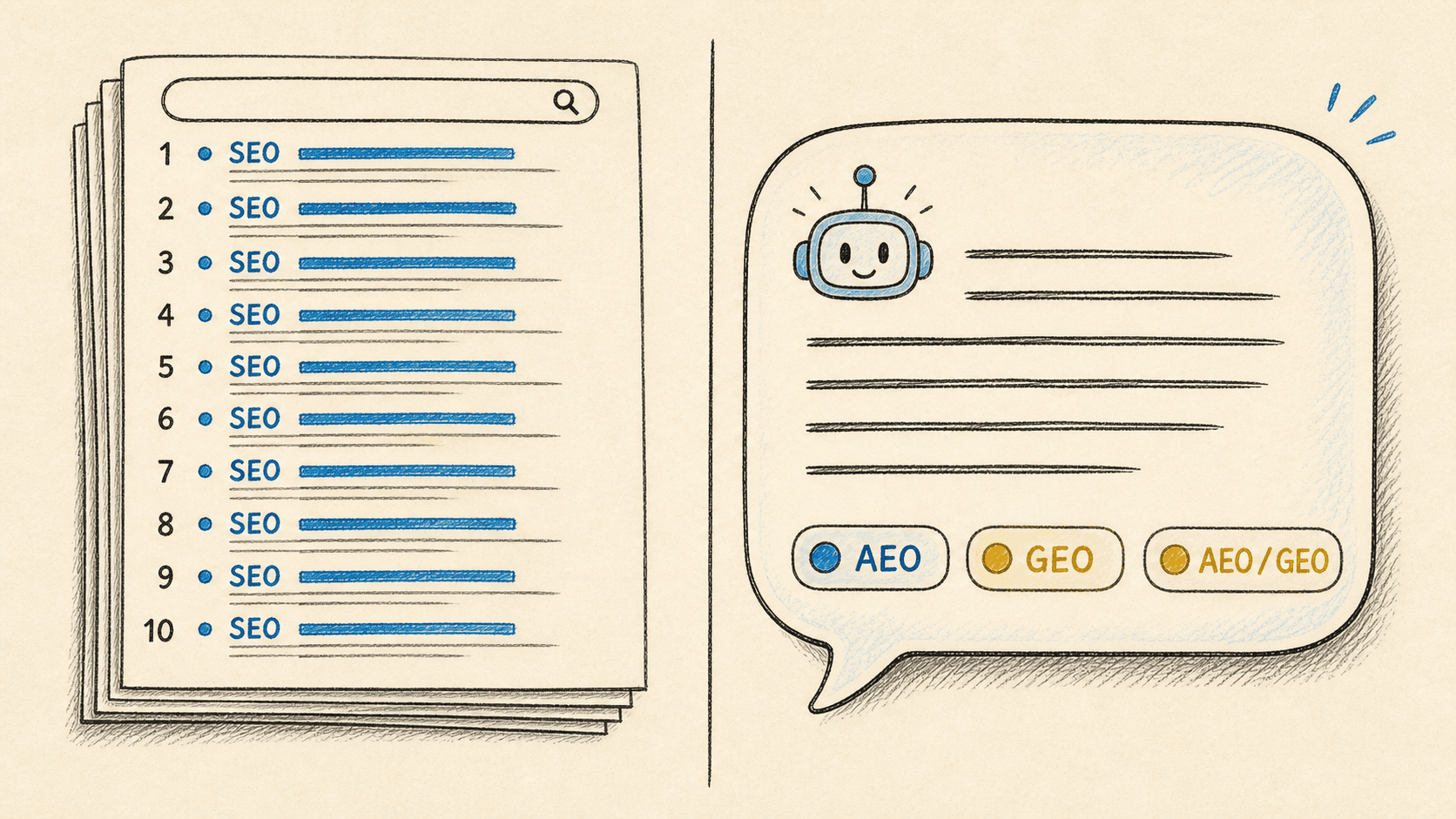
SEO ranks links in classic search. AEO (Answer Engine Optimization) and GEO (Generative Engine Optimization) optimise to be cited inside the AI-generated answer in ChatGPT, Perplexity, Google AI Overviews, Gemini and Copilot. AEO and GEO are near-synonyms for the same goal; SEO is a separate, still-necessary discipline that feeds the retrieval pool. The practical answer in 2026 is that you do all three, but you measure AEO/GEO on citation share, not blue-link position, and the winning levers (off-site footprint, entity authority, content shape, freshness) sit mostly off your own site.
How to Build AI Agents on the Peec AI MCP for AEO and GEO (2026)
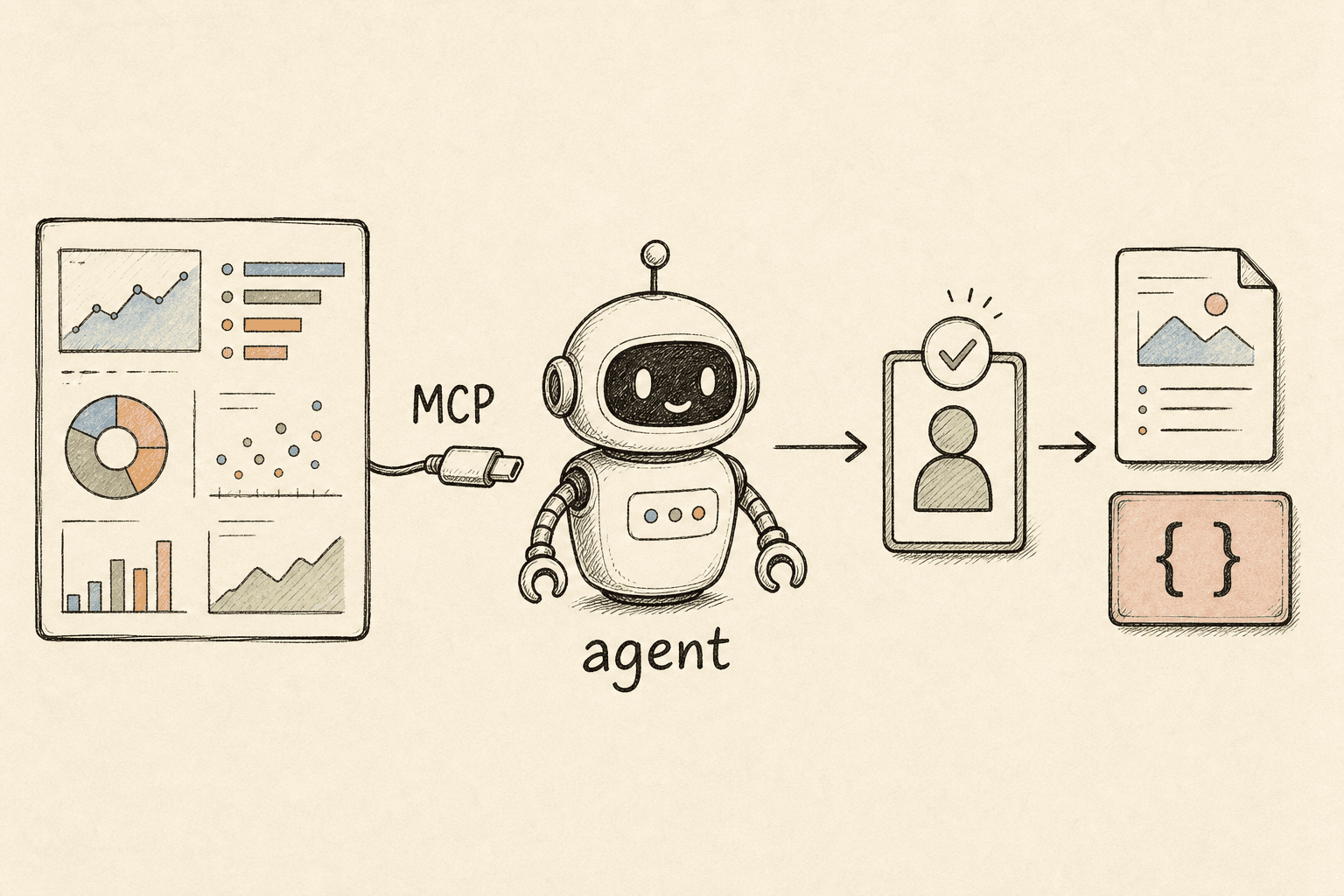
In late 2025 Peec AI shipped an official MCP server, which makes its entire AI-search measurement layer — projects, prompts, per-engine brand visibility, full AI answer transcripts, the source/citation graph and scored Actions — directly callable by an LLM agent. That means you can wire a Claude or GPT agent straight to the ground truth of how ChatGPT, Perplexity, Gemini and AI Overviews answer your category, and have it reason over the data and draft the work to close the gaps. The defensible build pattern is a read-only, five-stage loop with a human ship gate: the agent triages and drafts; a person verifies and ships.